





Published date:
29/08/2026
Share




The list of BMSB target risk countries issued by DAFF (the Australian Department of Agriculture) encompasses nations across Europe, North America, and several Asian countries. Mandatory regulations apply to goods originating from or transiting through these regions during the seasonal risk period (from 1 September to 30 April of the following year). Regulated consignments must undergo approved treatment before customs clearance.
1. What is the BMSB Season and Why Does DAFF Tighten Controls on Target Risk Countries?
The Brown Marmorated Stink Bug (BMSB) is a dangerous invasive pest capable of causing severe damage to agriculture. To safeguard its domestic ecosystem, the Australian Department of Agriculture, Fisheries and Forestry (DAFF) maintains extremely stringent biosecurity controls against this pest.

What is the Brown Marmorated Stink Bug (BMSB)? The Threat of This Pest in Cargo
- The measures apply according to the annual BMSB season schedule from September to April of the following year, based on the cargo's actual shipped-on-board date.
Important Note: DAFF calculates the applicable period based on the actual shipped-on-board date (the Shipped on Board Date on the Ocean Bill of Lading); the biosecurity authority does not accept the terminal arrival date (Gate-in Date) as the basis for determining seasonal risk measures.
- DAFF's Risk Management Mechanism: During the BMSB risk season, the Australian biosecurity authority (DAFF) enforces strict control measures based on two factors: commodity category and country of origin. Specifically, goods classified as Target High Risk Goods that are manufactured in or shipped from Target Risk Countries must undergo mandatory treatment or inspection as regulated.
As the only provider in Vietnam fully qualified and approved for BMSB treatment, VFC FUMIGATION is committed to delivering international-standard pest control protocols, ensuring your cargo achieves safe and seamless customs clearance.
For regulated consignments, businesses should identify treatment requirements as early as the transition planning stage. You can refer to container fumigation services to Australia under AFAS/BMSB to determine the technical solutions and required documentation for each shipment.
2. Latest List of BMSB Target Risk Countries
To assist businesses in proactively cross-referencing requirements and formulating shipping plans, below is a consolidated list of target risk countries published by DAFF:
| DAFF Classification | Region | List of Applicable Countries | DAFF Control Measures |
|---|---|---|---|
| Target Risk Countries | North America | United States (USA), Canada | Mandatory biosecurity treatment for Target High Risk Goods originating from, or loaded/transhipped during the risk season. |
| Increased random inspections for Target Risk Goods. | |||
| Europe & Surrounding Regions | Albania, Andorra, Austria, Azerbaijan, Belgium, Bosnia & Herzegovina, Bulgaria, Croatia, Czech Republic, France, Georgia, Germany, Greece, Hungary, Italy, Kosovo, Liechtenstein, Luxembourg, Montenegro, Moldova, Netherlands, North Macedonia, Poland, Portugal, Romania, Russia, Serbia, Slovakia, Slovenia, Spain, Switzerland, Turkey, Ukraine... | ||
| Central Asia | Armenia, Kazakhstan, Uzbekistan | ||
| Emerging Risk & Vessel Surveillance Countries | Asia & Europe | United Kingdom (UK), China, Japan, South Korea | • Apply specific vessel surveillance measures (such as for roll-on/roll-off [Ro-Ro] vessels) to control the risk of BMSB entry through vessel structures. |
Note on cargo routing: Even if goods are not manufactured in a target risk country, any cargo that is loaded, stored, consolidated, or transhipped (transshipment/consolidation) in any listed BMSB risk country during the designated seasonal period remains subject to BMSB treatment under DAFF regulations.
When a consignment falls within scope, businesses should further consult BMSB-AusTreat regulations for exports to Australia to determine treatment requirements, approved treatment providers, and corresponding documentation.
3. Categories of Goods Subject to BMSB Regulations
The Australian biosecurity authority (DAFF) categorises imported goods into distinct risk levels to apply corresponding control and treatment measures:
Target High Risk Goods
Goods in this category are subject to mandatory BMSB treatment prior to import into Australia, covering the following key HS code chapters specified by DAFF:
- Machinery, mechanical appliances, and electrical equipment.
- Vehicles, transport equipment, and automotive parts.
- Iron, steel, metals, and metal products.
- Bricks, stone, ceramics, and glass.
- Wood, wooden pallets, and manufactured wood products.
If your business is preparing an actual consignment, it is advisable to also check 5 notes for fumigating export goods to Australia to promptly address compliance standards, BMSB seasonal timelines, and treatment provider requirements.
Target Risk Goods
Includes the following goods:
- Plastics, rubber, and articles of plastic or rubber.
- Paper, paperboard, textiles, apparel, and footwear.
- Consumer packaged industrial products.
Note: For Target Risk Goods, businesses are advised to carry out pre-treatment to proactively manage biosecurity risks, as cargo may still be subject to random inspections by quarantine authorities at the port of destination.
4. Technical Requirements and Treatment Conditions for Goods Bound for Australia
Công việc xử lý cần tuân thủ tiêu chuẩn AFAS cho hàng hóa xuất khẩu đi Úc và các yêu cầu tương ứng của chương trình AusTreat.
Treatment Provider Standards
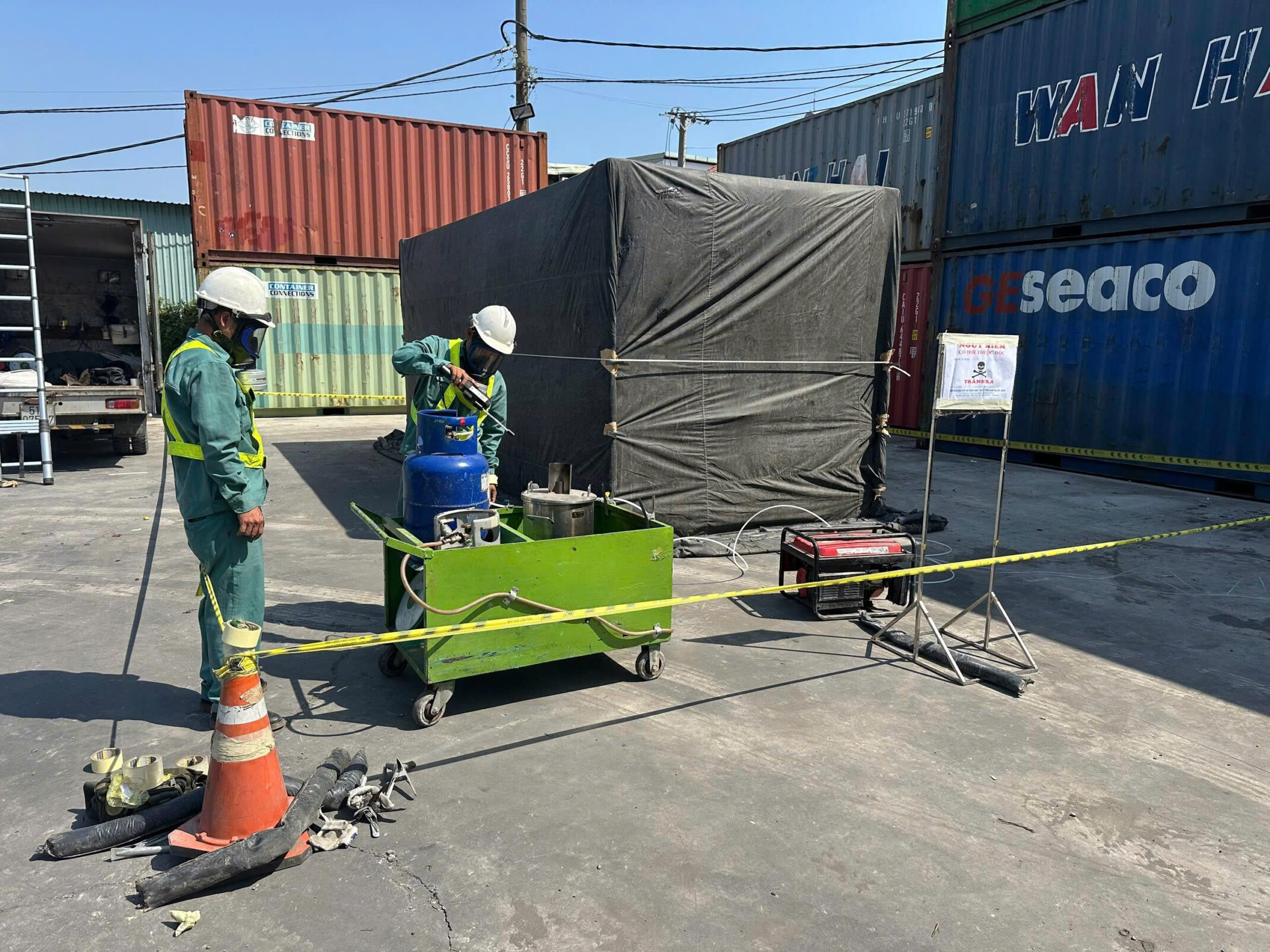
Treatment operations must be conducted by a service provider approved by DAFF under the AusTreat scheme. In Vietnam, VFC Fumigation is proud to be the sole provider licensed for BMSB treatment, fully compliant with stringent technical standards to guarantee regulatory compliance for export consignments to Australia.
Mandatory Technical Requirements for Containers
- Treatment Requirements: When fumigating containers bound for Australia, the container doors must be opened to install gas sampling lines, supply lines, circulation fans, etc., ensuring the treatment is carried out strictly in accordance with technical standards.
- Fumigant Application Method: A vaporiser must be used during gas introduction to ensure the fumigant is evenly distributed throughout the entire cargo load.
Fumigant Types and Technical Monitoring
- Approved Fumigant: In Vietnam, under AFAS standards and current regulations for the Australian market, the only approved treatment method is the use of Methyl Bromide.
- Concentration Monitoring: Technicians must take measurements at least twice at the start to establish the exposure period and at the end of fumigation to ensure the concentration remains effective in eradicating target pests across all developmental stages.
5. Frequently Asked Questions About BMSB Risk Countries
Q1: Is Vietnam on the list of BMSB risk countries for goods exported to Australia?
Answer: Vietnam is not currently on DAFF's list of BMSB target risk countries. However, if your consignment incorporates imported materials, or transits/consolidates in a BMSB risk country during the risk season (1 September – 30 April), it remains subject to mandatory fumigation treatment regulations.
Q2: What happens if a consignment originates from a BMSB risk country but is not treated before departure?
Answer: The consignment will face severe risks: refusal of biosecurity clearance, mandatory re-export to the country of origin, or destruction at the port of arrival. If quarantine authorities detect live pests, businesses will incur exorbitant storage and demurrage fees, alongside emergency onshore treatment costs that are exponentially higher.
Q: How can I check for updates or changes to the list of BMSB risk countries?
Answer: DAFF regularly updates this list prior to each new season (usually before September each year). Businesses can check directly on the official DAFF portal or contact VFC FUMIGATION for consultation and the latest regulatory updates.
6. Summary of BMSB Control Regulations for Export Goods
Accurately identifying BMSB risk countries and thoroughly understanding seasonal regulations (1 September – 30 April) is key for businesses to proactively safeguard their supply chain when exporting to Australia.
To ensure smooth cargo clearance, businesses should keep the following in mind:
- Thoroughly check the shipping schedule and vessel transit points.
- Select a reputable treatment provider listed on the DAFF-approved AusTreat register.
- Strictly comply with technical procedures: opening container doors, applying the correct dosage, maintaining the required exposure period, etc.
With over 50 years of experience, VFC FUMIGATION is always ready to advise and partner with businesses to ensure biosecurity compliance for every export consignment.


-
Blog-old (23)
-
Regulation updates (4)
-
Partnerships & Collaborations (4)
-
General News (15)
Featured News



Related Knowledge