






Published date:
25/08/2026
Share




In import-export operations to Australia and New Zealand, the brown marmorated stink bug (BMSB) is a biosecurity pest subject to strict surveillance. To prevent the introduction of this pest, quarantine authorities in importing countries enforce seasonal risk management measures. Having a clear understanding of the BMSB season schedule alongside a methodical preparation roadmap will help businesses proactively manage shipping schedules and effectively control risks related to documentation and additional costs at destination ports.
1. What is the BMSB Season Schedule and What Is Its Detailed Application Timeline?
The BMSB season schedule is the period during which quarantine authorities in Australia (DAFF) and New Zealand (MPI) enforce mandatory control measures for goods classified as at-risk. The timeframe extends from September 1 to April 30 of the following year, based on the shipped-on-board date recorded on the Ocean Bill of Lading (B/L). The timeline is only one condition. Businesses must also check whether the shipment originates from, is loaded in, or transits through a country on DAFF's BMSB risk list.

Annual BMSB Season Schedule
Definition and Timeline for BMSB Regulations
- Definition of the BMSB season schedule: It is the period during which quarantine authorities in importing countries enforce mandatory inspection and treatment measures to prevent the entry of brown marmorated stink bugs through goods originating from or transiting through listed risk countries.
- Applicable period: The regulations are officially activated from September 1 of the current year through April 30 of the following year.
- Basis for determining applicability: Whether goods are subject to mandatory BMSB quarantine regulations is determined by the shipped-on-board date officially recorded on the Ocean Bill of Lading.
- Important note: The container gate-in time or port dwell time is not accepted as grounds for exemption. Therefore, any shipment with a Shipped-on-Board date falling between September 1 and April 30 must fully comply with all regulatory control requirements.
2. How Is the 3-Stage Preparation Roadmap Implemented Under the BMSB Season Schedule?
The BMSB risk management roadmap consists of 3 stages: Pre-season (Jul–Aug) to review HS codes and select an AusTreat partner; Peak season (Sep–Dec) to manage the 120-hour post-treatment window and cut-off timelines; Season maintenance and conclusion (Jan–Apr) to audit documentation and update adjustments from DAFF.
2.1. Stage 1: Pre-BMSB Season Preparation (July – August) – What Needs to Be Done?
- Commodity classification review: Cross-check the shipment's HS Code against the classification list issued by DAFF:
- High-risk goods: Mandatory quarantine treatment is required prior to export.
- Risk goods: Subject to random inspection at the port of arrival.
- Shipping route assessment: Evaluate maritime routes to determine whether the shipment involves consolidation, storage, or transshipment in countries on the BMSB risk list.
- Selecting a treatment provider: Search for and confirm a licensed fumigation service provider that holds an official accreditation number on the AusTreat system of the Australian Department of Agriculture, Fisheries and Forestry (DAFF). Businesses should not merely accept the ID code provided by the supplier, but should independently verify their current status on the DAFF system. See how to look up AEI codes on DAFF and verify treatment providers for Australia.
To understand how DAFF combines target high risk goods with target risk countries during the BMSB season, see the complete BMSB-AusTreat regulations for exports to Australia.
2.2. Stage 2: Peak Season Execution (September – December) – How Is It Implemented?
- Managing the post-treatment timeframe: For shipments treated in the exporting country prior to December 1, cargo must be sealed in containers or loaded onto the vessel within 120 hours after technical treatment is completed. The 120-hour window must be managed alongside the loading schedule, cut-off time, container condition, and certification requirements. Businesses can view 5 important notes when fumigating export cargo to Australia.
- Coordinating cut-off timelines: Work closely among the warehouse department, shipping line, and fumigation service provider to ensure sufficient exposure time for the fumigant and safe aeration in time for gate-out. If you need a complete view of the entire chain from documentation and field treatment to data transmission and certification, see the A–Z cargo fumigation procedure for exports to Australia.
2.3. Stage 3: Season Maintenance and Conclusion (January – April) – What Needs to Be Reviewed?
- Updating regulatory adjustments: Closely monitor announcements regarding additional countries or commodities subject to heightened surveillance from biosecurity authorities.
- Document review and reconciliation: Check operational data and electronic certificates, ensuring all information matches on the system before the vessel arrives at the destination port.
Discrepancies in container, seal, treatment date, or bill of lading information can cause documentation to no longer match actual operations. See 3 fumigation mistakes for Australia-bound exports businesses should avoid.
3. What Regulations Must On-Site Technical Preparation Procedures for BMSB Cargo Comply With?
Containers exported to Australia must have their doors opened so that the treatment service provider can take responsibility for executing the procedure in accordance with technical standards. This requirement belongs to the system of technical standards applicable to Australia-bound cargo treatment. Businesses can view the AFAS standards for cargo exported to Australia and essential technical requirements.
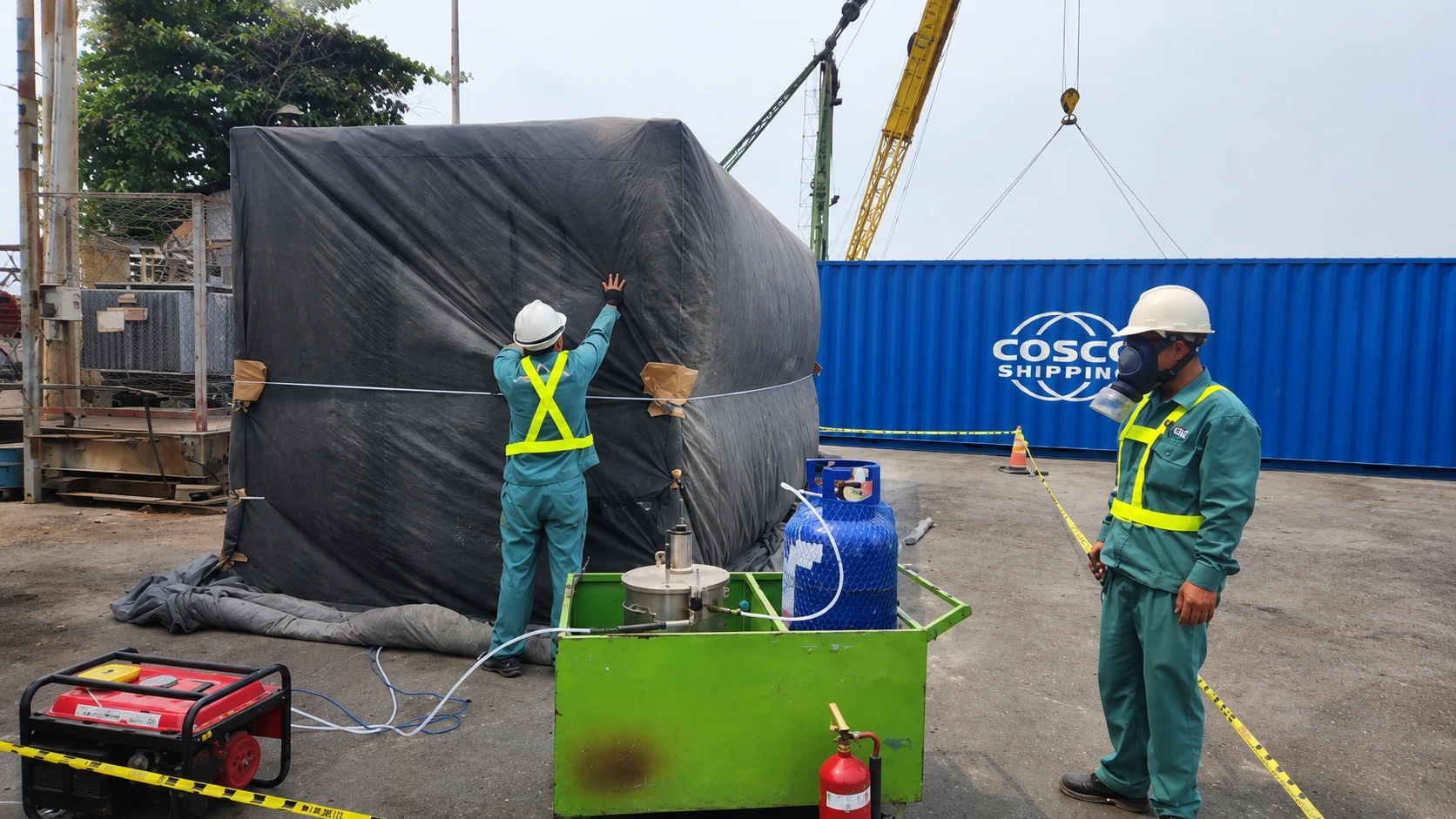
Quy trình khử trùng hàng đi Úc chuẩn AFAS
Mandatory Operational Requirements for Australia-Bound Containers
- Performing container fumigation: Upon completion of cargo loading, the treatment provider (VFC-fumigation) must open the container doors to set up the concentration monitoring system, gas injection lines, circulation fans, etc., in accordance with technical standards.
Fumigant concentration monitoring
- Pest control concentration monitoring: Technicians measure fumigant concentrations after gas dosing to establish the exposure period and at the end of fumigation to verify that levels ensure effective pest control across all developmental stages (eggs, larvae, pupae, adults).
4. Frequently Asked Questions About the BMSB Season Schedule
Q1: Does the BMSB season schedule apply to all modes of transport or only sea freight?
Answer: BMSB regulations apply to goods imported into Australia during the BMSB season (including FCL/LCL containerized cargo, breakbulk cargo, and Open Top/Flat Rack equipment), whereby regulated commodities during the season must undergo pest control treatment. For air cargo specifically, DAFF applies distinct surveillance measures based on country and commodity type; therefore, businesses must check the corresponding BICON conditions prior to export.
Q2: Can export containers bound for Australia be sealed before fumigant injection is carried out?
Answer: The treatment provider needs to open the container doors to install gas supply lines, concentration sampling lines, circulation fans, etc. Therefore, applying the container seal can only be carried out after fumigation is completed and safe aeration is achieved.
Q3: What should be done if a vessel delay causes the post-treatment window to exceed 120 hours?
Answer: In the event of an unforeseen vessel delay, businesses must immediately coordinate with the fumigation provider to inspect sealing conditions, provide documentation verifying the vessel delay schedule, or implement additional technical measures in accordance with DAFF guidelines.
Q4: How can you verify whether a fumigation service provider is licensed to perform BMSB treatment for the Australian market?
Answer: Businesses can directly search for the service provider's name and accreditation number on the public list under the AusTreat scheme published on the official website of the Australian Department of Agriculture, Fisheries and Forestry (DAFF).
5. Summary of the BMSB Season Risk Management Plan
Proactively grasping the BMSB season schedule from September 1 to April 30 is a critical factor helping businesses exporting to Australia and New Zealand plan their logistics effectively. Strictly adhering to technical procedures and selecting service providers that meet AusTreat standards enable enterprises to proactively control biosecurity risks, safeguard delivery schedules, and maintain credibility across international supply chains.


-
Blog-old (23)
-
Regulation updates (4)
-
Partnerships & Collaborations (4)
-
General News (15)
Featured News




Related Knowledge