






Published date:
30/01/2026
Share




Due to shortages of fuel imports from Russia, the EU has increased demand for imported wood pellets, also known as sawdust pellets, from many countries including Vietnam. This has driven Vietnam’s wood pellet export prices significantly higher, with no signs of slowing down at present.
Wood pellet export prices surge as the EU aggressively purchases supply
According to a report from the United States department of agriculture, the EU is the world’s largest consumer of wood pellets, accounting for 75% of global demand and reaching 23.1 million tons in 2021. This record is expected to be surpassed this year as consumption rises to 24.3 million tons.
With rising demand from this market, wood pellet export prices from many countries, including Vietnam, have also increased accordingly.
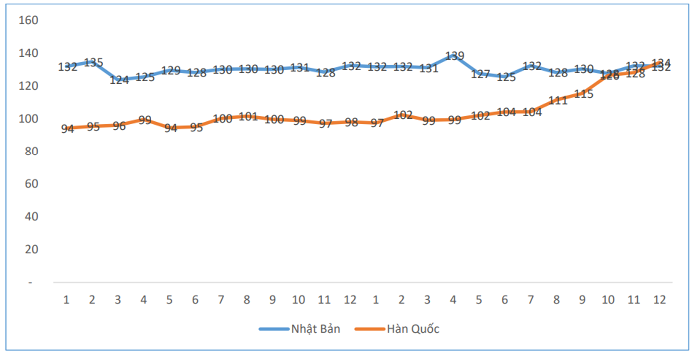
Speaking with the author, Mr. Ngo Sy Hoai, vice chairman and secretary general of the Vietnam timber and forest products association (Viforest), said: “At the end of 2021, wood pellet export prices at one point dropped to usd 100 per ton, but they are currently ranging from usd 180 to usd 200 per ton.”
As a result, wood pellet export prices have increased by 1.8 to 2 times. According to Mr. Hoai, Vietnam previously focused on exporting wood pellets to South Korea and Japan, but Europe’s strong current demand for this product has pushed export prices in Vietnam significantly higher.
Since march 2022, the Russian government has imposed a ban on the export of certain wood products, including pellets and roundwood, in retaliation against sanctions from European countries. Under this ban, wood pellets exported from Russia are considered illegal.
As a result, pellet supplies from Russia have been disrupted, forcing global importing markets, including the EU, to seek alternative suppliers.
“Geopolitical conflicts among European countries, energy supply shortages, and commitments to reducing greenhouse gas emissions are creating favorable conditions for wood pellet exports because this product is considered a biomass energy source with significantly lower emissions than traditional fossil fuels,” the vice chairman of Viforest stated.
In addition to strong price growth in the EU market, a report from research groups of timber associations and Forest Trends also indicated that export prices of pellets to South Korea increased sharply during the first months of 2022.
Specifically, some exporters signed contracts to South Korea at prices of usd 150–160 per ton, up approximately 19.4% compared to the end of 2021. Export prices to Japan ranged from usd 140–145 per ton, an increase of about 10%.
Mr. Nguyen Liem, chairman of Lam Viet company, stated that rising fuel prices and increased pellet usage at thermal power plants in South Korea and Japan have contributed to higher export prices for this product.
Demand continues to rise with no signs of price stabilization
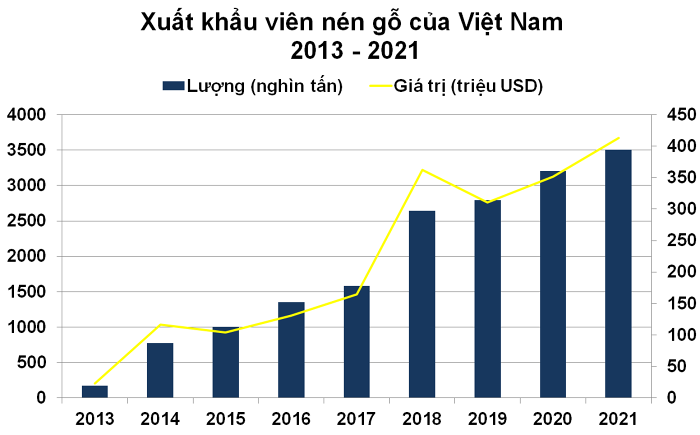
According to Viforest, wood pellets are an emerging product in Vietnam’s wood processing and export industry. Vietnam has now become the world’s second-largest exporter of wood pellets, after the United States, with continuously increasing output and export value. In 2021 alone, exports exceeded 3.5 million tons, generating more than usd 400 million for the timber industry.
Japan and South Korea are Vietnam’s two largest wood pellet consumption markets. Exports to these two markets account for more than 95% of the country’s total wood pellet export volume. Currently, the Asia-Pacific region has the largest number of coal-fired power plants in the world, making it a promising market for the future development of Vietnam’s wood pellet manufacturing industry.
For the EU market, there remains substantial growth potential for Vietnam, while shortages of fuel imports from Russia are driving the EU to increase wood pellet imports from many countries, including Vietnam.
Moreover, the supply of 2.4 million tons of pellets exported annually from Russia disappeared completely after the export ban. This has forced countries that previously imported pellets from Russia, mainly EU members, to seek alternative suppliers.
Alternative suppliers include the United States and Canada. Several Vietnamese companies have also become ideal supply sources. This will create opportunities for businesses to increase exports to the world’s largest wood pellet consumption market.
According to Wood Resources International LLC, in the EU, wood pellets are used for residential heating at 40%, power plants at 36%, commercial building heating at 14%, and combined heat and power plants at 10%. Demand for wood pellets is expected to increase by 30–40% over the next five years, and depending on import development strategies, Europe’s wood pellet production may need to increase by up to 10 million tons.
Not only serving as important new supply sources for the EU, the US and Canada are also the leading wood pellet export markets for Japan and South Korea. Therefore, as EU countries "absorb" supplies from the US and Canada, it will create a shortage for these two Asian nations. This widespread scarcity keeps wood pellet prices remaining at a high level.
“There are currently no signs that Vietnam’s wood pellet export prices will stabilize in the near future,” the Viforest report stated.
However, one major challenge for Vietnam’s wood pellet export activities is that export markets are imposing increasingly strict requirements regarding the legality of timber used for pellet production.
Specifically, most EU countries and now Japan require FSC certification, which guarantees that the timber raw materials used for pellet production originate from sustainably managed forest areas.
Meanwhile, according to Viforest data, Vietnam currently has only about 186,000 hectares of FSC-certified production forests, of which only around 40–50% are available for harvesting. As a result, the supply of FSC-certified timber raw materials for pellet production remains limited and is mainly concentrated in northern and central provinces where FSC-certified plantation forests are more common.
Moreover, although export prices have increased, supply output has not grown significantly because raw materials are being heavily competed for by the woodchip industry.
“Wood pellet prices are increasing, but export prices for woodchips are rising even higher. Both products use timber from plantation forests, so while demand is increasing and raw material supplies remain limited, wood pellet export volumes will find it difficult to grow rapidly,” Mr. Ngo Sy Hoai stated.
>> Có thể bạn quan tâm: Wood chips vs wood pellets: What is the difference?

India imposes taxes and bans exports of certain rice varieties
-
Regulation updates (4)
-
Partnerships & Collaborations (4)
-
General News (15)
Featured News




Related Knowledge



30/01/2026
30/01/2026
Representative of American Coffee Corp Visits VFC in Vietnam
On the afternoon of June 10, 2023, Mr. Anthony Caputo, representative of American Coffee Corp, and Ms. Lan Huong, Chief Representative of Hacofco, visited Vietnam Fumigation Joint Stock Company in Ho Chi Minh City (VFC HCM). Representing VFC at the meeting were Mr. Truong Vinh Chanh – Deputy Director of the HCM Branch, along with VFC management staff, who warmly welcomed the guests.