




Published date:
18/09/2026
Share




A Fumigation Certificate is an official legal document issued by a licensed fumigation service provider. This document certifies that the consignment has been treated with specialized fumigants in strict compliance with prescribed dosage and exposure time standards. The core objective is to completely eradicate pests before cargo enters international transit.
1. The Nature of a Fumigation Certificate and Key Legal Distinctions
In international trade, properly understanding the legal validity of each document helps businesses avoid costly disputes.
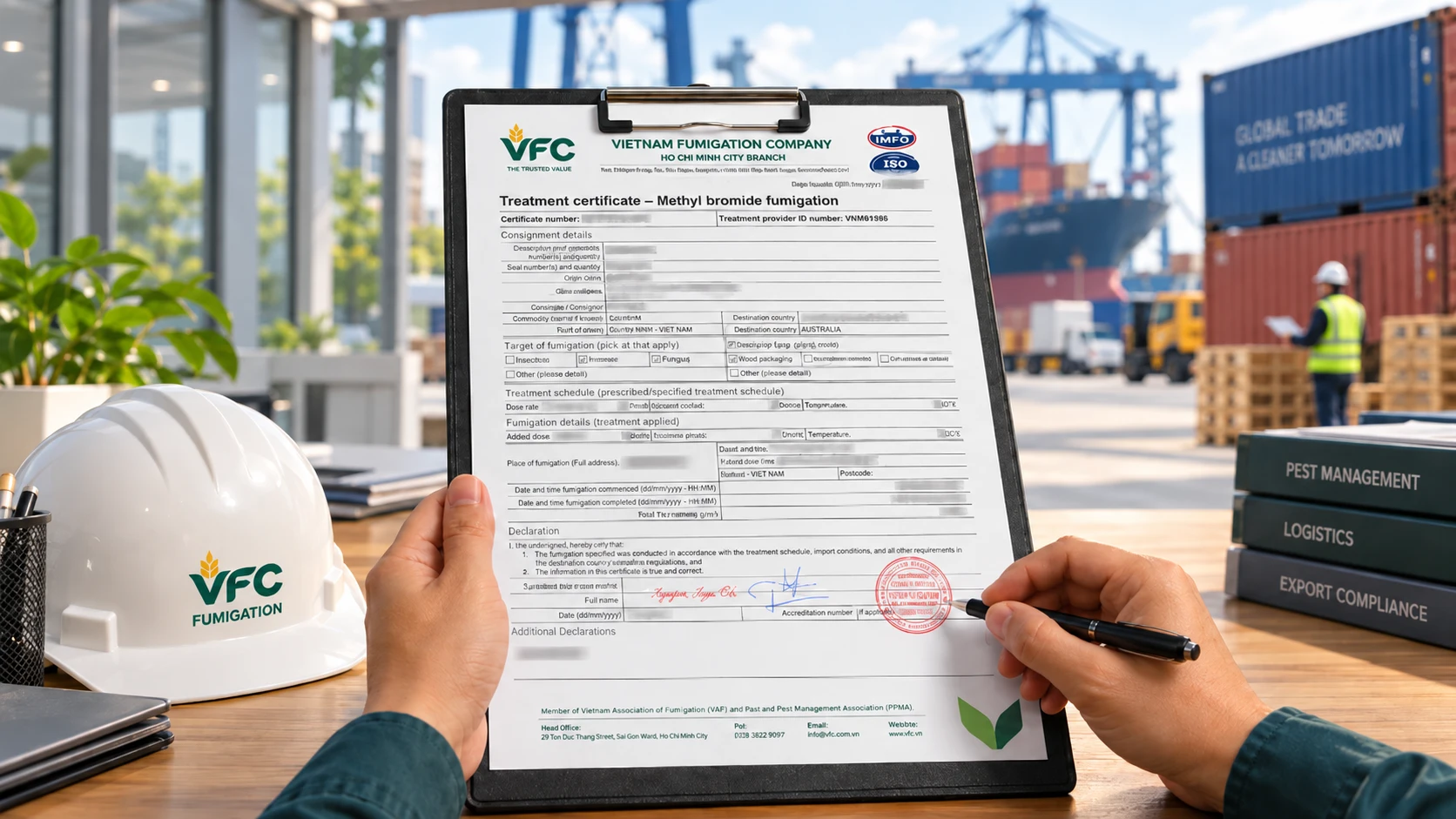
Fumigation Certificate – Treatment Certification for Export Cargo
1.1 Legal Validity of the Fumigation Certificate in International Trade
For consignments subject to mandatory quarantine regulations or commercial trade terms, the Fumigation Certificate serves as verified proof that the cargo has undergone compliant pest treatment prior to port arrival. Failure to present this technical document can result in shipments being detained for rigorous inspection at the destination port, exposing exporters to re-treatment risks and directly disrupting the business supply chain.
Additionally, it serves as an essential payment document under international trade payment methods such as L/C, CAD, or D/P. The letter of credit issuing bank will scrutinize this certificate with strict diligence.
Furthermore, the certificate proves that the enterprise has fully fulfilled its pest control obligations prior to shipment. Consequently, cargo owners have a clear legal basis when working with insurers and shipping lines should maritime disputes arise.
1.2 Key Differences: Fumigation Certificate vs. Phytosanitary Certificate
Many entry-level documentation specialists often confuse these two documents. The comparison table below provides a clear distinction:
| Comparison Criteria | Fumigation Certificate | Phytosanitary Certificate |
|---|---|---|
| Issuing Authority | Licensed independent fumigation service providers | Regional Plant Quarantine Sub-Departments (Plant Protection Department) |
| Nature of Certification | Certifies that the consignment has been treated with approved fumigants in accordance with technical standards | Certifies that the consignment is free from quarantine pests |
| Scope of Application | Agricultural commodities, containerized cargo, and wood packaging material (pallets, dunnage) | Live plant products, seeds, tubers, fresh produce, and raw agricultural commodities |
| Interchangeability | Not interchangeable; both documents are typically required to be submitted in parallel as part of the documentation set. | Not interchangeable; provides legal substantiation for quarantine inspection in the destination country. |
This distinction stems from the fundamental function of plant quarantine in the export supply chain: a Phytosanitary Certificate verifies the overall quarantine status of the consignment, whereas a Fumigation Certificate attests that a specific technical treatment measure has been completed.
2. Which Commodities Require a Mandatory Fumigation Certificate for Export?
Each commodity category is subject to distinct quarantine regulations upon export. Enterprises must proactively review their product portfolio:

Commodity Categories Requiring Fumigation Prior to Export
2.1 Agricultural Commodities, Dried Foodstuffs, and Animal Feed
First are dry agricultural commodities such as rice, coffee, pepper, cashew nuts, maize, cassava chips, and pulses. These represent ideal habitats for stored product pests. Consequently, fumigation—conducted either before or after container stuffing or vessel loading—is a near-mandatory global requirement. For this commodity group, the certificate is merely the final step in a systematic chain: assessing cargo condition, executing the treatment, logging on-site operational data, and reconciling records before issuing the certificate for the export consignment.
2.2 Wood Packaging Material (WPM)
Enterprises must take special note: the ISPM 15 standard applies exclusively to wood packaging and dunnage materials (pallets, wooden crates, dunnage).
Conversely, wooden furniture, cabinetry, and rattan or bamboo handicrafts are finished goods and therefore do not fall under ISPM 15 stamping requirements. Nonetheless, these commodities still require fumigation because natural wood structures inherently pose a risk of wood-boring insects, latent pests residing within the timber, or insects already harboring inside the container shell. Fumigation is essential to ensure complete pest eradication, safeguard cargo quality, and minimize the risk of live pest interceptions at the destination port.
2.3 Export Commodities Subject to Seasonal Biosecurity Measures (Australia & New Zealand)
During the peak risk season from September 1 to April 30 of the following year, the Australian Department of Agriculture, Fisheries and Forestry (DAFF) enforces strict biosecurity measures against the Brown Marmorated Stink Bug (BMSB – Halyomorpha halys).
For target high-risk goods such as iron and steel, vehicles, or mechanical machinery, mandatory treatment and AusTreat certificate issuance apply when the consignment originates in, transits through, or incorporates parts and materials from nations on Australia's BMSB target risk countries list.
3. Standard Structure of a Valid Fumigation Certificate
To avoid documentary discrepancies at the bank, import-export specialists should master the verification checklist below:
3.1 Mandatory Information Fields on a Standard Fumigation Certificate
On a standard Fumigation Certificate, mandatory data fields must be recorded fully, accurately, and in strict consistency with the entire export documentation set (B/L, Commercial Invoice, Packing List):
Identification details and parties involved:
- Certificate No: Unique certificate number of the consignment (facilitates verification and cross-referencing on the VFC Fumigation database).
- Shipper: Full legal name and address of the exporting enterprise/consignor.
- Consignee: Full legal name and address of the receiving party/consignee (or issued "To order" in accordance with Letter of Credit [L/C] terms).
- Notify Party: The designated party to be notified upon cargo arrival at the destination port.
- Product and shipping information:
- Description of goods: Commercial name of the goods, including details on quantity and gross weight.
- Means of conveyance: Name of the means of transport, including vessel name/voyage number.
- Bill of lading (B/L): Official bill of lading number of the shipment.
- Port of loading / Port of discharge: Designated loading port and discharge port.
- Place of delivery: Final place of delivery.
- Container No. / Seal No.: Container number and corresponding seal number.
- Disinfection treatment specifications
- Fumigant used: The fumigant actually used, either Phosphine or Methyl Bromide.
- Dosage: Dosage calculated according to the technical treatment plan.
- Time of Exposure: Records the actual exposure time of the shipment. The number in this field is not merely procedural information; container exposure time must comply with the active ingredient, target pests, and technical requirements of the shipment.
- Date of fumigation: Date on which the treatment operation was carried out.
- Place of fumigation: Actual location where fumigation was implemented, such as warehouse, port yard, or buoy berth.
For shipments exported to Australia and controlled under the AFAS standard, the fumigation certificate form must include additional specialized technical parameter fields:
- Treatment Provider ID / Accreditation Number: The unique identification number of the fumigation provider approved and accredited by the Australian Department of Agriculture, Fisheries and Forestry (DAFF).
- Temperature: Records the minimum forecasted temperature at the fumigation site throughout the exposure period (the baseline parameter for calculating MB dosage according to the AFAS standard dosage chart). Logging the exposure time is valid only when coupled with verified concentration monitoring; under MB treatment protocols, a Methyl Bromide gas detector is utilized to monitor gas concentrations throughout the fumigation process.
3.2 Top 3 Classic Discrepancies Leading to L/C Document Rejection
- Treatment Date Discrepancy: The fumigation completion date recorded on the certificate post-dates the bill of lading issuance date (the "Shipped on Board" date on the B/L).
- Container / Seal Number Discrepancy: A mismatch of even a single alphanumeric character due to a typographical error. This leads the bank to immediately flag a documentary discrepancy.
- Description of Goods Discrepancy: The commodity description on the certificate fails to match verbatim with the terms stipulated in the Letter of Credit (L/C).
All three discrepancies stem from a single underlying cause: field operational data and documentary records are not managed as a unified information flow. The 2-layer transparent fumigation solution was engineered specifically to enhance cross-verification between actual on-site operations and issued certificates.
4. Fumigation Certificate Regulations across Key Export Markets
Every export market imposes its own distinct technical barriers. Therefore, mastering market-specific regulations is the most reliable strategy to ensure seamless customs clearance.
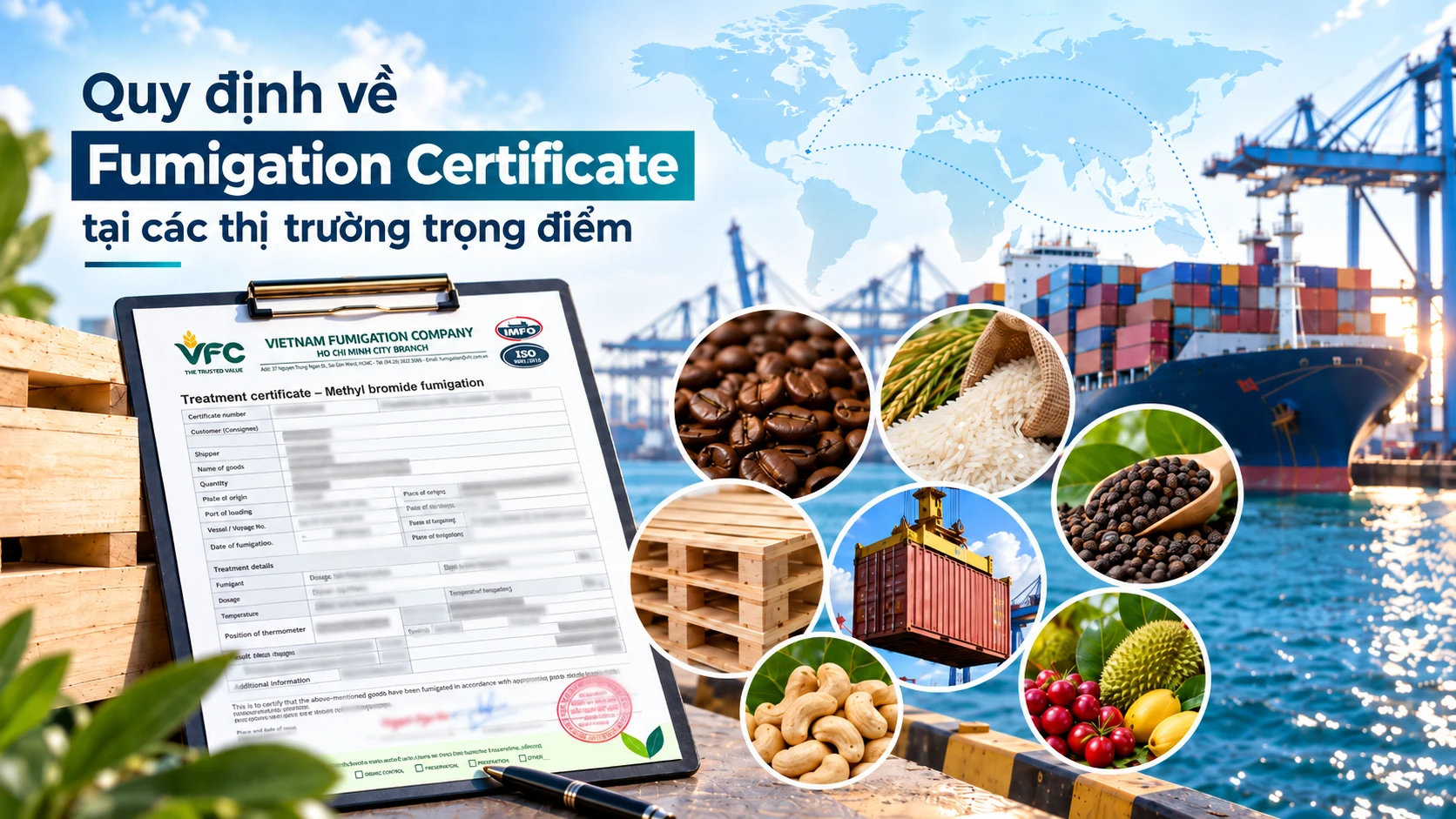
Export Fumigation Certificate Requirements by Destination Market
4.1 Australia & New Zealand Markets: AFAS Standards
For cargo exported to Australia under AFAS standards, the treatment provider must be assigned an AEI code (Australian Entity Identifier) by DAFF.
In Vietnam, the AFAS fumigation treatment protocol for Australia-bound cargo exclusively approves Methyl Bromide. Furthermore, upon completion of the treatment, the consignment must be loaded on board within the prescribed timeframe (the treatment validity window is typically 21 days) to prevent the risk of re-infestation.
4.2 United States & Canada Markets: USDA-APHIS & FDA Standards
The key inspection focus of U.S. Customs and quarantine authorities is the absence of live pests. They frequently use advanced scanning equipment at the destination port. Therefore, for cargo exported to the United States, the certificate should be reviewed together with the current U.S. quarantine regulations, especially the section on pest control for cargo and WPM at the destination port.
In addition, wooden dunnage and packaging materials must strictly comply with the ISPM 15 standard, with a clear mark, no bark, and no signs of borer damage.
4.3 European Union (EU) Market: Clearly Defining the Scope of Application
The European Union (EU) strictly controls Methyl Bromide (MB) to protect the ozone layer. Goods treated with MB in the exporting country may be imported into the EU if they fully meet quarantine, safety, and import requirements for each type of commodity.
In addition, businesses need to choose suitable options such as Heat Treatment or Phosphine fumigation according to the quarantine requirements of each shipment, in order to meet the requirements of the importing country and support smooth customs clearance into the EU.
4.4 China Market: Compliance with Signed Protocols
The General Administration of Customs of China (GACC) manages imported agricultural products through bilateral protocols with strict quarantine control requirements. Businesses should use services from professional fumigation providers such as VFC Fumigation to ensure that the treatment process meets technical standards and that the documentation set is complete for Phyto issuance procedures as well as smooth customs clearance.
5. Risks of Invalid Certificates and Transparent Solutions from VFC Fumigation
5.1 Risks from Invalid Certificates and Underqualified Treatment Providers
In actual export operations, there have been many cases where businesses used certificates issued by underqualified fumigation providers:
- Fumigation implementation: Due to limited capability, the treatment provider does not carry out the process according to technical requirements. When the cargo arrives at the destination port, if quarantine authorities detect live pests on the cargo or packaging materials, the shipment may be held for treatment or temporarily suspended from customs clearance. Before handing over the shipment, businesses should evaluate the capability of the fumigation provider in terms of technical expertise, documentation, and ability to meet the requirements of each market, instead of only checking the service price.
- The certificate is not recognized because the treatment provider is not on the approved list: In strict quarantine markets, the importing country’s authorities issue official lists of recognized treatment providers. Typical examples include the Australian Department of Agriculture, which manages the list of providers meeting AFAS or AusTreat program requirements with an AEI code. If the provider issuing the certificate is not included in the approved list, the certificate may be rejected, causing customs clearance delays or requiring the shipment to be treated again.
5.2 QR Code Electronic Certificate Solution from VFC Fumigation
To completely eliminate the risk of forged documents, VFC Fumigation has applied a comprehensive digital ecosystem:
- Dynamic QR Code on each certificate: Customs authorities at the destination port, shipping lines, and buyers can use a phone to directly scan the QR Code printed on the Fumigation Certificate to cross-check original data in real time.
- Operation updates through FumiApp: Field operations are updated promptly and fully on the internal management software FumiApp, helping closely control the operating process and synchronize data.
- Assurance from IMFO: VFC Fumigation is the official member in Vietnam of the International Maritime Fumigation Organisation (IMFO), ensuring that issued certificates comply with the world’s most stringent maritime fumigation standards.
6. Five-Step Process for Issuing an International-Standard Fumigation Certificate
The technical treatment process and issuance of the fumigation certificate (Fumigation Certificate) require synchronized coordination between field operations and documentation work to ensure strong legal validity for the shipment during international customs clearance.
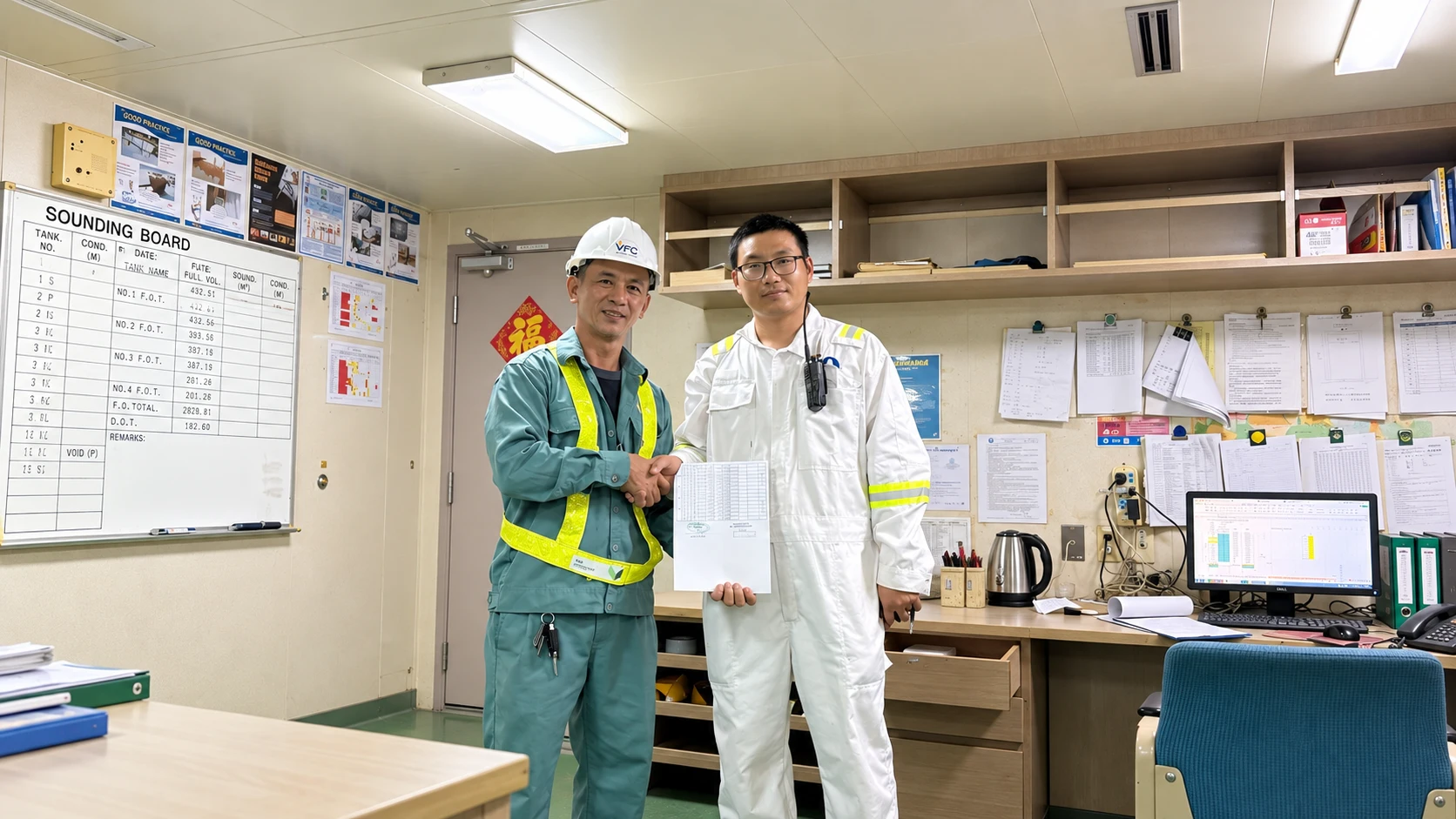
International-standard fumigation certificate issuance process
Step 1: Receiving information and identifying the container location
- A professional fumigation provider, such as VFC Fumigation, receives and accurately verifies the shipment data set provided by the customer.
- The information checked includes container type (20ft, 40ft), container number, seal number, commodity name, destination port, actual yard location at the ICD/export port, and the vessel cut-off time to arrange an accurate operation schedule.
Step 2: Carrying out fumigation
- Arrange the piping system for the Methyl Bromide (CH3Br) fumigation plan or place Aluminium Phosphide (AlP) according to the agreed technical plan.
- Install specialized gas sampling lines at key positions inside the container to support fumigant concentration testing.
- Close the container doors, seal the ventilation holes and potential leakage points with specialized materials to maintain maximum gas-tightness.
- Inject the fumigant for Methyl Bromide treatment.
- Place safety warning signs in clearly visible locations on the container exterior to warn of danger and prevent unauthorized persons from approaching the operation area.
Step 3: Maintaining the exposure period and monitoring concentration
- The exposure period is strictly controlled depending on the fumigant used, the target pest, and the quarantine regulations of the importing country. For Methyl Bromide, the minimum exposure period is 24 hours; for Aluminium Phosphide, it lasts from 7 to 10 days.
- Technicians monitor and measure fumigant concentration periodically according to the technical plan to control fumigant vapor concentration and ensure comprehensive pest treatment effectiveness.
Step 4: Safe ventilation and on-site acceptance
- After the exposure period ends, technicians open the container doors and remove the sealing materials from the ventilation holes to carry out natural or forced ventilation.
- Specialized measuring equipment is used to check fumigant concentration, ensuring the concentration reaches the permitted safety threshold (TLV) before handover.
- The VFC Fumigation technical representative and the customer jointly conduct an on-site inspection, sign the record confirming the fumigation result, and hand over the treated container to the customer or port operations team for loading onto the vessel.
Step 5: Issuing the fumigation certificate (Fumigation Certificate)Fumigation Certificate)
- Complete and issue the official fumigation certificate (Fumigation Certificate) integrated with a QR Code for the export documentation set, serving as a basis for quarantine authorities to consider issuing the Phytosanitary Certificate (Phyto) and supporting smooth customs clearance at the destination port.
Note: The actual process may be flexibly adjusted depending on the specific commodity type, fumigant used, container condition, cargo loading progress, and the specific quarantine requirements of each export market.
7. Frequently Asked Questions About Fumigation Certificates
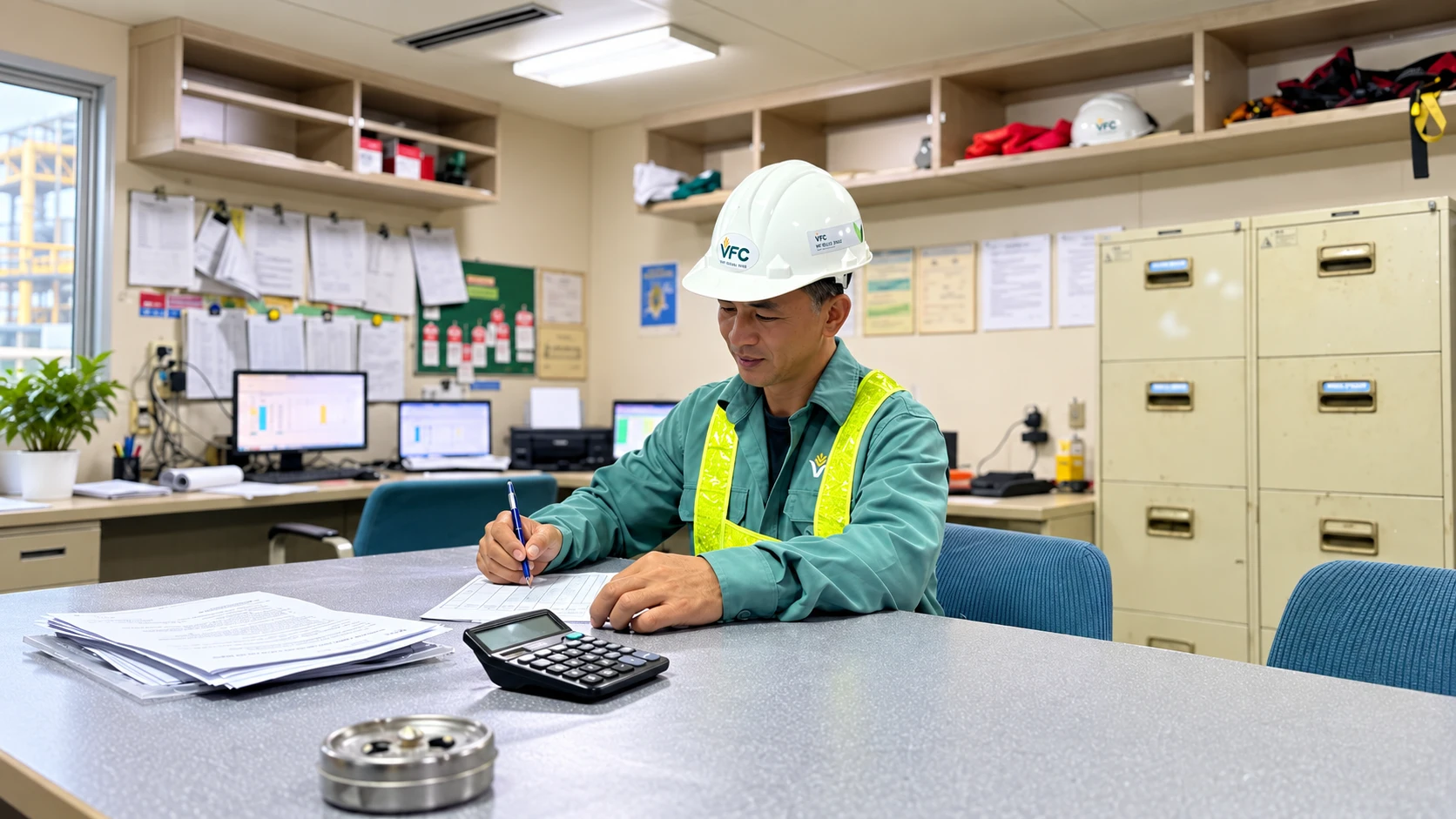
Questions and answers about fumigation certificates
Question 1: Can a Fumigation Certificate replace a Phytosanitary Certificate?
Answer: Absolutely not. These are two separate documents:
- Fumigation Certificate: Issued by the fumigation provider, confirming that the shipment has been treated with fumigant according to the correct technical process.
- Phytosanitary Certificate: Issued by the competent plant quarantine authority, confirming that the shipment meets the quarantine requirements of the importing country. For export agricultural products, the quarantine authority will use the fumigation certificate (Fumigation Certificate) as a technical basis for reviewing and issuing the Phyto certificate.
Question 2: When is the fumigation certificate issued?
Answer: Immediately after the fumigation process is completed on site, VFC Fumigation staff will promptly update the treatment information on the FumiApp management system. Based on the field data combined with the Bill details sent by the customer, the office team will check and cross-check the information, then issue the fumigation certificate (Fumigation Certificate) for the export documentation set.
Question 3: How can a foreign buyer verify a VFC Fumigation certificate by themselves?
Answer: The customer or foreign partner only needs to open the camera on a smartphone and scan the QR Code printed in the corner of the VFC Fumigation certificate to access the shipment’s original verification data portal.
Question 4: Can a Fumigation Certificate be requested after the vessel has departed if fumigation has not been carried out?
Answer: It is completely impossible to issue a certificate if fumigation treatment has not been carried out before the vessel departs. For the in-transit fumigation method on bulk vessels, the certificate is issued immediately after the technician completes fumigant placement, seals the cargo holds, and hands over the safety instruction record for the vessel’s immediate departure, with confirmation from the Captain before the vessel leaves berth.
8. Ensuring Supply Chain Safety with VFC Fumigation
A proper Fumigation Certificate is not only a mandatory requirement for customs clearance and completion of international payment, but also a commitment of responsibility for the quality of Vietnamese goods in the global market.

Export businesses, Logistics companies, and Forwarders that need consultation on container fumigation or bulk vessel fumigation plans, or fast support for issuing QR Code electronic certificates, can contact VFC Fumigation:
- Technical support hotline: 1800 577 788
- Email: contact@fumigation.vn
- Network: Branches and service stations on duty 24/7 at all seaports, ICDs, and key raw material areas nationwide.

-
Blog-old (23)
-
Regulation updates (4)
-
Partnerships & Collaborations (4)
-
General News (15)
Featured News


Related Knowledge