










 SECTION
01
SECTION
01
Coffee Berry Borer (Hypothenemus hampei)

Category:
Fumigation by Industry Sector

Published date:
10/02/2026
Share
Aside from certain fungi, weather, and climate, the coffee berry borer is perhaps the most serious natural threat to coffee production. The species mentioned here is the Coffee Berry Borer (Hypothenemus hampei), whose presence causes enormous losses in both yield and quality of coffee.
Table of Contents
Hypothenemus hampei
This species is endemic to Central Africa and is currently present in almost all coffee-producing countries. They were first discovered in Brazil in 1962, spread to Guatemala and Mexico in 1970, detected in Colombia in 1980, and discovered in Hawaii in September 2010. In Vietnam, this species was first detected in 1993.
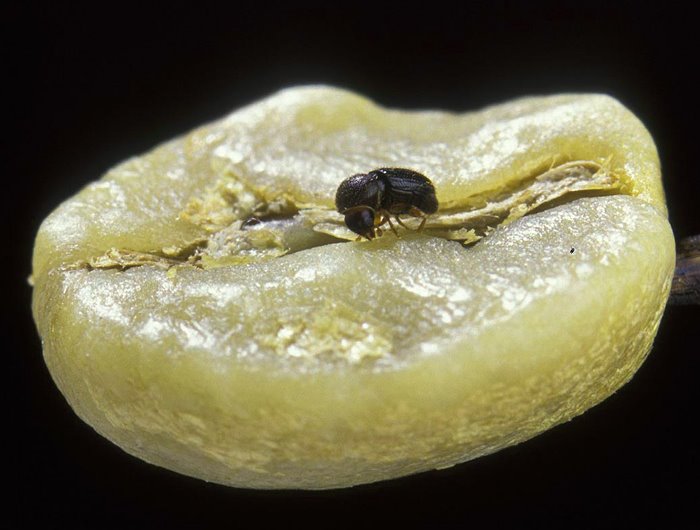
Adult Hypothenemus hampei
Adult coffee berry borers are dark brown to black in color, with short body hairs and strong mandibles. Male beetles have reduced and deformed membranous wings and are unable to fly. Females measure approximately 1.4–1.8 mm in length and are capable of flying long distances, whereas males never leave the coffee berry. A female can lay between 30 and 50 eggs. Each male may mate with multiple females, averaging up to three females per day. After fertilization, females can disperse to other coffee berries within 3–4 days to lay eggs. The larvae then develop and continue boring deeper into the coffee bean. A single coffee berry may host 3–5 generations, with populations reaching up to 100 individuals per fruit.
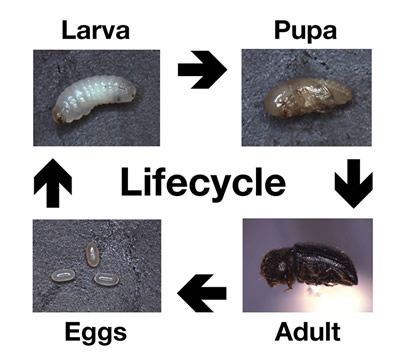
Vòng đời của H.hampei
Damage
H. hampei attacks coffee 8 weeks after flowering. They begin attacking and laying eggs on early-season berries, reaching a peak when the fruit ripens. At the end of the season, adults continue to live in the dry berries left on the ground, then disperse and cause damage the following season. Berries infested with H. hampei often dry out and drop prematurely.
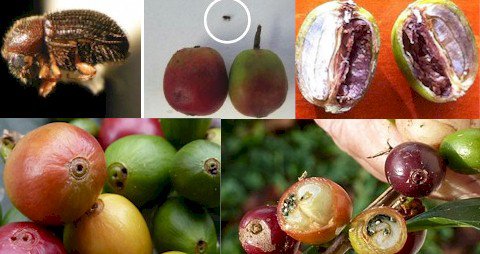
Coffee beans bored by H. hampei typically have small circular holes about 0.3-1.5mm in diameter, and the insect's remains may still be inside the bean. This is also a significant issue at the port of destination during export.
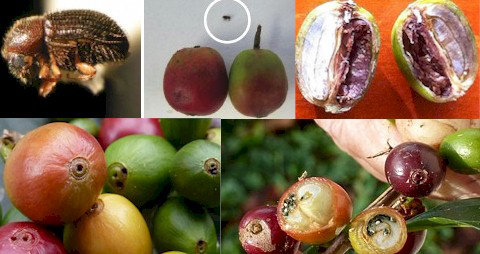
H. hampei Infestation on Coffee Berries
Control
H. hampei is a field pest that attacks coffee berries before harvest. To control this pest, apply insecticides containing the active ingredient Pirimiphos-methyl (e.g., Actellic 50EC) while the berries are still green. After each harvest season, collect and remove any dried or fallen berries beneath the coffee trees to prevent carryover infestations from one crop cycle to the next.
During storage and processing prior to warehousing, maintaining coffee beans at a moisture content of below 14% through proper drying and curing can help control and prevent the development of this pest.
During storage, early detection and timely treatment can help protect commodity stocks from infestation by this pest. For professional insect control and fumigation solutions, please contact VFC Fumigation for expert consultation and support.
See more: Lesser Grain Borer – A Plant Quarantine Pest of Concern in Vietnam