









 SECTION
01
SECTION
01
BMSB-AusTreat: A Complete Guide to Brown Marmorated Stink Bug (BMSB) Control Requirements for Exports to Australia and New Zealand

Category:
Fumigation by Market
Standards & Regulations

Published date:
09/03/2026
Share
BMSB is a 'nightmare' for every business exporting to the Australian and New Zealand markets. If even a single live BMSB is detected in a container when the ship arrives at the port, the entire shipment, worth billions of VND, can be refused entry or forced to be re-exported immediately. This article will explain in detail about BMSB, the BMSB-AusTreat program, and the mandatory treatment procedures to ensure your goods clear customs smoothly.
Table of Contents
1. What is BMSB? Why are Australia and New Zealand so strict?
1.1. Definition of BMSB
BMSB stands for Brown Marmorated Stink Bug, scientifically known as Halyomorpha halys. It is an invasive insect species native to East Asia and is considered one of the most dangerous pests to global agriculture.
1.2. Biological Characteristics and Destructive Potential

Brown Marmorated Stink Bug (BMSB) – The Dangerous “Stowaway” That Can Cost Exporters Billions
Adult brown marmorated stink bugs have a distinct greyish-brown color and measure approximately 12–17mm in length. They are capable of damaging over 300 different plant species, including:
- Fruits: apples, pears, grapes, peaches, citrus fruits.
- Vegetables: tomatoes, chili peppers, corn, beans.
- Industrial crops: soybeans, sunflowers, cotton.
- Nut trees and ornamental plants.
1.3. Why do Australia and New Zealand enforce strict BMSB management?
Unlike standard quarantine regulations, the Australian and New Zealand BMSB screening campaign is based on a unique geographical factor: the seasonal disparity between the two hemispheres.

The seasonal differences between the two hemispheres drive BMSB to seek shelter in containers, allowing it to “hitchhike” its way into Australia and New Zealand.
Most goods imported into Australia originate from countries in the Northern Hemisphere (USA, Europe, China, Japan, etc.). From September to April of the following year, the Northern Hemisphere transitions from Autumn to Winter. To escape the cold, brown marmorated stink bugs seek shelter in the crevices of containers, machinery, and components to hibernate, inadvertently becoming "stowaways" on ocean freight vessels.
The alarming reality is that when these shipments arrive in Australia, the Southern Hemisphere is experiencing Spring and Summer. Instead of continuing to hibernate, the warm weather "wakes" the BMSB. With an abundant food source and no natural predators in Australia or New Zealand, they can breed rapidly and devastate the entire agricultural sector, causing massive economic losses. This is why these two nations prefer to "err on the side of caution" rather than risk an infestation.
2. BMSB Season and Cargo Requiring Mandatory Fumigation
2.1. Annual Fixed BMSB Seasonal Schedule
Based on the biological behavior mentioned above, the Australian Department of Agriculture, Fisheries and Forestry (DAFF) and New Zealand's Ministry for Primary Industries (MPI) apply a shared strict management timeframe: From September 1st of the previous year to April 30th of the following year (based on the date of loading onto the ship).
All shipments categorized as "at-risk" during this period must have a valid BMSB treatment certificate before arriving at the port.

The BMSB risk season runs from September 1 to April 30 of the following year.
2.2. Which goods must undergo BMSB treatment?
This regulation applies to shipments that simultaneously meet two criteria: originating from or transiting through a Target Risk Country and belonging to the Risk Goods Category.
2.2.1. Country Risk Groups
- Target Risk Countries (Mandatory treatment):
- Europe: Albania, Andorra, Austria, Belgium, Bosnia and Herzegovina, Bulgaria, Croatia, Czech Republic, France, Georgia, Germany, Greece, Hungary, Italy, Kosovo, Liechtenstein, Luxembourg, Montenegro, Moldova, Netherlands, Poland, Portugal, North Macedonia, Romania, Russia, Serbia, Slovakia, Slovenia, Spain, Switzerland, Turkey, Ukraine.
- Americas: Canada, United States.
- Asia and Central Asia: Armenia, Azerbaijan, Kazakhstan, Uzbekistan.
- Countries subject to increased vessel surveillance only: China, Japan, South Korea.
- Emerging Risk Countries (Random inspection):
United Kingdom, China, Japan, and South Korea.
2.2.2. Goods Risk Groups
- Agricultural products: Rice, corn, cashews, coffee, pepper, various beans, fresh fruits, dried fruits, vegetables.
- Handicrafts: Wooden furniture, rattan and bamboo products, decorative items.
- Machinery and equipment: Especially used machinery, vehicles, construction equipment, agricultural tools.
- Containerized goods: All types of sea-freight containers are considered at risk.
Beyond the specific scope of BMSB controls, treatment requirements also depend on the commodity type, packaging materials, and regulations of the importing market. Businesses are advised to check in advance types of goods that typically require fumigation prior to export to avoid missing quarantine requirements.
3. Consequences of Detecting BMSB in Containers
If quarantine authorities detect a live BMSB in a container upon the ship's arrival at an Australian or New Zealand port, the consequences are extremely severe:
3.1. Refusal of Entry or Mandatory Re-export
- Refusal of Import: The entire shipment is denied entry and is not permitted to be unloaded at the port.
- Forced Re-export: The business must charter a vessel to return the cargo to the exporting country or transfer it to a third country. Costs for chartering vessels, container storage (demurrage), and insurance for the return journey are often many times higher than the value of the shipment itself.

Containers and their cargo provide ideal shelter for BMSB. As a result, mandatory treatment at origin is required during the BMSB risk season.
3.2. Exorbitant Additional Costs
- Emergency Quarantine Treatment Fees: Treatment at a foreign port is not only complex but also "extortionate," costing 5–10 times more than domestic services, posing a major financial risk to the business.
- Demurrage & Detention Fees: Fees at Australian and New Zealand ports are very high and can reach hundreds of millions of VND after only a few days of delay.
- Quarantine Supervision Fees: Authorities will assign officers to supervise the entire treatment process and charge service fees.
3.3. Destruction of Goods
In cases where live BMSB is found and the shipment cannot be treated thoroughly, quarantine authorities have the power to:
- Destroy the entire shipment: Goods are destroyed right at the port; the business loses both the capital and the business opportunity, while also bearing the destruction costs.
- Administrative Penalties: Businesses may be fined according to local laws.
3.4. Impact on Business Reputation
Both Australia and New Zealand maintain a "blacklist" of businesses that violate quarantine regulations. If placed on this list:
- 100% of subsequent shipments will be subject to manual inspection, delaying customs clearance.
- Importing partners may cancel contracts due to concerns over legal risks and delays.
- Brand reputation is severely damaged in the international market.
4. BMSB-AusTreat – The Golden Key to Smooth Customs Clearance
4.1. What is BMSB-AusTreat?
BMSB-AusTreat is the name of a program for registering and managing fumigation treatment providers recognized by the Australian Department of Agriculture, Fisheries and Forestry (DAFF).
This program is also known as AusTreat, an abbreviation for the "Pre-border Biosecurity Treatment Provider Scheme."
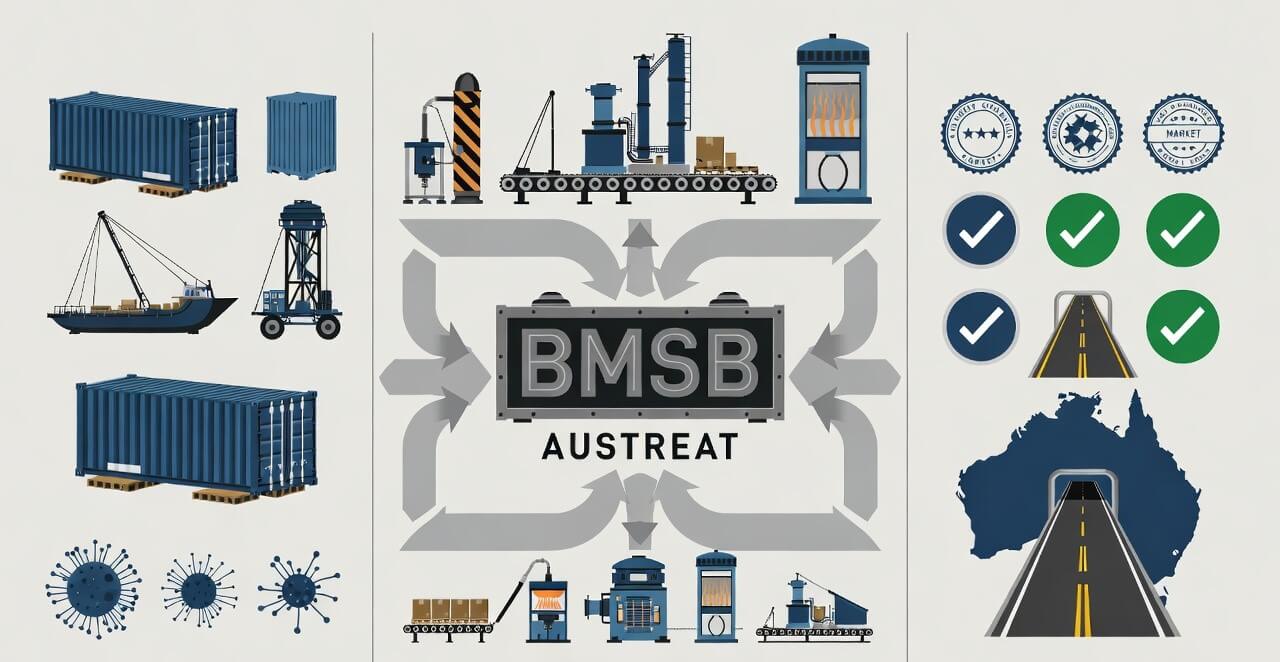
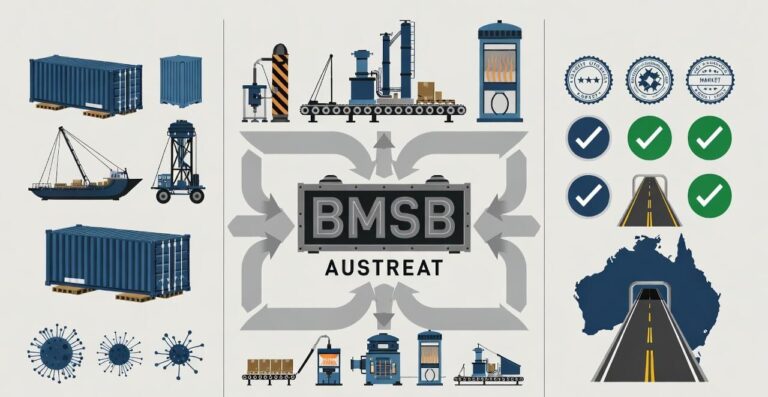
BMSB-AusTreat (also known as BMSB treatment) is a mandatory treatment program for cargo and shipping containers originating from BMSB risk countries and destined for Australia or New Zealand. Its purpose is to eliminate the Brown Marmorated Stink Bug (BMSB) and prevent its introduction into these countries.
Besides AusTreat, businesses exporting to Australia often encounter AFAS requirements. Understanding correctly what AFAS is and the role of an accredited treatment provider helps businesses avoid confusion when preparing documentation for each commodity group.
4.2. The Role of BMSB-AusTreat
The AusTreat program establishes a strict set of technical standards to ensure:
- Competence of the treatment provider: Quarantine service providers must fully meet requirements regarding equipment, technical processes, and personnel.
- Treatment Quality: Ensures all treatment activities are effective. In Australia, the list of approved measures is broad, including heat treatment or chemical treatment (Methyl Bromide, Sulfuryl Fluoride, Ethyl Formate). However, in Vietnam, VFC Fumigation is the only unit qualified to register for BMSB treatment, and the currently approved method is limited to Methyl Bromide fumigation.
- Legal validity of a Fumigation Certificate: Only Fumigation Certificates issued by companies listed on the AusTreat register are accepted by the quarantine authorities of Australia and New Zealand.
During the treatment process, technicians must use appropriate Methyl Bromide gas measuring equipment to monitor concentrations at specified intervals and confirm the gas retention capability within the fumigation enclosure.
4.3. Units with BMSB-AusTreat Certification
Agricultural exporters must choose a treatment provider with AusTreat certification to ensure the shipment is recognized. Key criteria to verify include:
- The AusTreat registration number must be active on the DAFF system.
- The provider must implement the exact, approved measure registered with DAFF.
- Proven experience in handling shipments to Australia and New Zealand over multiple seasons.
For shipments subject to BMSB control, businesses need to use AusTreat-standard container fumigation services for Australia to ensure that treatment methods, certificates, and declared data are accepted by quarantine authorities.
5. Process for Issuing BMSB Fumigation Certificates
5.1. What is a BMSB Fumigation Certificate?
A BMSB Fumigation Certificate is an official document certifying that your shipment has been fumigated to eliminate Brown Marmorated Stink Bug (BMSB) in accordance with the stringent requirements of Australia and New Zealand..
This certificate is issued upon the successful completion of an approved treatment process carried out by a service provider registered under the BMSB-Austreat Program.
5.2. Accepted Treatment Methods
To obtain a BMSB Fumigation Certificate, the shipment must be treated using one of the following approved methods:
5.2.1. Heat Treatment (HT):
- Requirement: The core temperature of the commodity must reach at least 56°C (132.8°F) and be maintained continuously for 30 minutes.
- Advantages: Environmentally friendly and leaves no chemical residues.
- Applications: Suitable for organic agricultural products and commodities that are sensitive to chemical treatments.
5.2.2. Methyl Bromide (MB) Fumigation:
- Requirement: The dosage varies depending on the ambient temperature.
- Example: At temperatures above 21°C (69.8°F), the minimum dosage is 24 g/m³ with an exposure period of 24 hours.
- In Vietnam: VFC Fumigation is the only company registered and authorized to perform BMSB treatment using Methyl Bromide fumigation for export cargo.
Treatment effectiveness depends not only on chemical dosage but also on container gastightness, gas distribution capability, and concentration monitoring throughout the exposure period. Businesses can refer to the Methyl Bromide container fumigation process to clearly understand each step of execution.
5.2.3. Sulfuryl Fluoride (SF) Fumigation:
- Characteristics: High penetration capability and rapid effectiveness.
- Applications: Used as an alternative to Methyl Bromide in many treatment scenarios.
5.2.4. Ethyl Formate (EF) Fumigation:
Must be performed at temperatures of 10°C or higher.
See more: Why does improper fumigation lead to prolonged risks?
5.3. Fumigation Certification Process
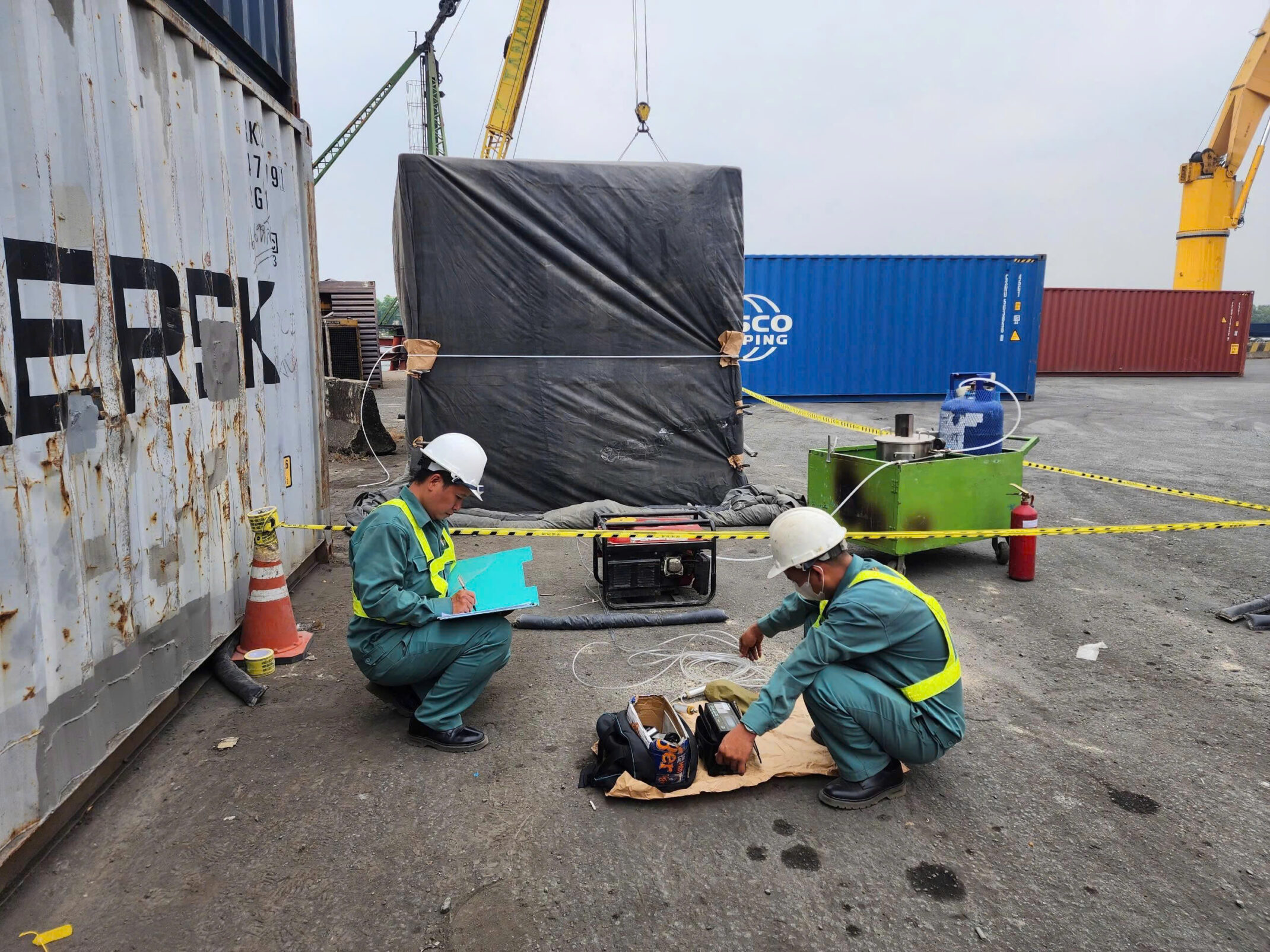
A professional treatment process carried out by a BMSB-AusTreat approved provider helps ensure smooth customs clearance and compliance for export shipments.
Step 1:: Determine Whether the Shipment Requires BMSB Treatment.
Step 2: Inspect the Container and Cargo Before Treatment
- Ensure the container is clean and dry.
- Verify that there are no signs of insects, soil, or contamination.
- Check the gas-tightness of the container (for fumigation treatments).
Step 3: Carry Out Treatment in Accordance with the Approved Procedure
- Treatment is performed by qualified technicians. All treatment parameters are recorded and documented.
- Dosage, temperature, and exposure time are closely monitored throughout the process.
Step 4: Ventilate the Shipment
- Measure gas concentrations to verify treatment effectiveness.
- Open the tarpaulin or container doors for ventilation. Monitor gas levels until they reach the Threshold Limit Value (TLV) to ensure safe handling and access.
Step 5: Issue the BMSB Treatment Certificate
- The certificate is issued using the official format prescribed under the AusTreat Program.
- Upon completion of treatment, the service provider uploads all treatment records, fumigation data, and the certificate directly to the BMSB Portal. This enables Australian and New Zealand biosecurity authorities to immediately verify the validity and compliance status of the shipment.
For strictly controlled shipments, paper certificates are merely the final piece of a data chain that requires control. The 2-layer transparent fumigation model helps businesses enhance record traceability and certificate verification when requested by buyers, forwarders, or quarantine authorities.
Learn more: Fumigation for containers to Australia-AFAS/BMSB
6. Important Notes for Exporters
6.1. Time Management
Check if your shipping date falls within the BMSB season (Sept 1st – April 30th).
6.2. Choose a Reputable Provider
- Verify the AusTreat registration number: Ensure it is still valid on the official system.
- Understand the treatment method: In the Vietnamese market today, the method most widely accepted and commonly applied by Australian quarantine authorities is Methyl Bromide (MB) fumigation. Work with a provider that has deep expertise in the dosage and procedures of this specific method.
- Absolutely do not use fake certificates: Ensure that the executing provider has the capability to upload records directly to the BMSB system portal, as paper certificates are invalid if the data is missing from the system.
In addition to AFAS licensing, businesses should further evaluate implementation networks, document control capabilities, handling experience, and schedule fulfillment capacity when selecting an export cargo fumigation provider. Choosing the right provider from the outset will help significantly reduce risks during the export process.
6.3. Carefully Check Documentation
Ensure that the information on the BMSB certificate matches 100% with:
- Bill of Lading
- Packing list
- Invoice
- Other related documents
For shipments using pallets, crates, boxes, or dunnage, businesses need to separately check ISPM 15 standards for export wooden pallets, as this requirement cannot be substituted solely by a BMSB treatment certificate.
6.4. Coordinate with Logistics Partners
- Request your forwarder to provide a detailed vessel route.
- Avoid transit routes through countries with a high risk of BMSB during the season.
- Ask your partner to review the document set before the ship departs.
BMSB (Brown Marmorated Stink Bug) is a serious threat to every shipment exported to Australia and New Zealand. With the season lasting from the beginning of September to the end of April of the following year, businesses are required to follow the treatment process and be issued a BMSB certificate by a provider listed in the BMSB-AusTreat program.
The consequences of non-compliance are extremely severe: refused entry, forced re-export, and destruction of goods with massive costs, along with long-term impacts on business reputation.
To protect your shipment, choose a reputable provider with BMSB-AusTreat certification, and carefully check the procedures and documentation before the container sets off.
7. VFC Fumigation – The Only Unit in Vietnam Licensed for BMSB Treatment for Australia and New Zealand
Facing the risk of billions of VND in losses if a shipment is rejected, choosing the right partner is critical.
Proud to be a pioneer in the fumigation industry, VFC Fumigation is currently the first and only company in Vietnam officially approved by the Australian Department of Agriculture, Fisheries and Forestry (DAFF) to participate in the BMSB-AusTreat Program.
Hundreds of exporting businesses have chosen VFC Fumigation as their trusted partner, thanks to the following advantages:
- Exclusive Standardized Methods: VFC is the only unit in Vietnam licensed to use international-standard Methyl Bromide fumigation for BMSB.
- Guaranteed Clearance: VFC handles all technical parameters and uploads the necessary documentation to the BMSB Portal, ensuring your shipment clears quarantine smoothly.
- Proven Experience: VFC’s team of experts has supported thousands of containers of agricultural products, wood, and machinery through the most rigorous BMSB seasons.
Don't let a single stink bug ruin your multi-million dollar deal. Let VFC Fumigation guarantee the quality and safety of your shipment! If your business has not yet determined whether your shipment is subject to BMSB control or requires AusTreat treatment, please contact VFC for specific consultation based on the export market, commodity type, and shipping time. Our technical team will assist in reviewing treatment requirements, guiding document preparation, and scheduling fumigation to fit your delivery plan.
Hotline: 0914773300
Email: contact@fumigation.vn

Previous Article
What is AFAS? 5 important things exporters to Australia need to know
Next Article
SECTION
01
 SECTION
02
SECTION
02
What is AFAS? 5 important things exporters to Australia need to know
 SECTION
03
SECTION
03
BMSB-AusTreat: A Complete Guide to Brown Marmorated Stink Bug (BMSB) Control Requirements for Exports to Australia and New Zealand
SECTION
04
A–Z process for fumigating export cargo to Australia
 SECTION
05
SECTION
05
Khapra Beetle: How Does It Impact Agricultural Exports to Australia?