





Published date:
25/08/2026
Share




The United States is a major consumer market for wood products, while simultaneously enforcing strict phytosanitary regulations on wooden furniture, packaging, and dunnage materials. To proactively mitigate the risk of container detention at the port of discharge, VFC Fumigation has compiled 7 technical and documentation requirements that businesses exporting furniture to the US most commonly overlook during cargo preparation.
1. Commonly Overlooked Requirements for Wood Packaging Material (WPM)
Wood packaging material (WPM) destined for the US must be bark-free and comply with ISPM 15 standards, bearing legible marks on two opposite sides. Additionally, PE/PVC wrapping film used for furniture must be technically perforated to allow the fumigant gas to penetrate the WPM.
Requirement 1: Complete Bark Removal on Pallets and Dunnage
Natural wood used for pallets, wooden crates, or packaging materials must be completely debarked. Removing the bark helps eliminate the sheltering and breeding environments of bark beetles.
Requirement 2: Proper ISPM 15 Marking on Wood Packaging
The ISPM 15 mark certifies that the wood packaging has been treated in compliance with standards:
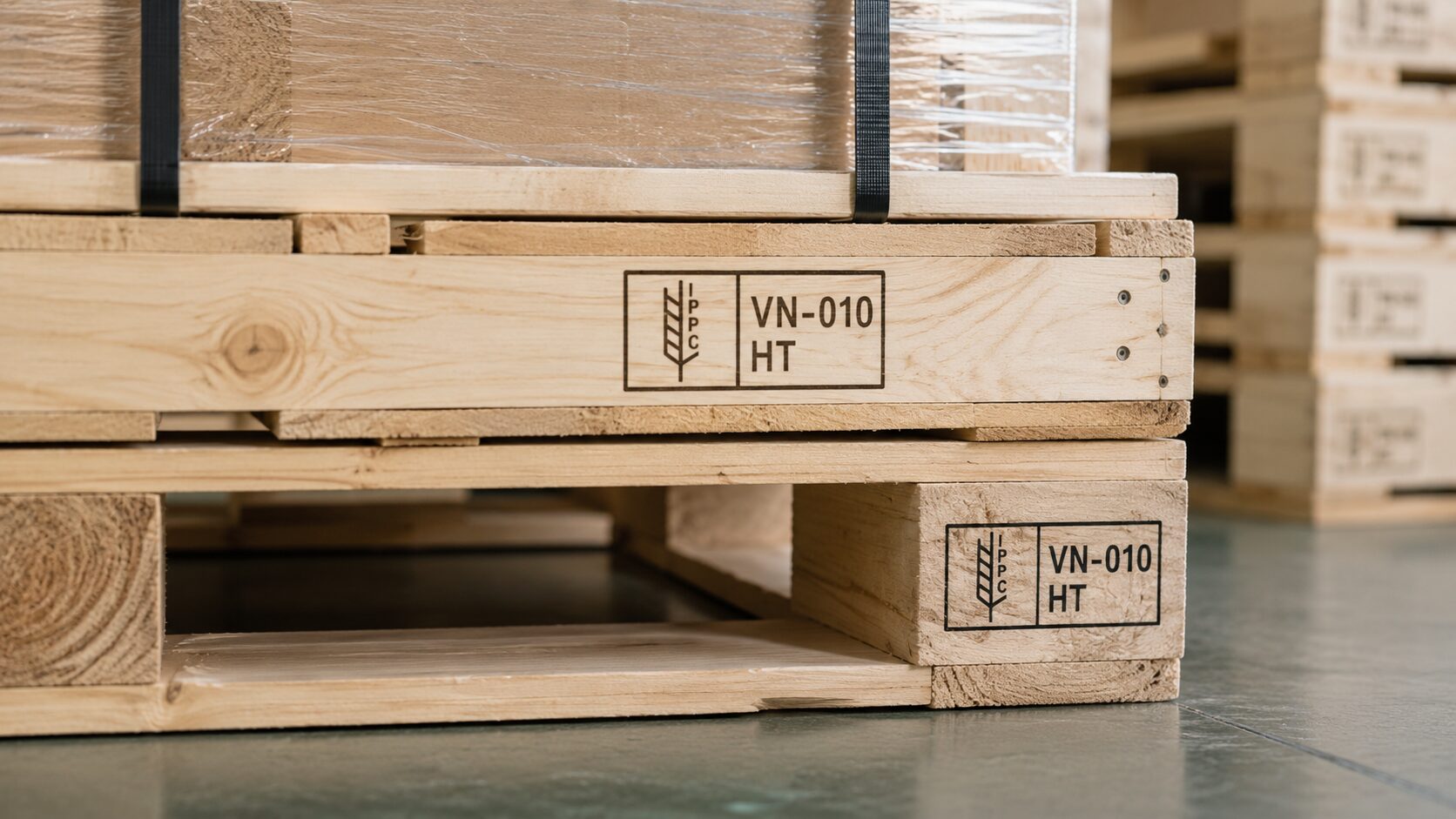
- The mark must be engraved or applied with permanent ink, clearly legible, and free from smudging or blurring.
- The mark must be placed in a visible location, on at least two opposite sides of each pallet, wooden crate, or wood dunnage.
- The mark must fully display all required components: the IPPC logo, the country code (VN), the licensed service provider code—such as VN-009 for MB or VN-010 for HT—along with the treatment code (MB for fumigation or HT for heat treatment).
Requirement 3: Perforating the Plastic Film Wrapping Around Furniture
When using impermeable materials such as PE or PVC film to wrap furniture, businesses must take care not to completely seal the internal wooden dunnage components. An airtight layer can hinder the diffusion and penetration of the fumigant gas into the WPM.
In cases where wrapping is required to protect the product surface, businesses can either fumigate the WPM prior to packing or perforate the plastic film according to technical standards to allow the fumigant gas to circulate evenly.
2. Technical Fumigation and Documentation Requirements
The procedure for fumigating furniture exported to the US requires careful attention to treating raw wood materials prior to surface coating, ensuring container gastightness, and maintaining a minimum Methyl Bromide (CH₃Br) exposure time of 24 hours.
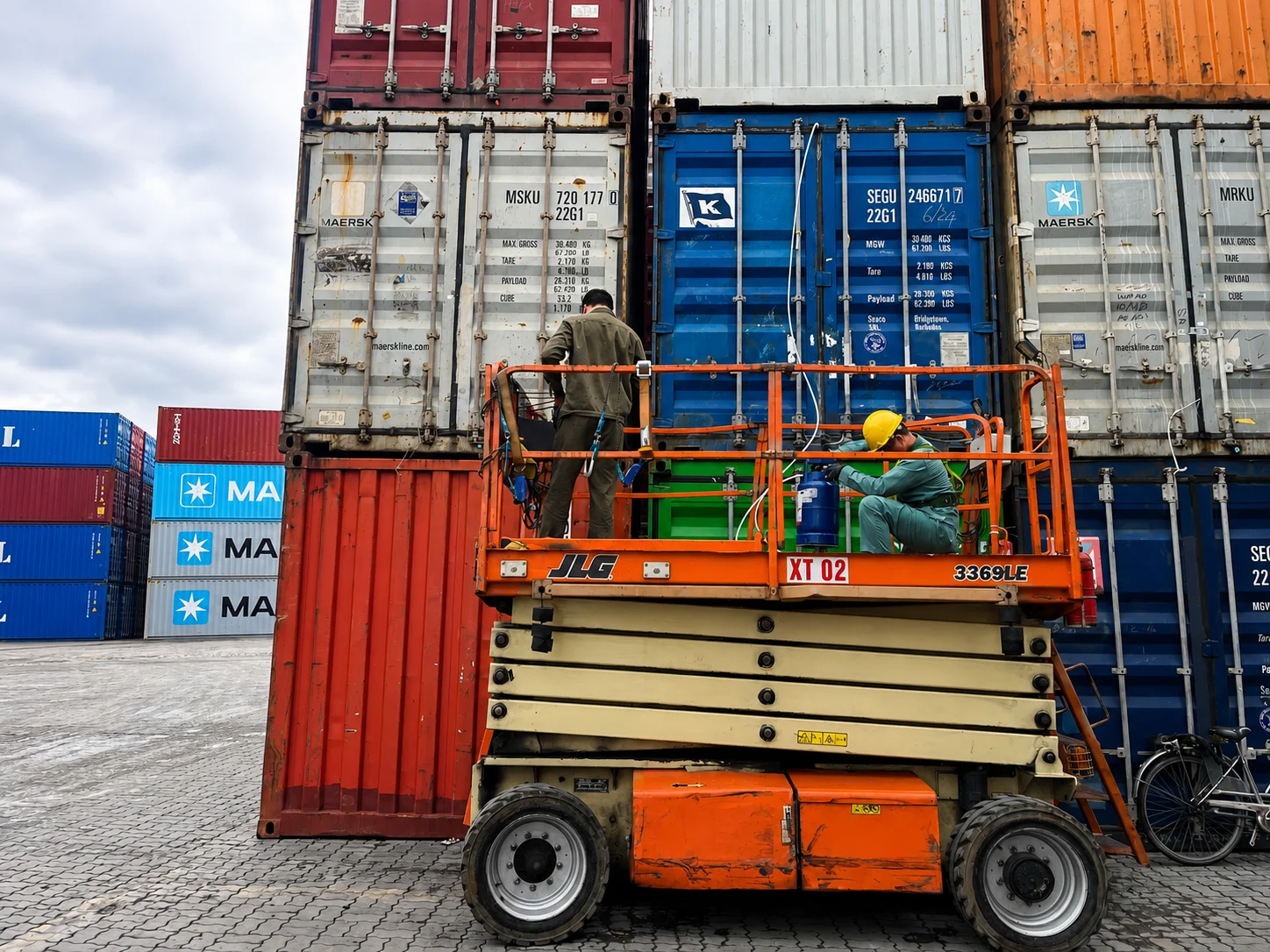
Container Fumigation Techniques for US-Bound Furniture
Requirement 4: Treating Raw Wood Materials Prior to Surface Coating
For furniture products with enameled, thickly coated, or varnished surfaces, an appropriate treatment plan should be implemented prior to coating.
Requirement 5: Ensuring Container Gastightness and Standard Exposure Time
The cargo container must be thoroughly inspected along its walls, floor, and door seals to minimize gas leakage. Air vents must be tightly sealed to maintain the required fumigant concentration inside the container.
When using Methyl Bromide (CH₃Br) to fumigate furniture destined for the US, the mandatory minimum exposure time is 24 hours.
For full container load (FCL) shipments, the treatment plan must be tailored according to the cargo type, packaging materials, and import market requirements. Businesses can refer to the procedure for export cargo fumigation in containers at VFC Fumigation.
Requirement 6: Checking Fumigant Gas Concentration After Aeration
Upon completion of the exposure period, technicians remove the seals from the air vents or open the container doors to conduct aeration.
Residual fumigant gas concentration should be tested using specialized detection equipment, such as electronic gas detectors or low-range detector tubes, to confirm that safe threshold levels have been reached prior to sealing and handing over the container.
Requirement 7: Ensuring Information on the Fumigation Certificate Matches the Export Documents
Information on the fumigation certificate—such as container number, seal number, commodity description, vessel name, voyage number, port of loading, port of discharge, and applied dosage—must be consistent with the Bill of Lading (B/L), Invoice, and Packing List.
Even minor discrepancies between documents can cause US quarantine authorities to raise questions and request additional inspections.
3. Consequences at US Ports for Violating Quarantine Regulations
When a shipment is found to violate quarantine regulations or contain live pests, US quarantine authorities may seal the container, require re-treatment, order destruction, or mandate re-exportation. In such cases, businesses may incur additional storage fees calculated in USD per day and two-way shipping costs.
Summary Table of Associated Risks and Incurred Losses
| US Quarantine Enforcement Measures | Incurred Financial and Reputational Losses |
|---|---|
| Mandatory Re-treatment | Incurring treatment service costs at US port yards. |
| Destruction of Wood Materials | Incurring destruction costs as required by quarantine authorities. |
| Mandatory Re-exportation | Incurring two-way ocean freight costs, demurrage/detention fees charged in USD per day, and damage to brand reputation. |
4. Frequently Asked Questions When Exporting Furniture to the US
Q1: Does furniture made entirely from engineered wood exported to the US require the ISPM 15 stamp?
Answer: No. Under regulations, the ISPM 15 standard applies to wood packaging materials (WPM) such as pallets, crates, and dunnage, not to the commodity itself. Furniture is classified as cargo and therefore is not subject to mandatory ISPM 15 stamping.
However, businesses must still pay attention to the packaging and dunnage materials used during cargo packing:
- If solid wood pallets or crates are used to transport the furniture, these pallets or crates must still undergo quarantine treatment and bear a valid ISPM 15 mark.
Q2: What fumigants are commonly used for furniture containers bound for the US, and what is the minimum exposure time?
Answer: Methyl Bromide (CH₃Br) is the commonly used fumigant to meet US market requirements, particularly for treating WPM in accordance with the ISPM 15 standard. The mandatory minimum exposure period when using Methyl Bromide is 24 hours.
Q3: Does the US market implement a specific fumigation accreditation scheme like Australia's AFAS?
Answer: No. The US does not implement a treatment provider accreditation scheme like Australia's AFAS. Its control mechanism focuses on physical verification of compliance with the ISPM 15 standard for wood packaging materials and phytosanitary requirements at the port of entry.
Q4: How can the authenticity of a fumigation certificate issued by VFC Fumigation be verified?
Answer: Businesses or US import partners can scan the QR code on the electronic certificate to access the online verification system and cross-check information against the original data.
5. Solutions for Optimizing the Furniture Fumigation Process for US Exports by VFC Fumigation
Proactively verifying the 7 technical and documentation requirements directly at the export yard helps businesses exporting furniture to the US minimize quarantine risks, ensure delivery schedules, and maintain their reputation across the international supply chain.
To accompany wooden furniture exporters, VFC Fumigation implements the 2-layer transparent fumigation model:
- Layer 1 (Internal Operational Data Management): Systematically tracking shipment information on the FumiApp application.
- Layer 2 (Electronic Certificate Verification via QR Code): Directly integrating a QR Code onto the electronic certificate, enabling supply chain stakeholders to quickly cross-check information against original data on the online system, thereby enhancing documentation reliability when working with international quarantine authorities.





Related Blogs