










 SECTION
01
SECTION
01
Commodity Groups Destined for the US That Require Mandatory Fumigation Prior to Export

Category:
Fumigation by Market

Published date:
21/08/2026
Share
The USDA Animal and Plant Health Inspection Service (USDA APHIS) and U.S. Customs and Border Protection (CBP) maintain an extremely rigorous biosecurity control system across all ports of entry. Although the U.S. does not operate a standalone fumigation accreditation scheme like Australia's AFAS standard, it enforces exceptionally strict controls over categories of US-bound goods requiring fumigation, particularly shipments utilizing Wood Packaging Material (WPM) in compliance with the international ISPM 15 standard.
Table of Contents
1. List of US-Bound Commodity Groups Requiring Mandatory Fumigation
1.1. Goods Utilizing Wood Packaging Materials (WPM)
Raw solid wood packaging and dunnage materials are subject to the most rigorous inspection by US quarantine authorities. Accompanying wooden materials include:
- Wooden pallets, wooden crates, and wooden packaging cases.
- Chocks, wooden supports, and wooden reels (dunnage) used to secure cargo inside containers.
These materials all belong to the Wood Packaging Material group. If the scope of application is unclear, businesses should see what WPM is and regulations for export wood packaging materials.
Reasons for mandatory treatment:
Raw, unprocessed wood materials are a potential habitat for 9 wood-boring insect families subject to key US quarantine controls:
- Bostrichidae: False powderpost beetles (auger beetles).
- Buprestidae: Metallic wood-boring beetles (jewel beetles).
- Cerambycidae: Longhorned beetles (roundheaded wood borers).
- Cossidae: Carpenter moths (goat moths / wood-boring moths).
- Curculionidae: Weevils and snout beetles (wood-boring weevils).
- Platypodidae: Pinhole borers (ambrosia beetles).
- Siricidae: Horntails (wood wasps).
- Sesiidae: Clearwing moths.
- Scolytidae: Bark beetles (engraver beetles).
These pest groups are the reason WPM is placed under quarantine control at the port of destination. Businesses can see more on what phytosanitary inspection is and the export cargo inspection procedure.
Consequences if live pests are detected:
In the event that US quarantine authorities detect live pests or non-compliant WPM under ISPM 15 standards, the entire container will be detained immediately. Businesses will face mandatory enforcement actions: compulsory re-treatment at the port of discharge at exorbitant costs, destruction of the WPM, or enforced re-export of the shipment in its original condition back to Vietnam.
Before loading containers, businesses should review small errors that are easily overlooked, such as blurred marks, residual bark, damp pallets, or signs of wood borers. See more: 5 small pallet errors that can put containers at risk upon entry.
1.2. Agricultural Products and Goods at Risk of Insect Infestation

US-Bound Dried Agricultural Products Requiring Fumigation
In addition to wood packaging materials, dried agricultural products such as coffee, cashew nuts, pepper, rice, spices, and similar commodities, or industrial goods containing organic components, are also considered high-risk groups for pest development during storage and processing. For agricultural products, businesses should assess the cargo condition, storage environment, treatment plan, and post-fumigation documentation.
See more: Export agricultural commodity fumigation: from cargo treatment to data and certificate management
Purpose of treatment:
Proper use of fumigants according to technical standards helps thoroughly eradicate insect pests hiding inside cargo or within the container space, preventing pest risks at the port of arrival and maintaining customs clearance schedules at the destination port. If you need to visualize the entire process from receiving information and container inspection to treatment, aeration, and certificate issuance, see the 2026 export container fumigation guide.
2. Mandatory Standards When Exporting Goods Utilizing Wood Packaging Material (WPM)
2.1. International Standard ISPM 15 Applicable to Wood Packaging Materials
ISPM 15 is an international phytosanitary standard issued by the International Plant Protection Convention (IPPC). This is not a standalone regulation established by the US, but the US uses ISPM 15 as a mandatory legal basis to inspect all WPM imported into its territory.
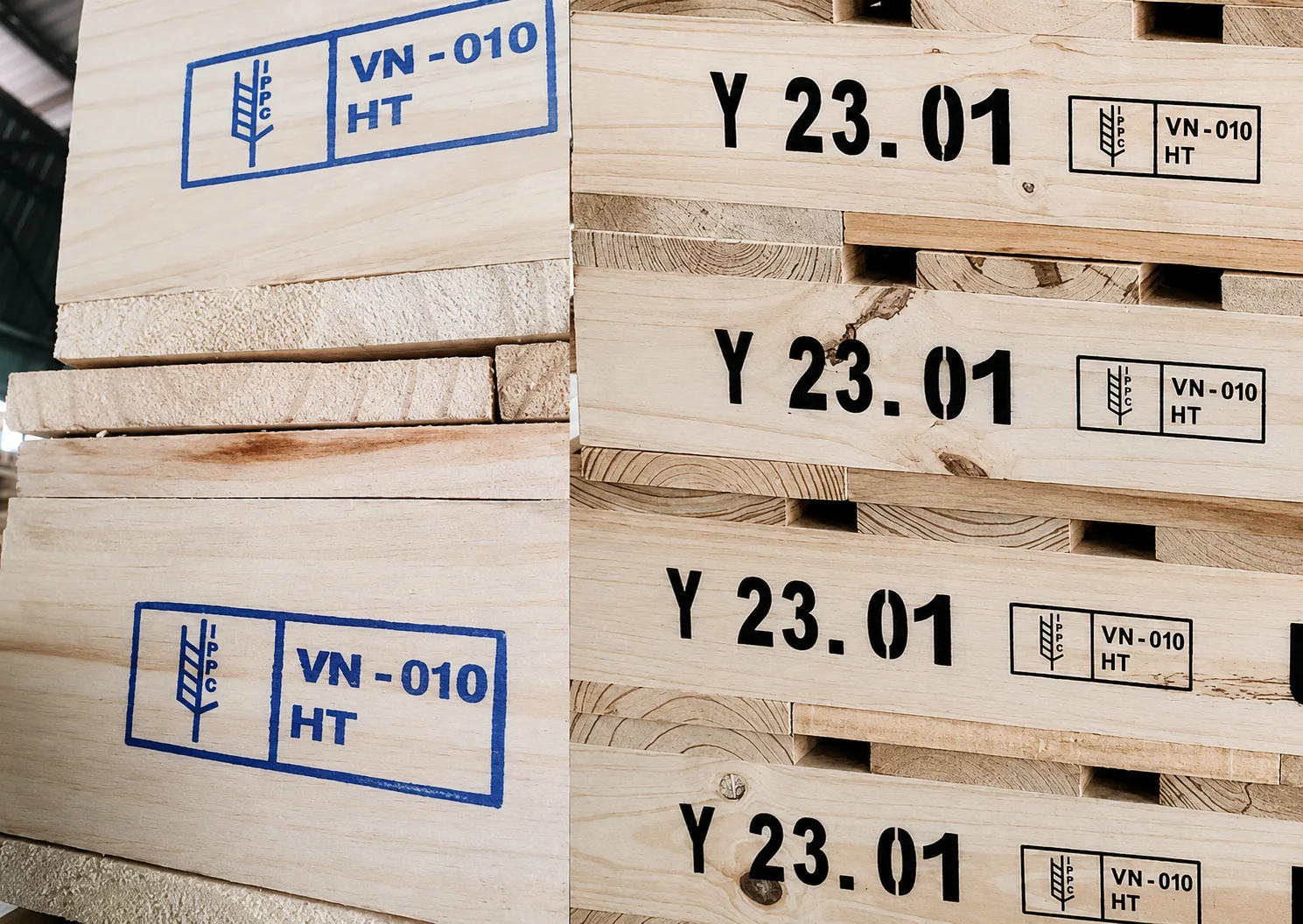
ISPM 15 Mark on Wooden Pallets
2.2. Technical Requirements for Wood Packaging Material (WPM)
- Debarked: Raw wood used for WPM must be thoroughly debarked to eliminate breeding grounds for bark beetles.
- Structural Quality: Wood must be dry (achieving appropriate moisture content), free from mold, and strictly free of wood borer holes or live pests.
- Fumigant Penetration: Strictly avoid completely wrapping or sealing WPM with impermeable films such as PE, PVC, etc. In cases where protective wrapping is mandatory, the WPM must be treated in accordance with ISPM 15 standards prior to packaging, or the wrapping film must be technically perforated to allow the fumigant to penetrate deep into the wood core.
Before deciding on a WPM treatment method, businesses can view distinguishing Methyl Bromide fumigation and HT heat treatment in the ISPM 15 standard.
2.3. Standard Specifications for ISPM 15 Marking
An ISPM 15 mark certifying that WPM has been validly treated must be clearly stamped/engraved, not smudged, and appear on at least two opposite sides of the wooden crate or pallet. If you need to check the IPPC symbol, country code, facility code, and treatment method symbol, see how to read and check the ISPM 15 mark before export.
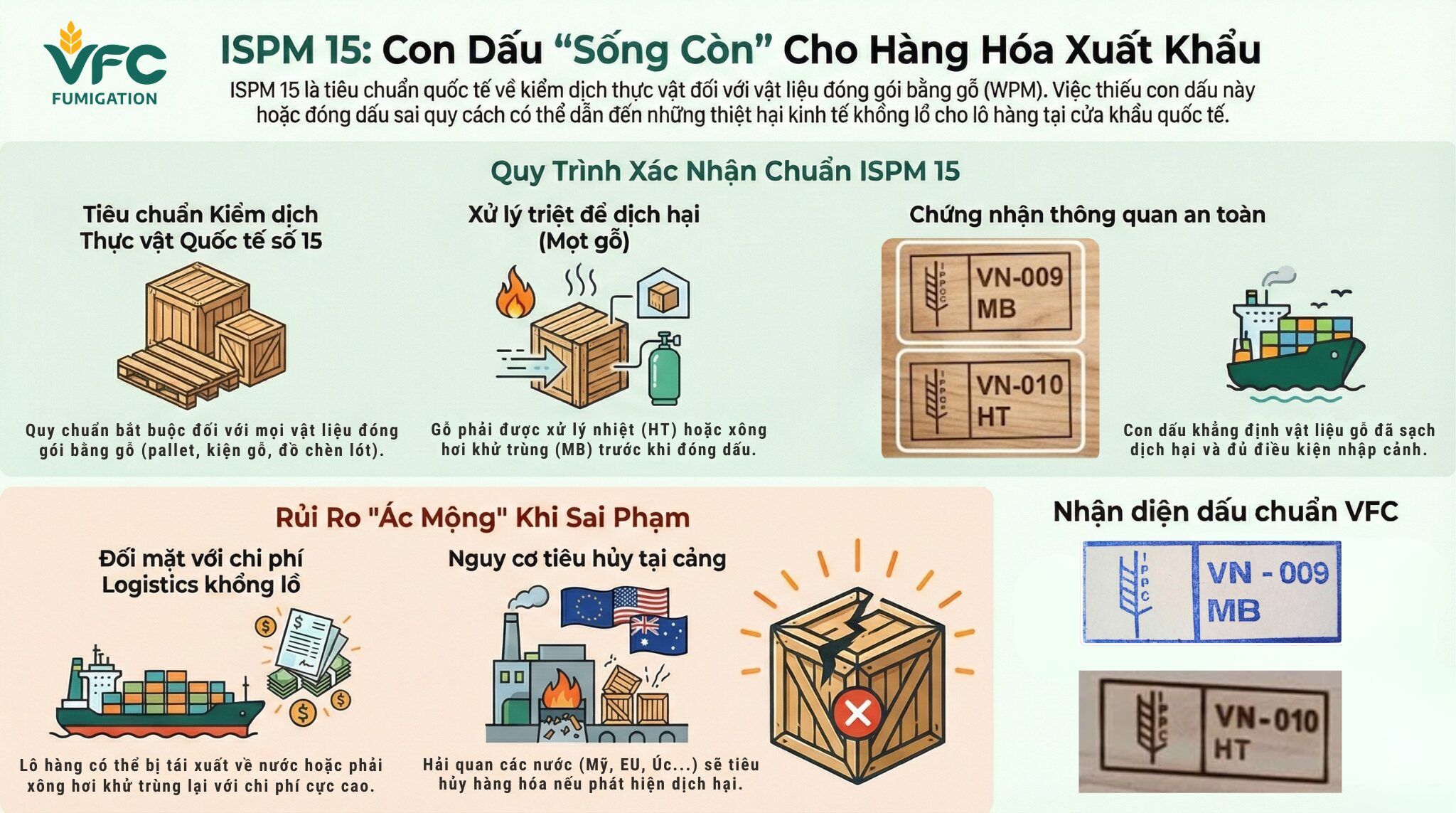
The mark must fully display all required components:
- IPPC Symbol: The international standard ear of wheat design.
- Country Code: VN (Vietnam).
- Treatment Provider Code: The code assigned by the phytosanitary authority (e.g., VN-009 for Methyl Bromide fumigation or VN-010 for the Heat Treatment (HT) method of VFC Fumigation).
- Treatment Method: MB (Fumigation with Methyl Bromide) or HT (Heat Treatment).
If pallets, crates, boxes, or dunnage are untreated, have blurred/incorrect marks, or require treatment prior to loading cargo, businesses can refer to the ISPM 15 treatment service for pallets and wooden crates.
3. Frequently Asked Questions Regarding US-Bound Cargo Requiring Fumigation
Q1: Do industrial goods packed in cardboard cartons and plastic pallets fall under the category of US-bound goods requiring fumigation?
Answer: Goods packaged in plastic, cardboard, or metal without the use of WPM are generally not subject to mandatory fumigation under ISPM 15 standards. However, pests—especially life stages that are difficult to detect with the naked eye—may still be present within the container. Performing container fumigation helps thoroughly control pre-existing pests and insects inside the container, minimizing the risk of pest detection at the port of destination.
Q2: Under which standard must Wood Packaging Material (WPM) destined for the US be treated?
Answer: 100% compliance with the international standard ISPM 15 is mandatory. The wood must be debarked, treated with Methyl Bromide (CH3Br) or Heat Treatment (HT), and then clearly stamped with a valid ISPM 15 mark on at least two opposite sides.
Q3: Which fumigant is commonly used for US-bound cargo, and what is the minimum exposure time?
Answer: Methyl Bromide (CH3Br) is the most commonly used active substance for goods and wood packaging material (WPM) exported to the US. When performing fumigation with Methyl Bromide, the mandatory minimum exposure time under technical regulations is 24 hours.
4. Register for Consultation and Receive a Quotation for US-Bound Cargo Fumigation from VFC Fumigation

An experienced technical team in the fFumigation industry
Do not let the risk of container re-export affect your costs and business reputation!
Ensure that your enterprise's entire shipment exported to the US strictly complies with quarantine regulations or the international ISPM 15 standard for wood packaging materials.
For technical consultation, container inspection, or to receive the fastest quotation for US-bound export fumigation services, please contact VFC Fumigation via the following channels:
- Hotline 24/7: 0914773300
- Email: contact@fumigation.vn