





Category:
Fumigation for Australia/New Zealand-bound cargo
Fumigation by Market

Published date:
28/07/2026
Share




Trade and economic cooperation between Vietnam and Australia have been growing strongly, driving increasing demand for exports to this market. However, Australia is known as one of the countries with the strictest biosecurity policies in the world, directly managed by the Department of Agriculture, Fisheries and Forestry of Australia (DAFF) to protect its native ecosystem from the risk of invasive organisms.
For this reason, fumigation for cargo exported to Australia is not merely an administrative procedure, but a mandatory condition for customs clearance. Proactively understanding quarantine treatment regulations helps businesses avoid the risk of penalties, costly storage charges, or, worse, forced destruction or re-export of goods at the destination port.
1. Why is fumigation for cargo exported to Australia mandatory under quarantine regulations?
Fumigation for cargo exported to Australia is a legal requirement imposed by the government on export shipments that may carry pathogens or harmful insects. Understanding the basis of these biosecurity policies helps cargo owners and logistics businesses become more proactive in preparing documentation and treatment procedures at the yard.
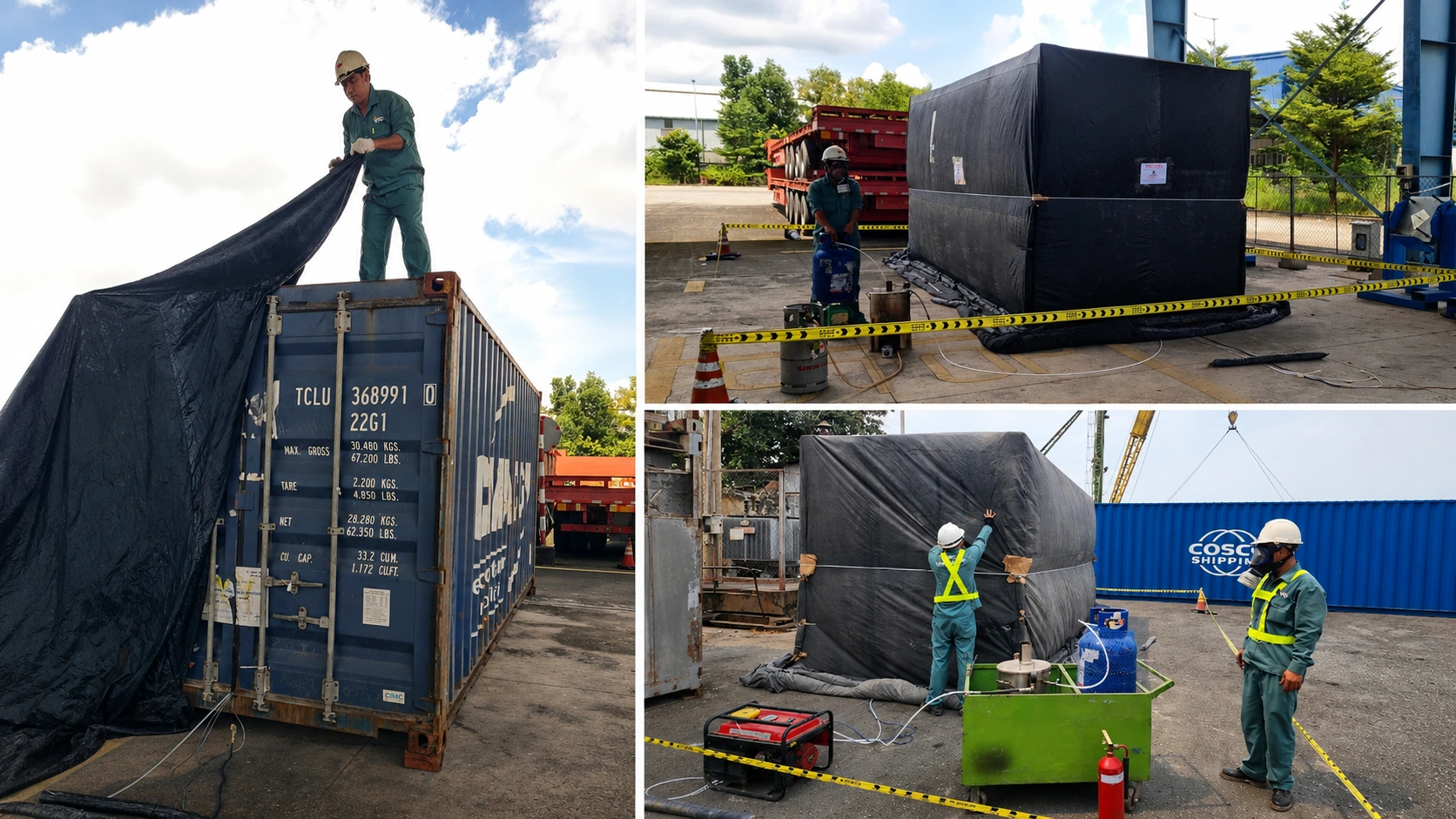
Why cargo exported to Australia must be fumigated
1.1 Australia’s unique ecosystem and strict protection policy from DAFF
Australia is both a continent and an island nation with a highly unique native flora and fauna system that is vulnerable to external pathogens. The country’s quarantine authority, formerly known as AQIS and now the Department of Agriculture, Fisheries and Forestry of Australia (DAFF), has established strict technical barriers for all imported goods.
Live pests, from insects and mold to pathogens, appearing on goods or hiding in dunnage materials can cause serious degradation to Australia’s agricultural and forestry sectors if they are not thoroughly treated before arrival.
1.2 Serious consequences of failing to conduct fumigation for Australia-Bound cargo properly
When a shipment arrives at port and live pests are detected, or when the fumigation certificate does not meet the required standards, the financial and reputational consequences for businesses can be significant:
- High storage charges: Containers may be held in the port quarantine area, causing demurrage and detention charges to increase continuously each day.
- Retreatment costs exceeding the budget: If corrective treatment is permitted, the shipment must be retreated at the Australian port at a cost many times higher than the original treatment cost in Vietnam.
- Risk of re-export or total destruction: If the shipment does not meet AFAS standards or Australia’s biosecurity requirements, the Australian authority may order compulsory re-export or destruction.
To proactively control the process and avoid being placed in a passive situation at the destination port, businesses should refer to detailed notes on fumigation for cargo exported to Australia in order to tightly control packing and select a qualified service provider.
2. Types of goods requiring fumigation for export to Australia and quarantine guidance
Each group of goods imported into Australia is subject to specific biosecurity management and treatment measures set by DAFF. Correctly classifying the product group helps businesses determine the appropriate fumigation method for Australia-bound cargo, thereby preparing an optimal quarantine plan and saving customs clearance time.
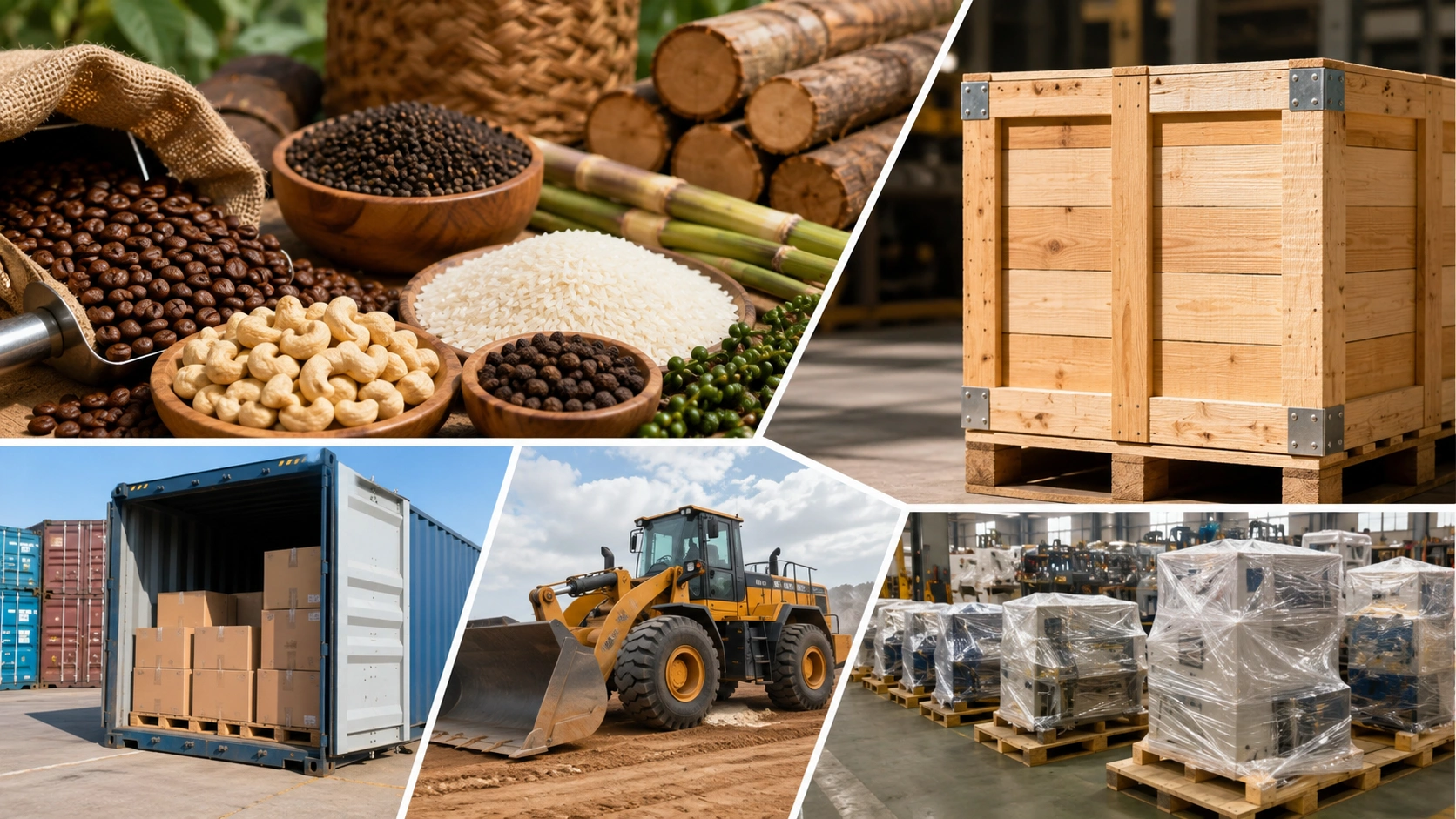
Types of goods requiring fumigation when exported to Australia
2.1 Agricultural products, food products, and organic-origin materials
Vietnam has strong advantages in key agricultural exports to Australia such as rice, cashew nuts, coffee, pepper, bamboo and rattan products, raw medicinal herbs, and animal feed preparations. However, due to their natural origin, these goods also carry a high potential risk of insects, pathogens, or invasive mold. Businesses can also cross-check common types of goods that often require fumigation before export to preliminarily determine requirements based on the nature of the goods, packaging materials, and importing market.
Australian authorities require all organic-origin goods to be completely cleaned of soil, sand, and weed seeds, and to undergo a strict fumigation process before being loaded onto the vessel. A phytosanitary certificate and valid insect treatment certificate are prerequisites for agricultural shipments to be permitted to enter port.
2.2 Wood and wood products
For the Australian market, the treatment of wood and wood products, as well as containerized cargo, requires compliance with phytosanitary regulations and AFAS treatment standards. When Methyl Bromide fumigation is conducted, the service provider must strictly comply with technical regulations.
2.3 Industrial goods, machinery, and equipment exported to Australia
For industrial goods such as new or used machinery, mechanical equipment, transport vehicles, or consumer goods packed in cartons, quarantine requirements mainly focus on surface cleanliness and the risk of pest insects hiding inside.
In particular, used equipment or machinery with surfaces that have been in direct contact with soil or mud will be inspected very carefully. Australia’s Department of Agriculture requires these items to be completely cleaned and fumigated to prevent invasive organisms before being packed into containers.
For machinery, industrial structures, or oversized cargo, the treatment plan usually needs to be designed according to the actual structure of the shipment. Businesses can refer to fumigation projects implemented by VFC to understand how surveys, technical organization, and document control are carried out for each case.
Để có cái nhìn tổng quan và chuẩn bị tốt nhất cho hoạt động giao thương, doanh nghiệp nên tham khảo thêm các nội dung sau đây:
- Danh sách các mặt hàng xuất khẩu sang Úc nhiều nhất và điều kiện kiểm dịch đi kèm
- Hướng dẫn chi tiết thủ tục và quy trình khử trùng hàng hóa xuất khẩu sang Úc từ A-Z
3. Mandatory standards in the fumigation process for cargo exported to Australia
Australia has established very strict technical barriers for biosecurity control. For goods to clear smoothly at destination ports, fumigation for Australia-bound cargo must not stop at field treatment operations; it must strictly comply with international quarantine standards issued by the Department of Agriculture, Fisheries and Forestry of Australia (DAFF).
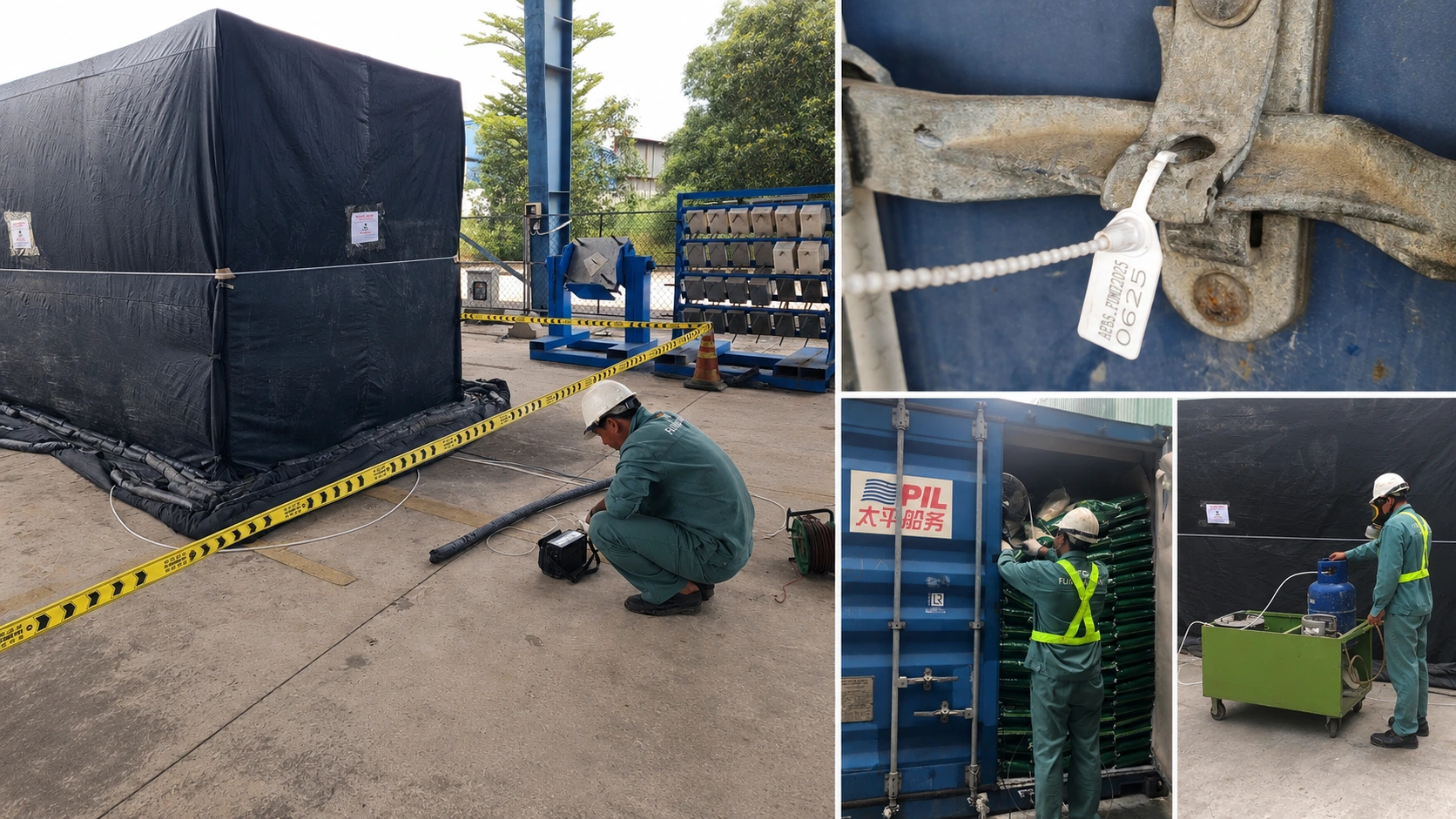
Mandatory standards in the fumigation process for cargo exported to Australia
3.1 AFAS standard applied to fumigation for cargo exported to Australia
AFAS(the Australian Fumigation Accreditation Scheme) is the fumigation accreditation system developed and managed by the Australian Government. Under current regulations, all shipments exported from Vietnam to Australia under AFAS must be fumigated with Methyl Bromide to eliminate pests. Treatment providers must be listed in the DAFF-approved register and operate under the management of the Plant Protection Department of Vietnam.
The policy of the Australian Department of Agriculture is very clear: certificates issued by providers outside this system will be completely rejected. When carrying out pest eradication using Methyl Bromide, cargo owners and logistics companies should proactively check the licensing conditions and the list of AFAS-approved providers for Australia-bound cargo in order to select the right treatment partner and avoid the risk of certificate rejection upon arrival.
3.2 BMSB-AusTreat regulations for export cargo treatment to Australia
In addition to regular quarantine standards, Australia also applies a special mechanism to prevent the Brown Marmorated Stink Bug (BMSB), an invasive pest that can severely damage its agricultural sector. This regulation is mandatory for high-risk goods such as agricultural products, handicrafts, machinery, equipment, containerized cargo, or materials from high-risk countries transported during the BMSB risk season, which usually lasts from September to April of the following year.
During this peak season, all regulated shipments must undergo treatment in accordance with the AusTreat requirements designated by Australia. Exporters of industrial goods and machinery need to proactively update and strictly comply with BMSB-AusTreat treatment regulations to ensure containers are allowed to be unloaded and cleared smoothly, avoiding the risk of vessels being denied entry or forced to turn back.
In practice, BMSB treatment requirements can become much more complex for machinery, equipment, or large industrial structures because insects may hide in many locations. Businesses can refer to the VFC Fumigation project on BMSB treatment for wind turbine blades exported to Australia to better understand the technical solution for oversized and overweight cargo.
4. AFAS-compliant fumigation method for cargo exported to Australia
To meet the strict technical barriers set by DAFF, the only and most commonly applied solution for fumigation of cargo exported to Australia today is Methyl Bromide (CH₃Br) fumigation in compliance with AFAS standards. This method is applied consistently to goods such as agricultural products and industrial cargo, as well as wood and wood products such as pallets accompanying containers.
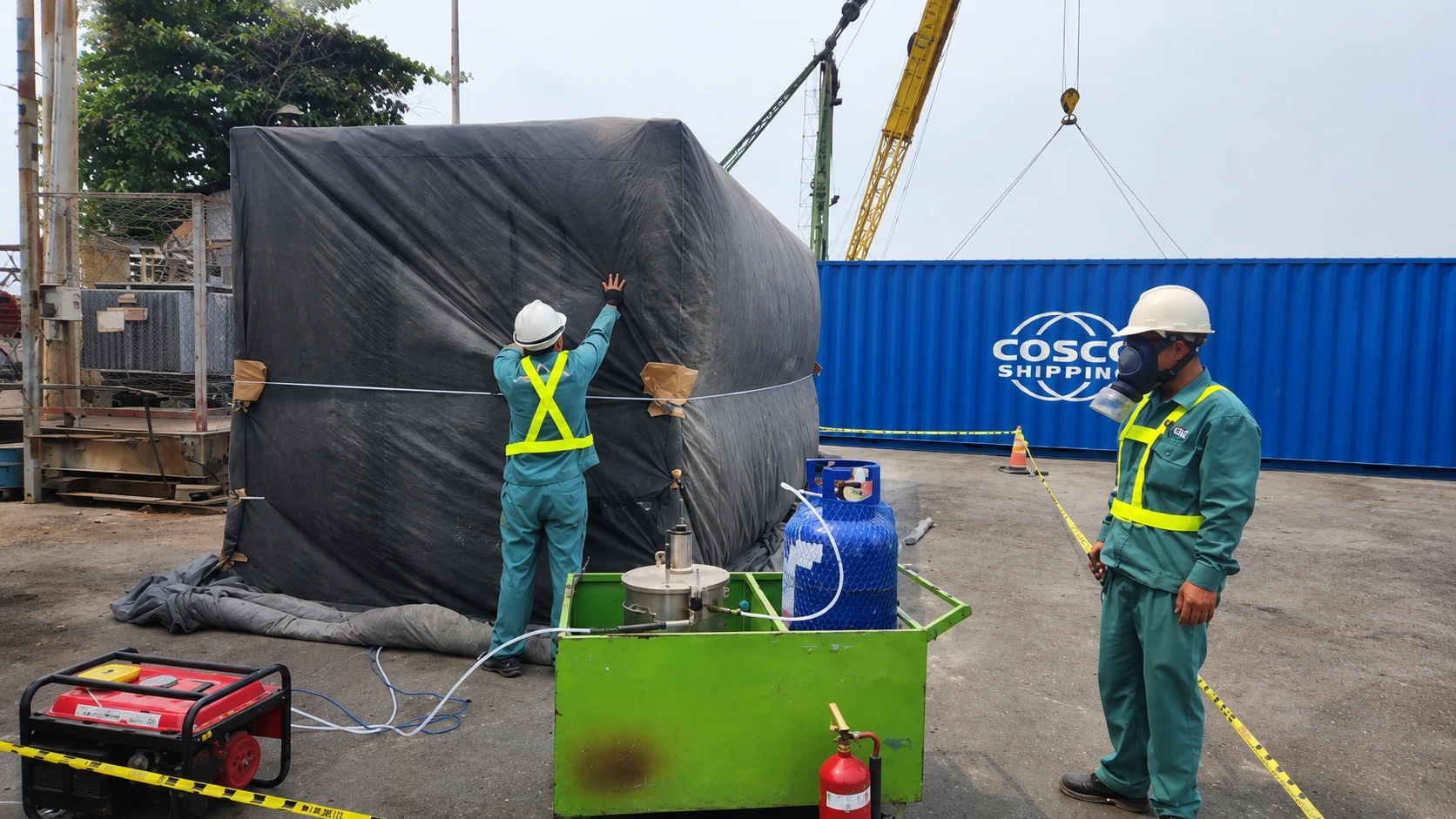
AFAS-compliant fumigation method for cargo exported to Australia
Methyl Bromide has extremely deep penetration capability and can eliminate live pests at all development stages, from eggs and larvae to pupae and adults, that may be hidden inside cargo. When fumigation is conducted according to AFAS standards, the treatment process must meet the following core technical requirements:
- Dosage calculation according to temperature: The fumigant dosage must be accurately calculated based on the actual ambient temperature at the time of treatment, in accordance with DAFF’s standard dosage chart.
- Ensuring a gas-tight structure: The container or fumigation area must be properly sealed to prevent fumigant loss and ensure the required exposure period is maintained.
- Control through concentration monitoring: The technical team conducts concentration monitoring in accordance with AFAS standards. At the end of fumigation, the concentration reading must be equal to or higher than the minimum standard to ensure complete elimination of live pests and serve as the basis for issuing the clearance certificate.
The steps for arranging fumigant delivery lines, concentration monitoring lines, gas circulation fans, container sealing, and leak checks are presented in detail in the Methyl Bromide container fumigation process.
5. Technical fumigation process for cargo exported to Australia at ports
The fumigation process for Australia-bound cargo at port yards requires precision in both timing and technical operations. Full compliance with standardized steps not only determines whether an AFAS certificate can be issued, but also ensures occupational safety and preserves the integrity of the export shipment.
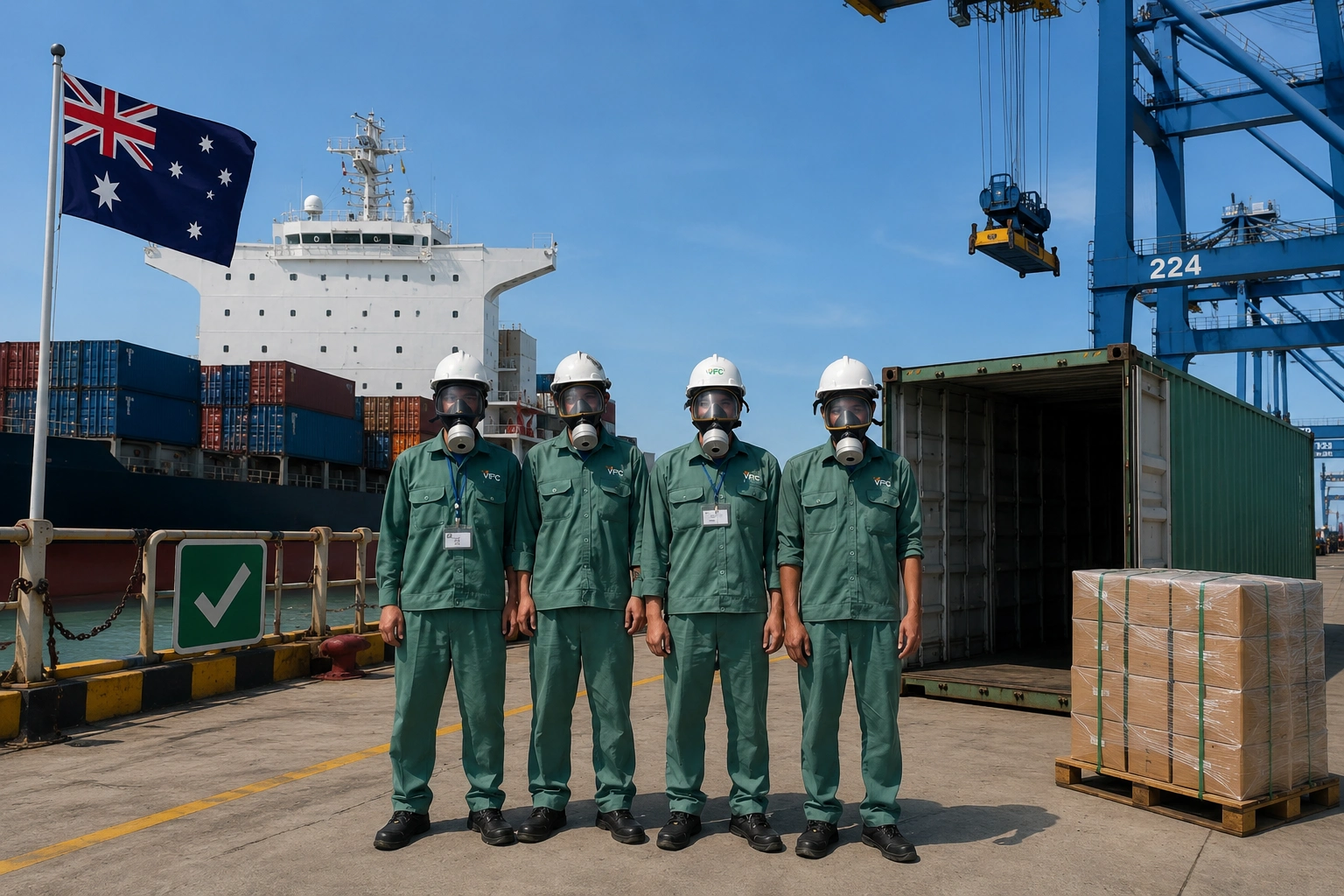
Procedures and process for fumigating cargo exported to Australia
5.1 Site preparation and standard fumigation timing for Australia-bound cargo
After receiving a customer request, VFC personnel conduct an on-site survey to develop a suitable treatment plan for each fumigation structure.
- Site requirements: The fumigation structure, whether a cargo lot or container, must be placed on a gas-tight surface such as a flat concrete or asphalt yard that is free from cracks or uneven areas, in order to prevent fumigant loss during the exposure period.
- Standard timeline: Fumigation must be carried out at least 48 hours before the shipping line’s Closing Time. This timeframe is mandatory to ensure sufficient exposure time and safe ventilation before the container is loaded onto the vessel.
5.2 Fumigation implementation
After the fumigation structure has been identified, VFC technicians arrive on site and carry out the fumigation process, including setting up the fumigation area, installing fumigant delivery lines, concentration monitoring lines, internal gas circulation fans, and sealing the structure with specialized tarpaulins before introducing the fumigant.
5.3 Exposure period
After fumigant application, concentration measurements are taken to determine the exposure period.
Standard exposure period: The minimum standard exposure period is 24 hours under AFAS regulations, or 48 hours depending on customer requirements. This may be extended depending on the actual fumigant concentration monitoring results for each shipment.
5.4 Ventilation and handover of the container or cargo lot
After 24 hours of exposure, if the measured concentration is equal to or above the AFAS standard, ventilation will be conducted. When the fumigant concentration reaches the safe TLV threshold, VFC will hand over the container to the dispatcher or customer.
If the business already has information about the commodity, number of containers, port of departure, and Closing Time, VFC can use these data points to propose a suitable treatment schedule. The implementation scope is presented on the AFAS/BMSB container fumigation service page for cargo exported to Australia..
6. Requirements for a valid fumigation certificate for cargo exported to Australia
The Fumigation Certificate is considered the “passport” that determines whether a shipment is allowed to be unloaded and cleared at an Australian port. Even a small formatting error or a discrepancy in technical parameters on the certificate may cause the entire container to be delayed for quarantine inspection.
6.1 Mandatory information that must be accurately displayed on the certificate
Australian authorities apply strict document inspection standards. A valid fumigation certificate for Australia-bound cargo must fully and accurately display the following information fields:
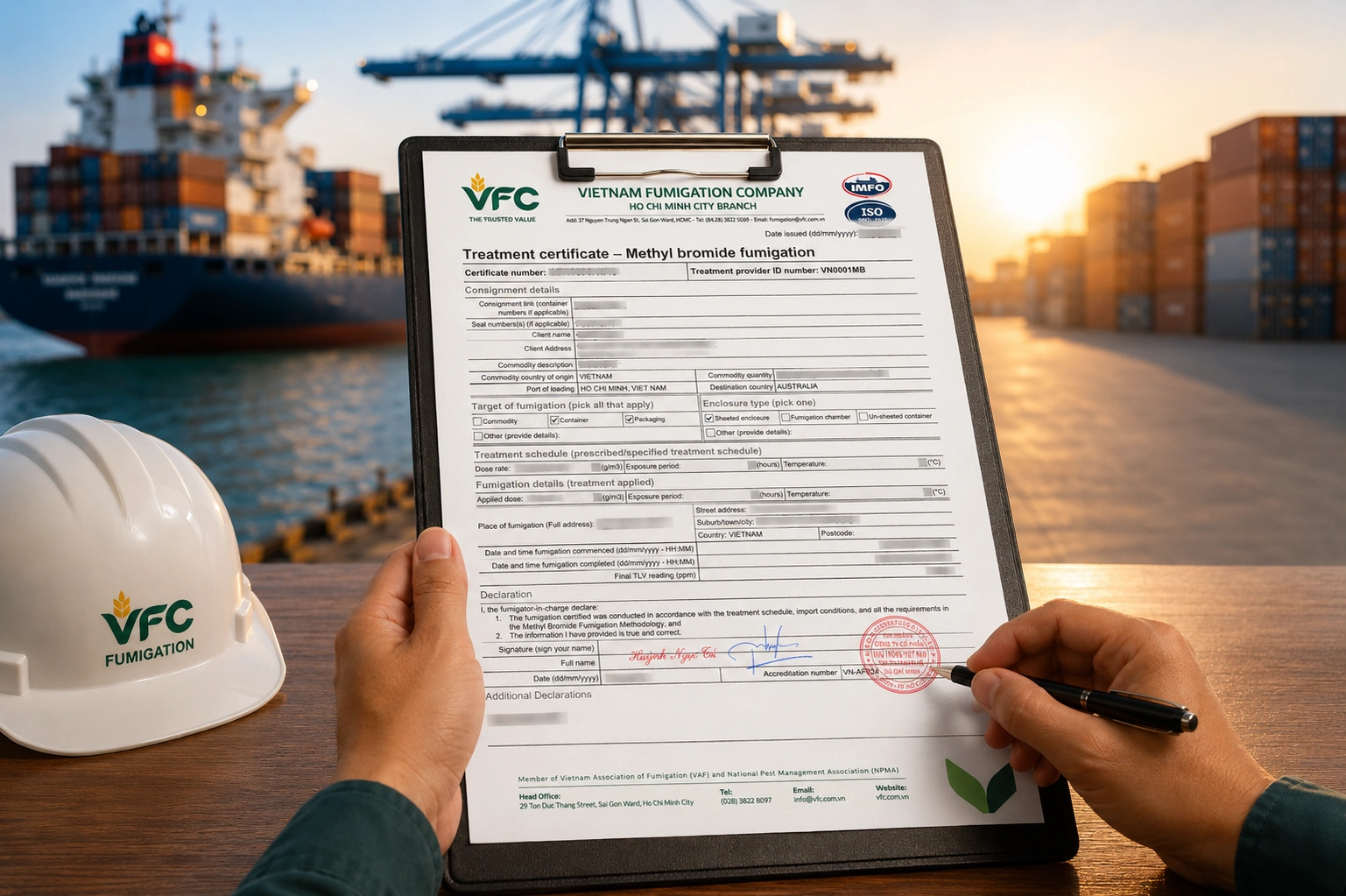
Required data fields on the fumigation certificate
- Service provider information: A valid AFAS registration number issued by the Australian Department of Agriculture to the service provider. VFC’s code is VN0001MB.
- Treatment method information: For current AFAS programs in Vietnam, Methyl Bromide is the method accepted by DAFF for issuing AFAS certificates.
- Technical parameters: The minimum temperature recorded during the exposure period, fumigation start time, and fumigation end time.
- Shipment identification information: Container number, customs or shipping line seal number, commodity name, and number of packages or accompanying pallets/dunnage.
In addition to recording accurate data, businesses also need to ensure that the certificate can be cross-checked when requested by the buyer, forwarder, or overseas agent. Applying a certificate verification and traceability process helps reduce the risk of using the wrong file or detecting discrepancies too late.
6.2 Common errors that cause fumigation certificates for Australia-Bound cargo to be rejected
Based on DAFF’s biosecurity control standards, AFAS certificates or Australia-bound shipments may be rejected if they fall into the following three common error groups:
- Information discrepancies between the certificate and bill of lading: Identification data such as container number, shipper/consignee name, or cargo description on the certificate does not match the bill of lading or other documents.
- Incorrect technical requirements: The calculated fumigant dosage does not match the actual ambient temperature, the exposure period is insufficient, or the minimum concentration reading at the end of fumigation is lower than the AFAS standard.
- Live pests remain in the cargo: The tarpaulin-covered structure or container is not sealed properly, causing fumigant leakage. This may affect environmental safety in the surrounding area and fail to meet the required concentration standard, resulting in treatment failure.
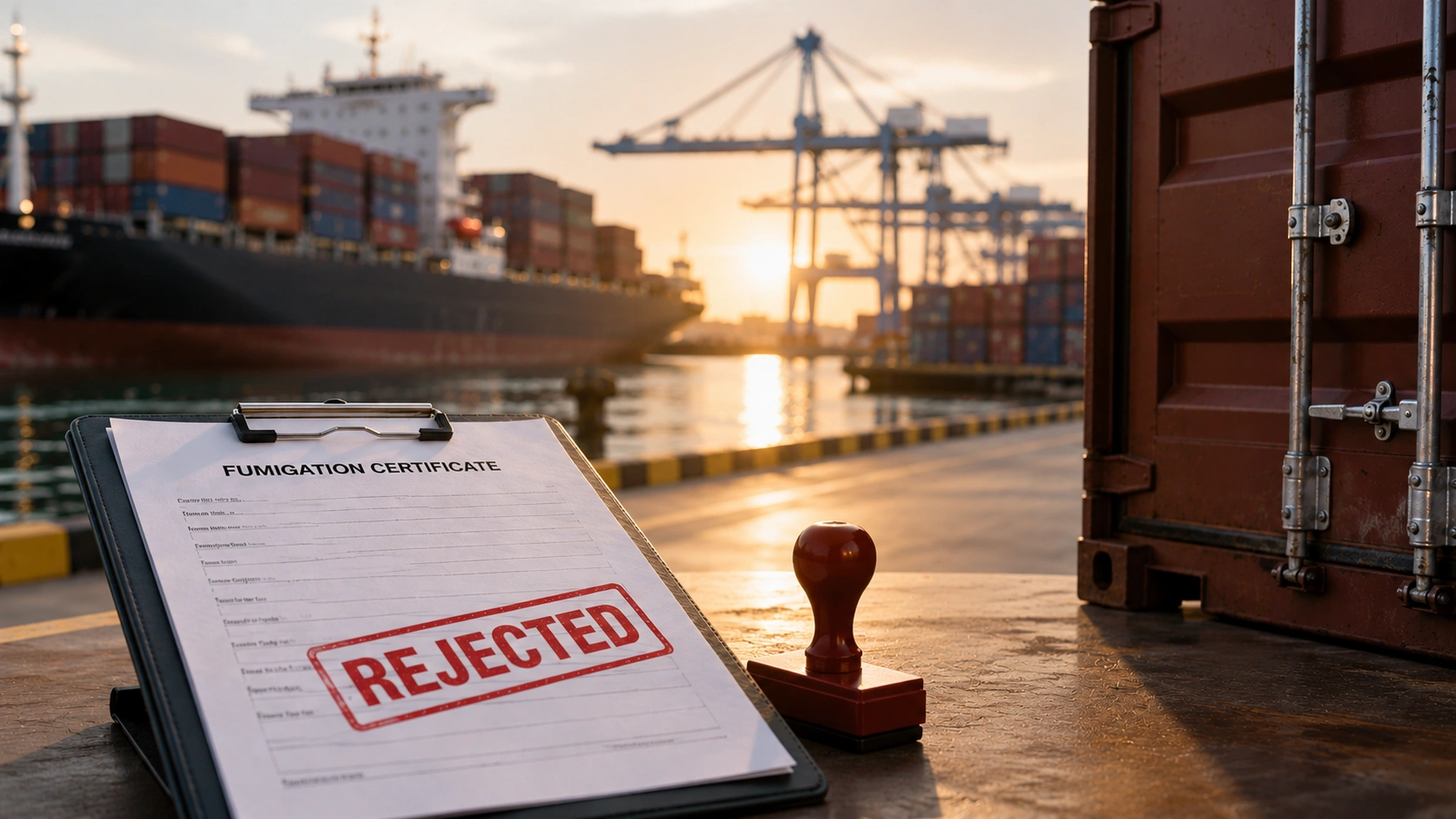
Errors that cause a fumigation certificate to be rejected
Incorrect treatment or documentation discrepancies may expose the shipment to significant corrective costs at Australian ports. Businesses need to carefully review every technical parameter and document detail before issuing the official certificate.
7. Latest quotation and cost of fumigation for cargo exported to Australia
The cost of quarantine treatment for goods exported to Australia is not fixed. It depends on many actual technical factors at the port yard. Understanding the criteria that make up the cost helps cargo owners and logistics providers optimize their export budget more effectively.
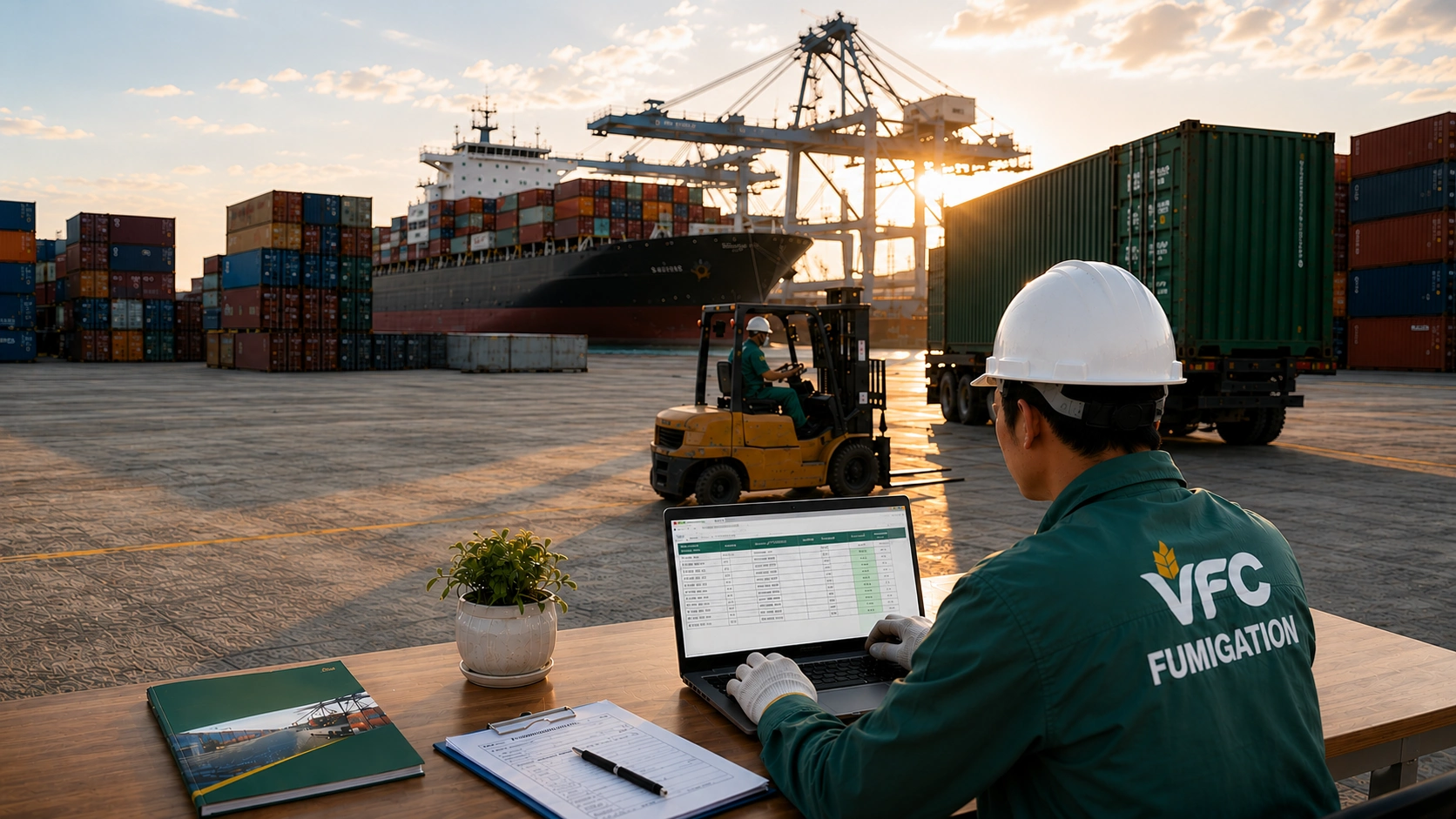
Get an official quotation from VFC FUMIGATION today
7.1 Factors that determine the cost of fumigation for cargo exported to Australia
The service cost for each export shipment to Australia is calculated based on the following main parameters:
- Cargo scale and packing method: 20ft container, 40ft container, 40HC container, or LCL cargo.
- Nature of the cargo: Each type of cargo requires a different treatment plan.
- Treatment location: Direct fumigation at major port yards such as Cat Lai, Hai Phong, or Da Nang, or treatment at the business’s own warehouse.
7.2 Receiving the mostoptimized quotation for fumigation services for Australia-bound cargo
Because service prices may vary depending on commodity type, BMSB seasonal characteristics, and updated DAFF regulations, applying a fixed price often does not accurately reflect the cost for each specific shipment.
To receive the most cost-effective and accurate treatment plan for your container, customers can refer to the detailed pricing criteria on the service page for container fumigation for cargo exported to Australia, or contact the specialist team directly for a customized quotation for each shipment.
Quick quotation request: Send us your shipment information, including commodity, number of containers, port of departure, and destination port, so VFC Fumigation can provide a detailed cost estimate as quickly as possible.
8. Trusted, standard-compliant fumigation service for cargo exported to Australia by VFC Fumigation
8.1 VFC Fumigation’s outstanding capabilities in quarantine treatment
With more than 50 years of experience accompanying thousands of exporting businesses, VFC Fumigation is proud to be a trusted provider in Vietnam with full operating licenses, an official AFAS code, and AusTreat capability certification licensed by the Australian Government in coordination with the Plant Protection Department of Vietnam. Customers can also follow VFC’s fumigation industry activities and news to continuously update the latest quarantine developments.

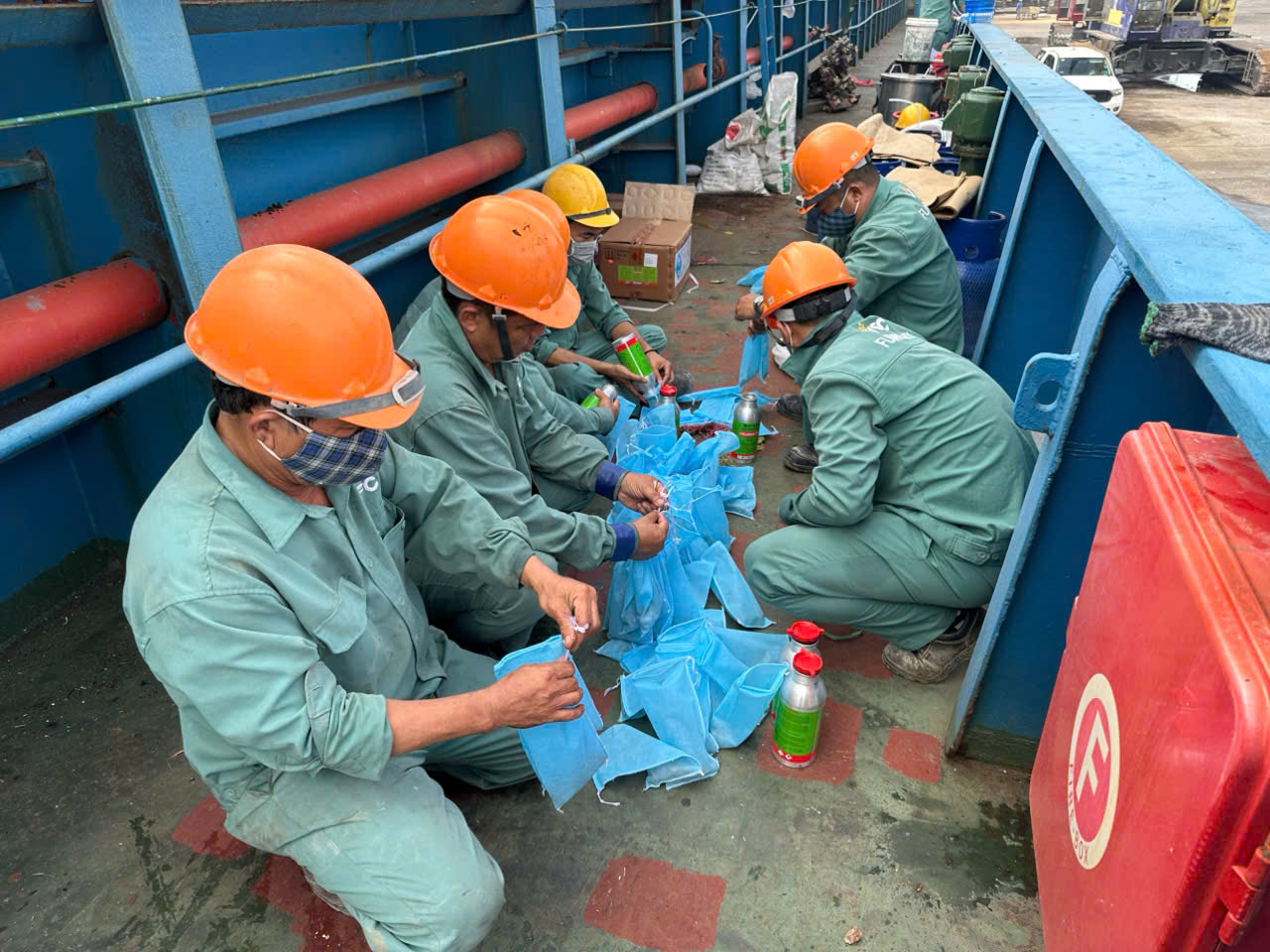
An experienced technical team in the fFumigation industry
In addition, VFC has modern equipment systems, imported fumigants that meet international standards, and a strict technical control process, ensuring compliance with Australia’s most stringent quarantine barriers.
8.2 VFC Fumigation’s service quality commitment for cargo exported to Australia
- Experienced technical team: Management personnel are professionally trained by DAFF and certified to carry out fumigation according to AFAS standards. The workforce is trained by quarantine authorities and issued fumigation operator cards, while VFC technicians have in-depth operational experience at major seaports nationwide, including Cat Lai, Hai Phong, Da Nang, Quy Nhon, and others.
- Fast issuance of valid certificates: VFC is committed to delivering accurate, on-time AFAS-standard certificates so cargo owners can complete export documentation promptly.
- Safe and fast customs clearance: Your shipment will minimize potential risks and support fast customs clearance at Australian seaports.
CONTACT HOTLINE: 0914.773.300 or email contact@fumigation.vn for consultation on a detailed technical plan and a quotation for AFAS/BMSB-standard container fumigation for Australia-bound cargo directly implemented by VFC.
Fumigation for cargo exported to Australia is a mandatory quarantine requirement that demands absolute precision, from field technical operations to the legal validity of the fumigation certificate. Even a minor error can disrupt the entire supply chain and cause substantial costs for businesses. Choosing an officially recognized and trusted partner such as VFC Fumigation is the safest and most effective solution to protect the entire supply chain, helping Vietnamese goods confidently reach the Australian market.

Featured Knowledge


Related Knowledge