





Category:
Fumigation by Industry Sector

Published date:
13/07/2026
Share




Warehouse, silo, and vessel hold fumigation projects have technical requirements that differ significantly from container treatment. As volume increases, the treatment space becomes more complex, the cargo mass becomes larger, and operating conditions change. Therefore, the fumigation plan must be developed separately based on the results of an actual site survey. This provides the basis for selecting the appropriate sealing method, treatment system layout, exposure monitoring process, and ventilation plan for each project.
Large-scale fumigation is not simply about increasing the fumigant dosage
Containers have relatively uniform dimensions and structures, which means factors such as volume, doors, ventilation openings, and sealing points can be identified quite clearly. When moving to warehouses, silos, or vessel holds, the treatment scope may be many times larger and involve a wide range of factors related to building structure, technical systems, and cargo arrangement.
A warehouse may have multiple doors, junction gaps, ventilation systems, and technical pipelines. A silo often has significant height, deep cargo mass, and connections to loading and discharge systems. A vessel hold is divided into cargo compartments with different sizes, depths, and access conditions. These characteristics mean that each fumigation scope requires a suitable treatment plan instead of applying the container process unchanged.
Before developing a fumigation plan, it is necessary to survey the type and quantity of cargo, packing method, treatment volume, cargo arrangement, storage structure, and related electrical, drainage, and ventilation systems.
The larger the scale, the more complex the fumigant distribution challenge
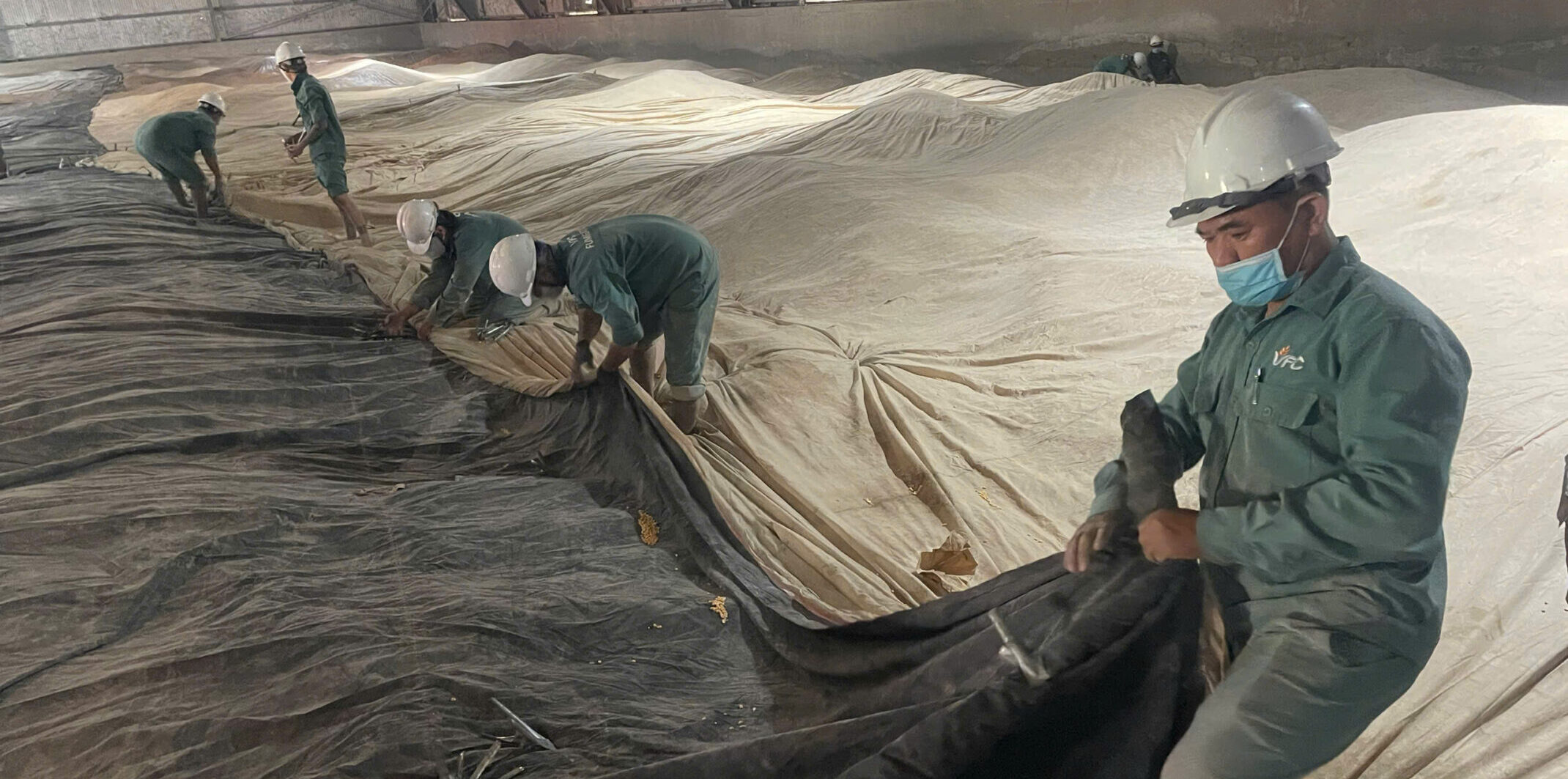
Khử trùng kho
The effectiveness of a fumigation project depends on the ability to deliver the fumigant to the required treatment points and maintain suitable conditions throughout the exposure period. When the treatment scope is large, the distribution distance increases, while the structure and cargo mass may create areas that are harder to reach.
Cargo depth, stacking density, packaging type, and gaps between packages all need to be considered when designing the treatment plan. Two warehouses with the same floor area may require completely different layouts if one stores bagged cargo on pallets and the other stores bulk cargo. For silos or deep cargo masses, the challenge is not only the fumigant quantity but also how to support distribution within the treatment scope.
Therefore, the technical process requires that the fumigant placement layout or fumigant delivery system be developed based on the characteristics of the fumigant, storage structure, cargo arrangement, cargo properties, and treatment volume. The layout should support appropriate fumigant distribution within the treatment scope while also facilitating operation, sealing, and post-fumigation ventilation.
Sealing capability becomes an important technical factor
The fumigation scope must maintain suitable tightness throughout the treatment period. For containers, the points that need to be checked are usually concentrated around doors, ventilation openings, and structural gaps. For warehouses, silos, or vessel holds, the number and characteristics of points requiring control are much more diverse.
A warehouse may have rolling doors, entry doors, roof gaps, electrical lines, and ventilation systems. A silo has loading lines, discharge lines, and fan systems. A vessel hold has hatch covers, ventilation systems, and multiple junction points within the vessel structure. Each of these points must be surveyed to determine the sealing plan before implementation.
QCVN 01-19:2010/BNNPTNT stipulates that the sealing method should be selected according to the storage structure, such as vessel holds, yards, or warehouses, and actual conditions. Gaps, ventilation systems, and related points must be handled appropriately. After completion, the tightness of the fumigation scope must be checked using specialized equipment.
Site survey is the foundation for developing a fumigation plan
Before a warehouse, silo, or vessel hold fumigation project, the technical team needs to clearly understand the treatment scope before selecting the implementation plan. The survey focuses on the structure, cargo characteristics, environmental conditions, sealing capability, surrounding area, and on-site operating conditions.
For cargo, factors such as commodity type, quantity, packing method, stacking specifications, and cargo mass depth need to be recorded. For the structure, the technical team needs to determine the volume, construction details, related systems, and any points that may affect sealing or fumigant distribution.
The survey results become input data for selecting the fumigant, determining dosage, defining the exposure period, and developing a suitable layout plan. This is also why the same commodity may require different technical plans when treated in a container, warehouse, silo, or vessel hold. Requirements for surveying and preparing survey records are also specified in the fumigation technical process. The ability to survey and design a plan before implementation is also an important criterion when businesses evaluate service providers.
See more: Criteria for selecting a fumigation provider for cargo and logistics projects.
The J-System must be selected according to actual project conditions
For some large-scale fumigation scopes, the J-System recirculation system can be used to support the distribution of fumigants. The effectiveness of the J-System is linked to the structure of the treatment area, cargo characteristics and layout, as well as the overall technical plan. Therefore, the use of the J-System should be determined after a site survey rather than being applied by default to all warehouses, silos, or vessel holds.
This approach is especially important for projects involving large cargo volumes. Technology delivers value when it is placed correctly within a plan that has already considered the fumigant pathway, cargo structure, and actual operating conditions.
Large-scale fumigation project implementation process at VFC Fumigation
For warehouse, silo, vessel hold, and other large-scale treatment scopes, VFC Fumigation implements projects through a sequence from survey to acceptance. Each step is developed based on the specific conditions of the structure and cargo instead of using a fixed configuration for every project.
Step 1 – Survey and current-condition assessment: The technical team surveys the treatment scope, structure, commodity type, arrangement, environmental conditions, surrounding area, and related systems. This information is compiled to determine the project’s technical requirements.
Step 2 – Fumigation plan development: Based on the survey results, VFC Fumigation determines the sealing method, fumigant, dosage, exposure period, fumigant placement or delivery system layout, gas circulation plan, and concentration monitoring points suitable for the treatment scope.
Step 3 – On-site implementation: The technical team prepares the fumigation scope, carries out sealing, sets up equipment, checks conditions before treatment, and implements the approved plan. Safety control and warning monitoring are maintained throughout the process.
Step 4 – Exposure, concentration monitoring, and safety control: During the exposure period, the treatment scope is guarded and monitored according to technical requirements. Monitoring points are arranged based on the structure of the fumigation scope to provide data for evaluating the treatment process.
Step 5 – Ventilation and acceptance: After the exposure period ends, the fumigation scope is ventilated using appropriate methods and equipment. Treatment results are checked, accepted, and documented in accordance with regulations. National technical procedures also state that ventilation depends on the treatment volume, equipment used, fumigant quantity, external conditions, and cargo characteristics.
For goods that subsequently enter the export supply chain, acceptance data and certificates also need to be consistent with shipment information. See more on export cargo fumigation from cargo treatment to data management and certificates.
A fumigation provider’s capability is reflected from the plan selection stage
In large-scale projects, equipment and technology are only part of the solution. The technical value lies in the ability to accurately survey the actual conditions, identify influencing factors, and design a plan suitable for each treatment structure.
A technology suitable for silos may not be deployed in the same way for ship holds. An effective solution for bulk cargo warehouses also needs adjustment when applied to bagged or palletized storage warehouses. It is precisely these differences in structure and cargo that make initial evaluation capacity a critical factor for the entire project. Businesses reviewing suppliers for warehouses or silos can refer to the summary of warehouse fumigation companies in Vietnam to compare service scopes and execution capacities.
VFC Fumigation is positioned in the field of high-technical fumigation for import-export supply chains and large-scale cargo storage, with treatment scopes including containers, warehouses, silos, and cargo vessels. Implementation experience, together with specialized methods and equipment, provides the foundation for VFC Fumigation to develop plans according to the actual conditions of each project.
Survey correctly to choose the right plan from the beginning
Large-scale fumigation is a combined challenge involving structure, treatment volume, cargo characteristics, sealing capability, fumigant distribution plan, operating time, and safety requirements. A change in any one of these factors may require adjustments to the entire plan.
For warehouses, silos, or vessel holds, a thorough survey before implementation gives businesses a basis to choose the right plan from the beginning, while also improving proactivity in operational planning and coordination among relevant parties.
VFC Fumigation provides survey and fumigation plan development services for warehouses, silos, vessel holds, and large-scale cargo projects. The technical team directly assesses on-site conditions, cargo characteristics, and operating requirements to propose a suitable plan for each project. If goods stored or treated in large volumes will later be packed into containers for export, businesses need to separately assess the shipment’s quarantine requirements before loading and moving containers to the port.
You may be interested in: Warehouse and silo fumigation services
Featured Knowledge


Related Knowledge