





Published date:
07/10/2026
Share




When a container is intercepted with live Brown Marmorated Stink Bugs (BMSB) in Australia, the Department of Agriculture, Fisheries and Forestry (DAFF) will immediately place the consignment on biosecurity hold to conduct a risk assessment prior to considering release. This non-compliance triggers a cascade of compounding expenses for exporters-ranging from statutory inspection and onshore treatment fees to port storage surcharges and return ocean freight. Any delay during the verification process escalates total financial losses, dictated directly by the duration of detention and the specific remedial actions mandated by DAFF.
1. How Australian Biosecurity Authorities Manage BMSB-Intercepted Containers?
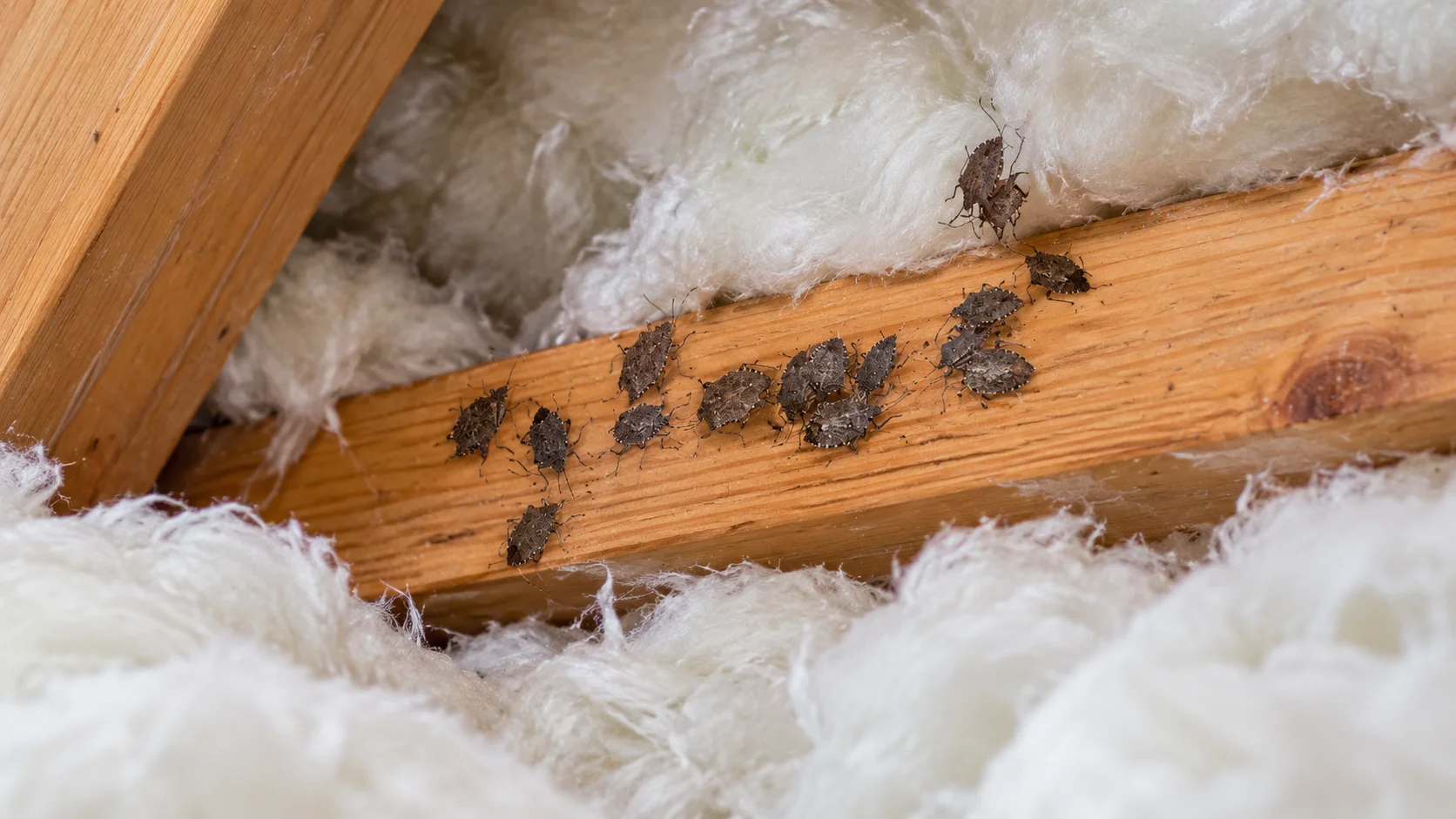
Containers intercepted with live BMSB may be held on biosecurity hold to determine appropriate intervention measures
DAFF maintains an uncompromised biosecurity surveillance framework to safeguard Australia’s native ecosystems and agricultural industries from BMSB incursions. Depending on the outcome of the risk assessment, an intercepted consignment typically undergoes the following statutory stages:
- Issuing a Biosecurity Direction (Hold): The container is immediately isolated at the container terminal berth. Unauthorized movement, unpacking, or release to the importer is strictly prohibited.
- Biosecurity Risk Assessment: DAFF biosecurity officers review import documentation, perform targeted physical inspections, and determine whether onshore remediation is legally and operationally permissible.
- Transfer to an Approved Arrangement (AA / QAP) Site: If detailed secondary inspection or onshore treatment is authorized, the container may be moved under customs bond and biosecurity escort to an authorized Quarantine Approved Premises (QAP) under DAFF direction.
- Final Regulatory Determination: Depending on the severity of live infestation and commodity classification, DAFF will issue a formal direction either permitting onshore remediation at an approved facility, ordering compulsory re-export of the container to the country of origin, or requiring destruction by deep burial or high-temperature incineration.
2. Potential Incurred Costs When a Container is Intercepted with BMSB in Australia
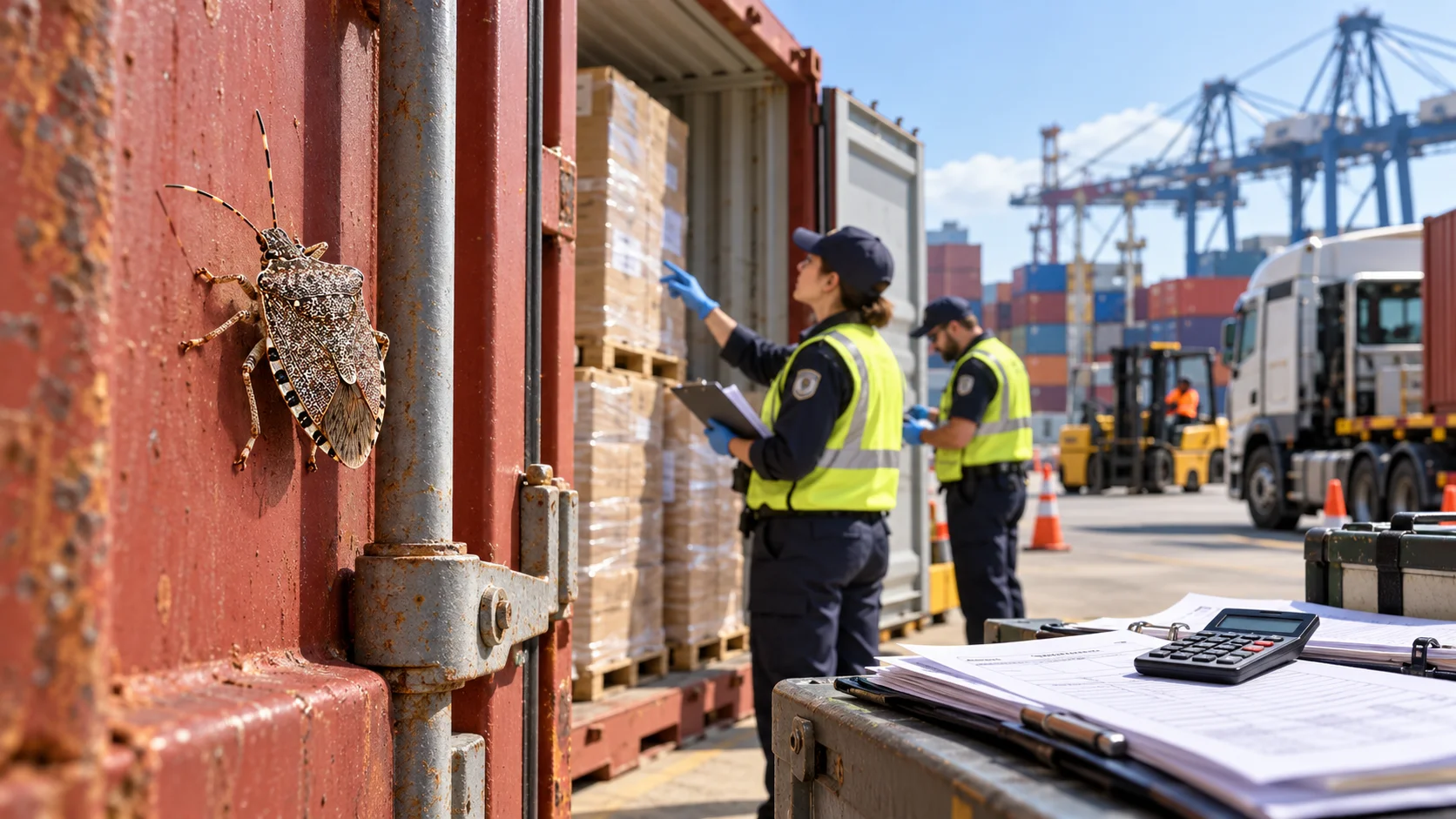
Potential incurred costs when a container is intercepted with BMSB in Australia
A biosecurity interception at the discharge port generates substantial ancillary expenses across multiple logistics stakeholders.
2.1. DAFF Statutory Inspection and Supervisory Fees
DAFF biosecurity officers execute both documentation auditing and on-site physical interventions. Exporters or their appointed customs brokers are billed directly under DAFF’s fee-for-service schedule:
- Lodgement and Document Assessment Fee: Standard statutory charges applied when a biosecurity incident is recorded within the department's import processing system.
- Field Inspection and Supervision Fees: Billed at DAFF's standard hourly fee-for-service rates for physical attendance, sampling, and supervision by biosecurity officers at the wharf or approved arrangement facility.
2.2. Demurrage, Detention, and Ancillary Logistics Expenses
Prolonged clearance suspensions while verifying live pest status rapidly inflate onshore logistics expenses:
- Demurrage (DEM): Port terminal and carrier storage fees accrued when a laden container exceeds its contracted free time on the wharf.
- Detention (DET): Carrier equipment usage surcharges applied when container equipment is detained beyond the agreed free-day allowance without being returned empty to the designated container park.
- Cartage, Shunting, and Lifting to Approved Facilities: Transport costs incurred transferring the sealed container from the wharf to an off-dock biosecurity site, including sideloader haulage surcharges and Lift-On/Lift-Off (LOLO) fees.
The majority of these incurred costs depend on container dwell time and coordination efficiency among stakeholders across the logistics chain. Therefore, 5 critical considerations for fumigating export goods to Australia focuses on upfront preparation steps, such as container condition, treatment specifications, vessel schedules, and documentation.
2.3. Onshore Remediation, Compulsory Re-Export, or Cargo Destruction
If DAFF permits onshore intervention at an approved facility, specialized treatment rates in Australia are substantially higher than pre-shipment offshore treatments in Vietnam.
In situations where live pest infestations exceed containment thresholds, or where commodities fall under mandatory offshore treatment categories (such as break bulk or open-top units), DAFF will issue an Export Order. The exporter must absorb return ocean freight, port handling charges (THC) at both origin and destination ports, or specialized destruction and environmental disposal fees within Australia.
Certain biosecurity incidents originate from discrepancies occurring right at the port of loading, such as insufficient container gas-tightness, substandard treatment parameters, or certificates mismatching actual operational data. These root causes are thoroughly examined in 3 fumigation mistakes when exporting to Australia that put consignments at risk of compulsory re-export.
3. Classification of Costs, Commercial Losses, and Legal Liabilities
The following matrix categorizes the primary financial exposures and operational liabilities associated with a BMSB interception in Australia:
| Category | Cost Item / Impact | Billing Party / Affected Entity | Root Cause |
|---|---|---|---|
| Biosecurity Fees | Physical inspection fees, DAFF officer supervision rates, QAP approved site handling & remediation charges. | Australian Department of Agriculture, Fisheries and Forestry (DAFF), Australian Approved Arrangement (AA/QAP) operators. | Live pest interception or non-compliant / fraudulent biosecurity documentation. |
| Logistics Expenses | Demurrage (DEM), Detention (DET), bonded container cartage, terminal handling, and depot LOLO fees. | Australian port terminals, ocean shipping lines, domestic transport carriers. | Container detained on biosecurity hold exceeding contracted free-time allowances. |
| Commercial Losses | Contractual breach penalties, return ocean freight, cargo destruction costs, commodity depreciation. | Exporting enterprise, Australian consignee / buyer. | Supply chain disruption, cancelled orders, missed delivery deadlines. |
| Legal Liabilities | Civil financial penalties, infringement notices under the Biosecurity Act 2015 (where applicable). Biosecurity Act (nếu có). | Commonwealth of Australia / statutory enforcement authorities. | Intentional non-compliance, falsification of treatment certificates, or false import declarations. |
4. Does Live BMSB Interception Automatically Result in a Legal Fine?
Exporters frequently mistake the total invoice of port fees and treatment costs for a formal government fine. Australian biosecurity law draws a clear distinction between cost-recovery statutory fees / logistics expenses and punitive civil penalties:
- Fee-for-Service and Logistics Charges Are Mandatory: All intercepted containers are billed for government inspection hours and carrier demurrage/detention, regardless of whether the introduction of the pest was intentional or accidental.
- Civil Penalties Require Actionable Violations: Australian authorities enforce formal penalty units and prosecution only when an exporter or representative willfully breaches statutory obligations such as falsifying treatment records, altering certificates, or submitting fraudulent border declarations.
Therefore, there is no fixed financial penalty applied universally across all consignments. Rigorous procedural compliance and transparent documentation coordination serve as the foundation to minimize potential legal liabilities. One of the key ways to mitigate documentation disputes is ensuring on-site operational data can be directly cross-referenced with the issued certificate. The two-layer transparent fumigation model links field operational data with a QR Code certificate authentication mechanism, enabling all stakeholders to verify information whenever needed.
5. Indirect Commercial Damages Beyond Direct Biosecurity Expenses
Beyond invoice line items, an overseas biosecurity failure inflicts enduring damage on long-term B2B operations:
- Elevated Risk Profiling for Future Consignments: Once live quarantine pests are intercepted, DAFF’s integrated tracking database records the non-compliance history. Subsequent consignments from the same shipper or supply chain may face higher intervention profiles and prolonged documentation scrutiny.
- Contractual Default and Commercial Penalties: Delivery delays caused by biosecurity holds frequently result in liquidated damages or breaches of delivery window clauses stipulated in international sales contracts.
- Erosion of Buyer Trust: Extended supply chain disruptions often force Australian buyers to source alternative suppliers, jeopardizing long-term vendor partnerships.
To prevent recurring incidents on subsequent consignments, exporters must review seasonal BMSB control requirements across each export campaign. Under the 2026–2027 BMSB control requirements, critical factors including country of origin, transshipment routing, treatment windows, and certificate data must be thoroughly verified prior to booking.
6. How Exporters Can Mitigate BMSB Biosecurity Holds in Australia
Proactive technical execution and document auditing at origin in Vietnam represent the most reliable strategy to eliminate border intervention.
6.1. Understand the BMSB Program and Partner with an Approved Provider
Many exporters mistakenly believe that BMSB treatment is equivalent to conventional cargo fumigation. In reality, BMSB management (now integrated into the AusTreat scheme) is an autonomous biosecurity program governed by distinct, rigorous standards set by the Australian Government to target the specific life cycle and chemical tolerance of the Brown Marmorated Stink Bug.
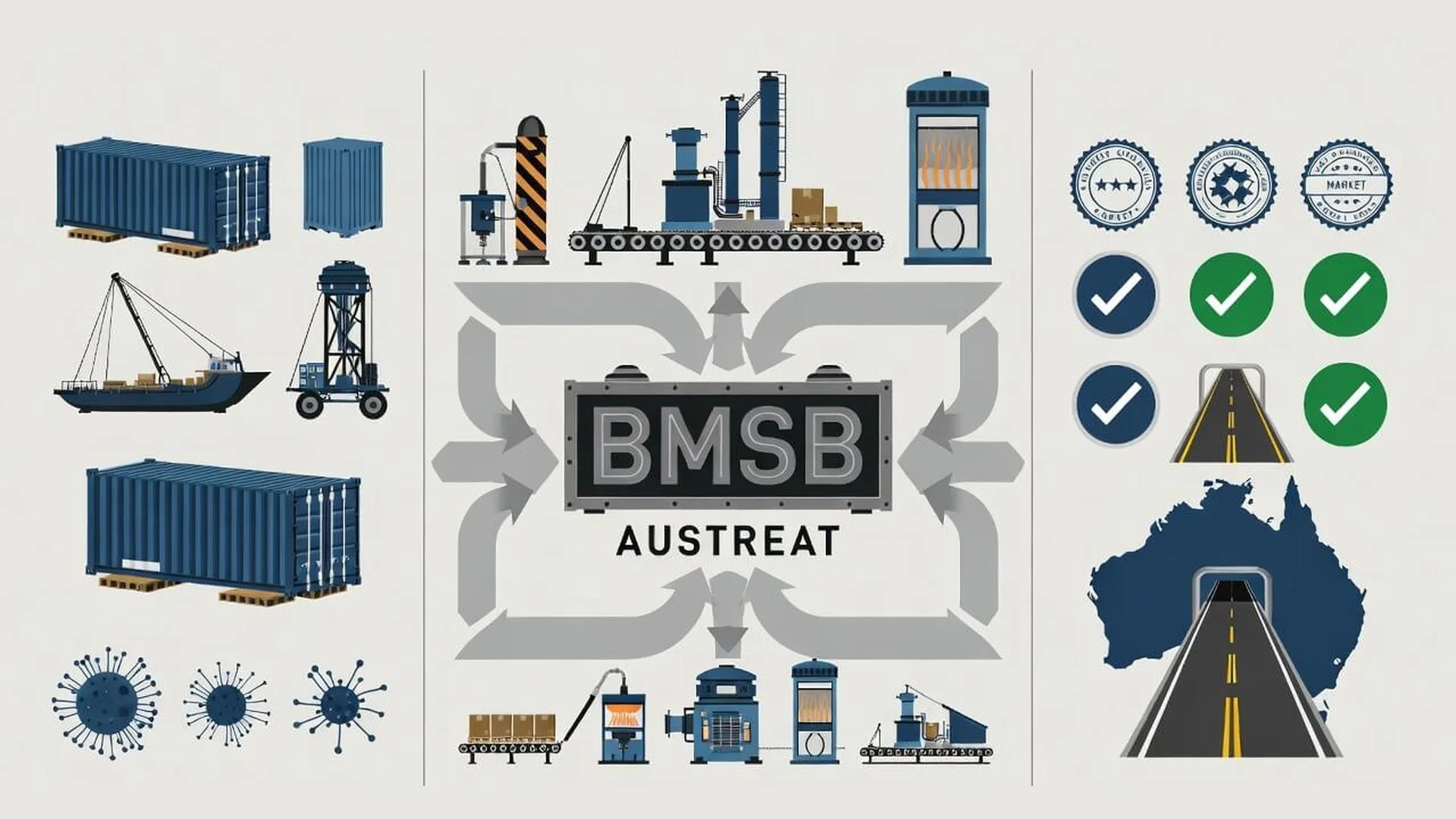
BMSB treatment under AusTreat must strictly follow DAFF's technical specifications and exposure schedules
To obtain approval, treatment providers must clear exhaustive operational, technological, and quality management audits conducted by DAFF. In Vietnam, VFC Fumigation is officially approved by Australian authorities to perform treatments under the BMSB-AusTreat scheme. Partnering with an accredited provider ensures certificate validity and prevents document rejection at destination ports.
6.2. Verify BICON Conditions and Confirm Provider AEI Status
- Check BICON Import Conditions: Prior to cargo stuffing, exporters must look up the product's HS code on the BICON system to determine whether the consignment falls under the scope of seasonal BMSB-AusTreat stink bug control regulations.
- Verify AEI Code: Check the status of the treatment provider on DAFF's official portal. The performing provider must hold a valid, active AEI (Australian Entity Identifier) code listed in "Acceptable" status.
6.3. Deploy Internationally Recognized Quality Control
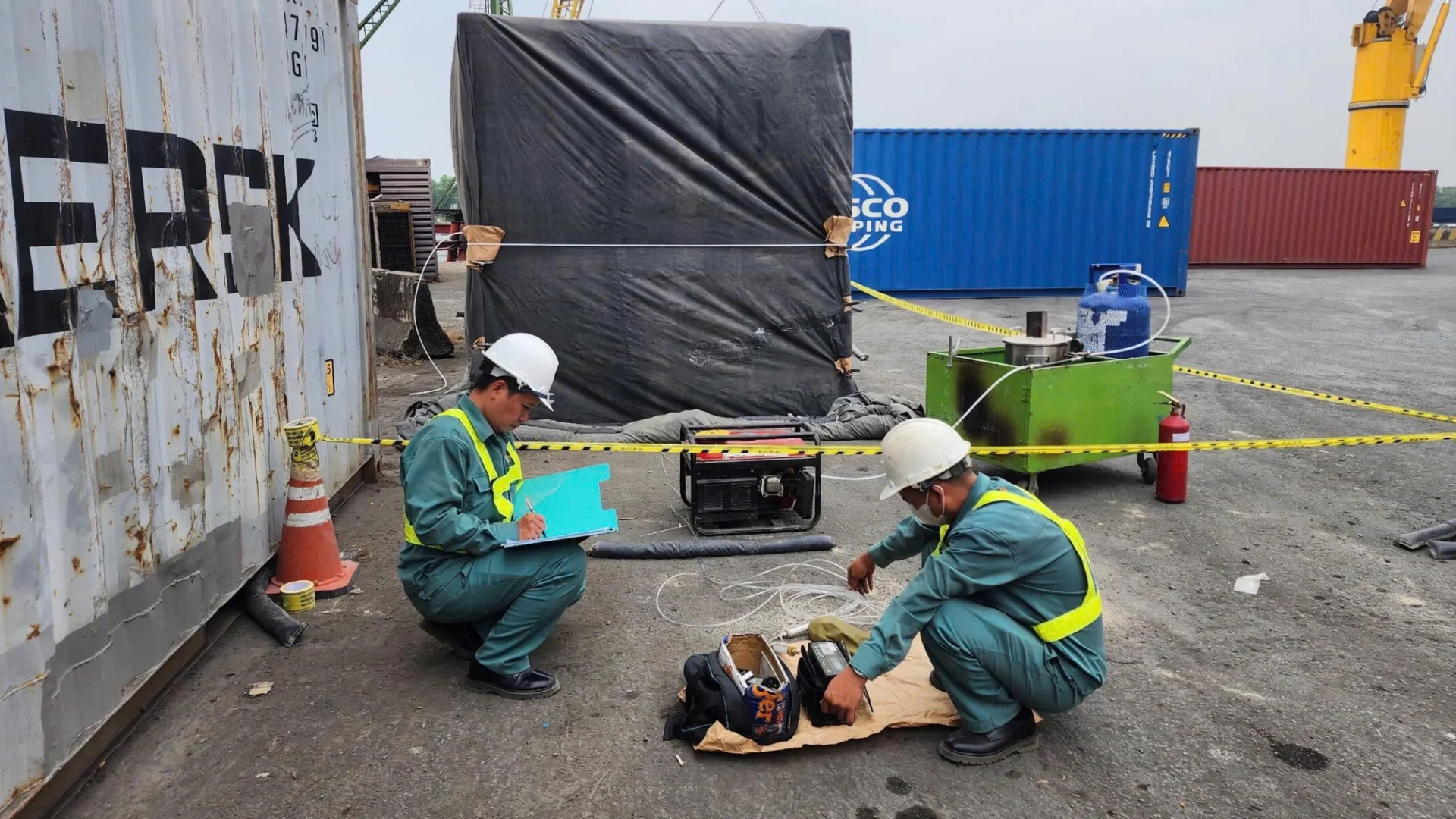
VFC Fumigation technicians utilize specialized equipment to monitor and record fumigant gas concentrations throughout exposure
To assist exporters in safely controlling pest risks and ensuring documentation transparency, VFC Fumigation implements standardized technical solutions:
- Application of the J-System for Gas Recirculation: For consignments of machinery, industrial equipment, or structurally complex cargo, VFC Fumigation deploys the J-System gas recirculation system. Forced airflow ensures homogeneous fumigant distribution throughout the treatment enclosure, assisting in maintaining required gas concentration thresholds and effectively eliminating live pests in areas with restricted air circulation.
- FumiApp Field Operational Digitization: Ambient site temperatures, multi-point gas concentration logs across all exposure intervals, and photographic evidence are captured live on-site via the proprietary FumiApp platform.
- Electronic Certificate Verification via QR Code: Fumigation certificates issued by VFC Fumigation integrate a QR code, enabling importers and biosecurity authorities to easily look up and cross-reference original records on VFC Fumigation’s database, mitigating the risk of documentation discrepancies.
To prevent incurred risks when containers are placed on biosecurity hold at Australian port terminals, businesses should proactively review critical export cargo fumigation mistakes to optimize transport planning and biosecurity clearance.
7. Frequently Asked Questions (FAQ)
Question 1: How long does Methyl Bromide treatment for BMSB take?
Treatment duration using Methyl Bromide fumigant is conducted in accordance with prescribed technical schedules (typically ranging from 24 to 48 hours depending on ambient operational site temperatures), followed by safe aeration and ventilation.
Question 2: What is the enforcement period for the Australian seasonal BMSB program?
Seasonal BMSB measures apply from 1 September of the current year through 30 April of the following year, determined strictly by the "Shipped on Board" date stated on the Ocean Bill of Lading.
Question 3: Are agricultural commodities classified under BMSB control lists?
No. Agricultural food commodities do not fall under the Target High Risk Goods category for seasonal BMSB measures. However, agricultural shipments must comply with specific phytosanitary import conditions under BICON.
Of particular note, if an agricultural consignment utilizes wood packaging material (WPM) such as pallets or dunnage, this timber must be treated with fumigants. Furthermore, risks from exotic pests or hitchhiker stink bugs harboring inside container crevices from prior voyages remain substantial. Therefore, executing full container fumigation is regarded as the most comprehensive and optimal safeguarding solution.
Question 4: How does Detention differ from Demurrage at Australian ports?
Demurrage applies to full containers sitting inside the port terminal beyond the carrier's granted free time. Detention applies when the importer retains empty shipping line equipment outside the terminal beyond agreed equipment free days.
Question 5: What is the function of the AEI code on a BMSB certificate?
The Agriculture Entity Identifier (AEI) is a registered credential assigned by DAFF to accredited offshore treatment providers. It serves as the primary prerequisite for Australian authorities to recognize the legal validity of a treatment certificate.
Question 6: How does the J-System assist during the treatment process?
The J-System uses forced air circulation to distribute fumigant homogeneously across dense, irregular, or out-of-gauge cargo, ensuring gas concentrations achieve regulatory saturation thresholds and eliminating live pests in restricted spaces.
Question 7: How can clients verify certificates issued by VFC Fumigation?
Exporters and international partners can scan the secure QR code printed directly on the certificate to cross-check real-time operational data, dosage records, and certificate status against VFC Fumigation’s database.
8. Safeguard Your Australian-Bound Consignments and Streamline Clearance Today
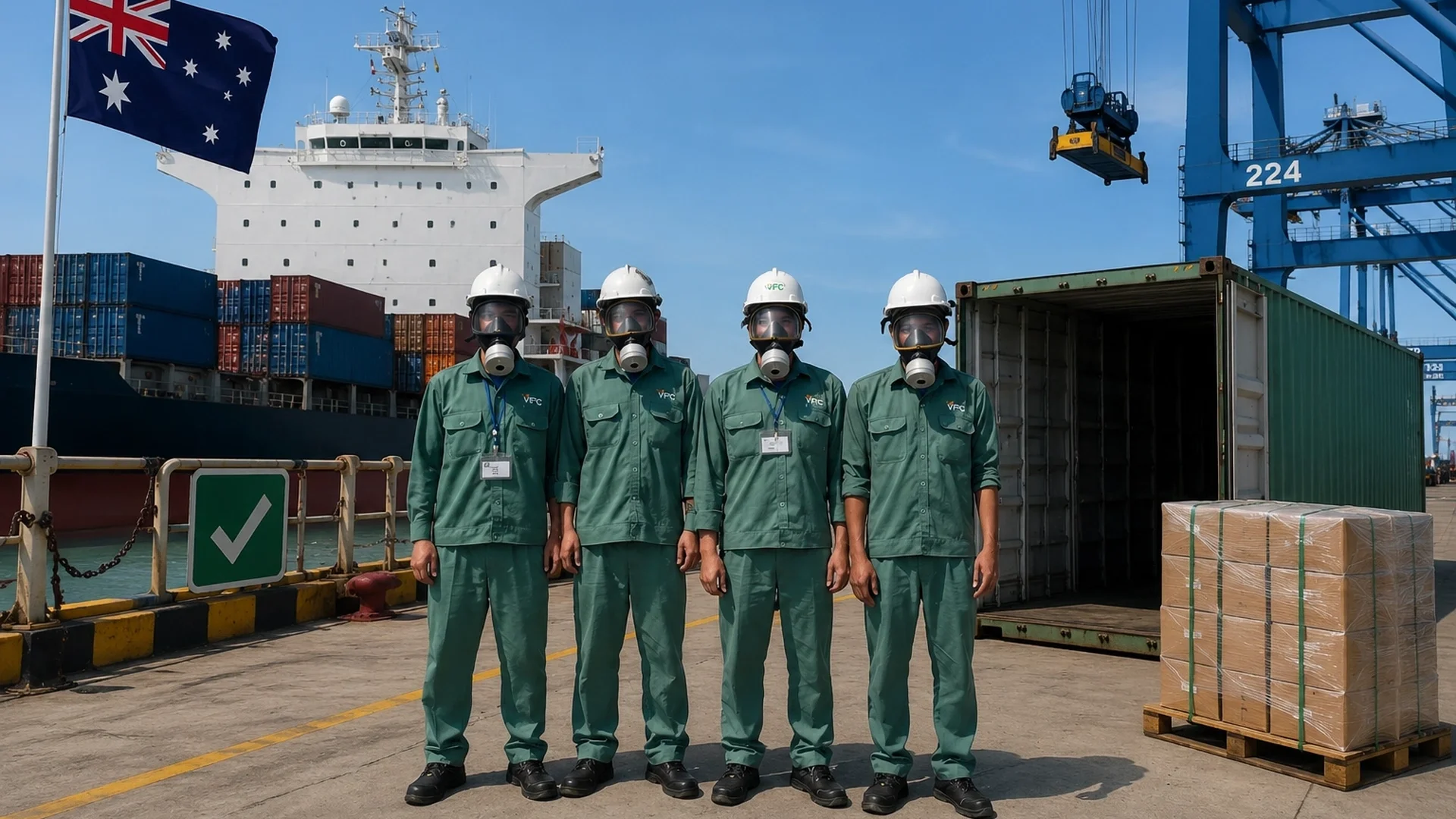
VFC Fumigation provides AusTreat-compliant BMSB treatment solutions for cargo bound for Australia
Do not allow biosecurity oversights to disrupt your supply chain and trigger costly port detentions in Australia. Secure technical compliance and certified documentation at origin with VFC Fumigation officially approved by the Australian Department of Agriculture, Fisheries and Forestry (DAFF) under the BMSB-AusTreat scheme.
For expert consultations on BICON requirements, AEI verification, or customized BMSB treatment proposals, contact our biosecurity team:
- 24/7 Technical Support: 0914 773 300 or 1800 577 788
- Email: contact@fumigation.vn
- Operational Network: Direct on-site readiness across key seaports and ICDs nationwide (Cat Lai, Cai Mep, Hai Phong, Da Nang, Quy Nhon).




Related Blogs

29/06/2026
29/06/2026
Which criteria are export businesses using to choose a fumigation unit?
Previously, cost was often the factor prioritized by many export businesses when choosing an export cargo fumigation unit. However, along with changes in quarantine requirements and standards from importing markets, the evaluation criteria have also gradually expanded. Besides the service price, businesses are now more concerned about operational capacity, document transparency, and the ability to accompany them throughout the export process.