





Published date:
07/07/2026
Share




For silos storing thousands of tons of agricultural commodities or raw materials, pest control is not simply a matter of treating areas that can be observed from the outside. Insects may survive deep within the commodity mass, while silo height, commodity density, and long diffusion distances make fumigant distribution a complex technical challenge. At a scale of 8,000 tons, treatment effectiveness depends on an integrated system that includes site assessment, technical planning, gas-tightness control, fumigant placement, gas recirculation, concentration monitoring, maintenance of the required exposure period, and safe aeration.
The larger the silo, the more complex the fumigation challenge
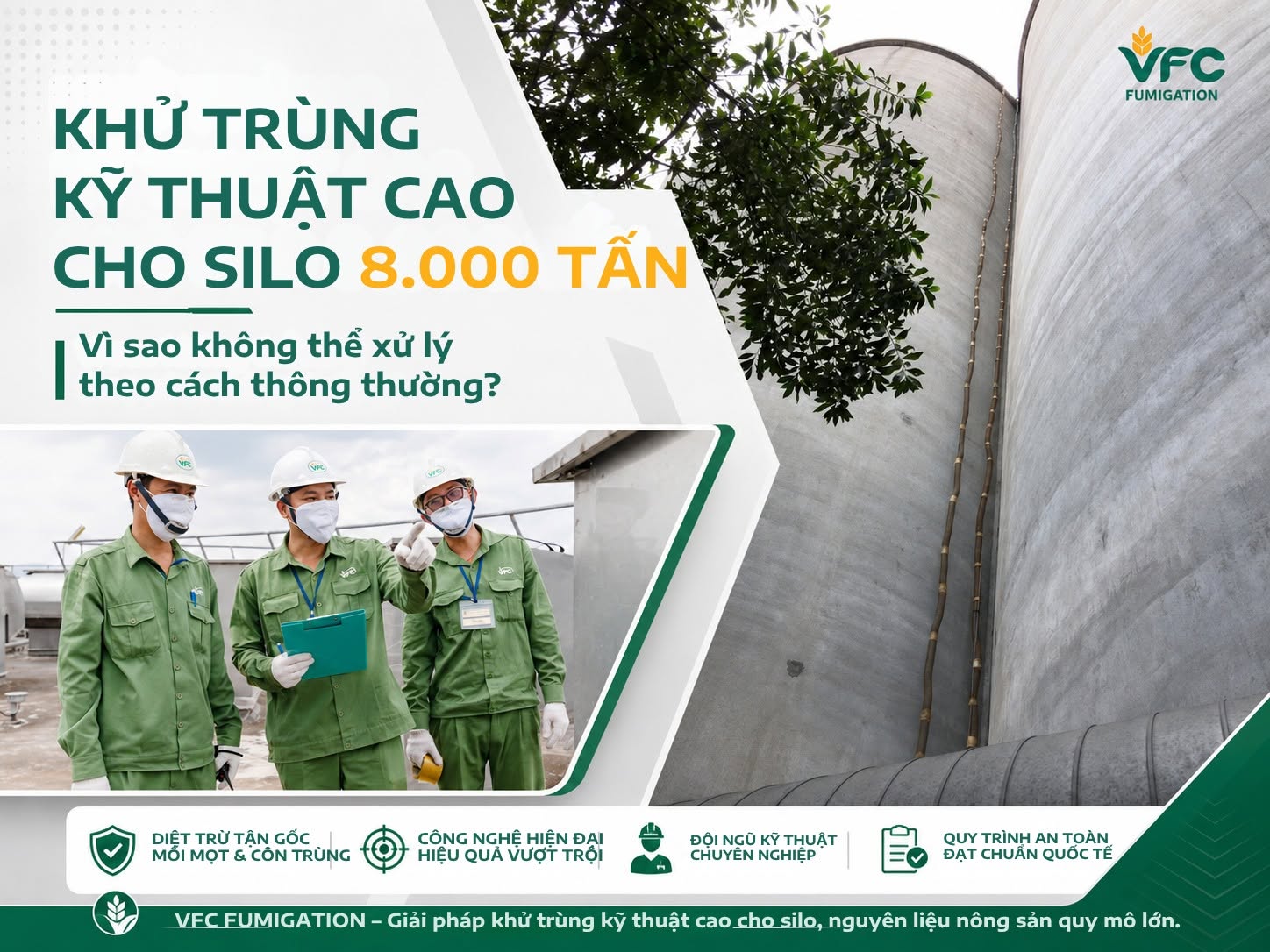
A silo is a fumigation environment with characteristics that differ significantly from containers or cargo lots that can be treated under tarpaulin. Commodities are stored in large volumes and at considerable depth, forming a dense commodity mass. When an infestation occurs, insects are not necessarily concentrated on the surface or in easily visible areas.
Weevils and other insect pests may remain deep within the commodity mass. This means that measures affecting only the surface or external areas may not reach the full treatment zone. Even if the number of visible insects decreases after treatment, deep internal areas still need to be considered in the pest control plan.
The challenge becomes more complex as silo capacity increases to thousands of tons. The fumigant must travel over greater distances, while the characteristics of the commodity mass can affect diffusion. If the treatment plan is not properly designed, fumigant concentrations may vary across different areas of the silo, reducing pest control effectiveness and allowing infestation risks to persist during storage.
For agricultural commodities, post-treatment re-infestation is also influenced by humidity and storage conditions. See more about why export shipments rejected due to weevil infestation tend to increase during the rainy season.
Silo fumigation is more than simply introducing fumigant into the silo
One common misconception in silo fumigation is that calculating the required fumigant dosage based on cargo weight or treatment volume and then applying it to the treatment area is sufficient. In practice, dosage is only one component of the overall technical plan.
The technical team must also consider silo structure, commodity type, the height and characteristics of the commodity mass, infestation level, temperature, sealing capability, treatment duration, and the factory's operational requirements. These factors directly influence fumigant placement and the ability to maintain the required treatment conditions throughout the fumigation period. For dry agricultural commodities and stored raw materials, factors such as temperature, moisture conditions, and exposure time are particularly important when Phosphine is used.
Businesses can also refer to: Phosphine fumigation process for dry agricultural commodities intended for export
Therefore, an 8,000-ton silo cannot be treated simply by scaling up the fumigant quantity used for a smaller silo. A change in scale also requires the technical plan to be reassessed and redesigned according to actual site conditions.
Fumigant distribution is critical in large commodity masses
In fumigation, the fumigant must be able to distribute throughout the treatment area in order to reach pests located in different parts of the commodity mass. In tall silos containing large volumes of cargo, relying solely on natural gas diffusion may have limitations, particularly in deep sections of the stored commodity.
This is why a silo fumigation plan needs to consider the fumigant pathway throughout the entire treatment space. Fumigant application points, ducting, and the gas recirculation system should be designed according to the silo structure and the actual characteristics of the commodity mass.
The objective is not simply to introduce fumigant into the silo, but to enable appropriate distribution throughout the commodity mass and maintain the required treatment conditions for the specified exposure period.
J-System supports forced gas recirculation in silos
For tall silos with capacities of several thousand tons, VFC Fumigation can apply the J-System - an active gas recirculation solution for large-scale silo fumigation where project conditions are suitable.
The system supports gas circulation throughout the fumigation area, helping the fumigant reach different sections of the commodity mass. Instead of relying solely on natural diffusion, a continuous circulation flow is created to support more consistent fumigant distribution throughout the silo.
The value of the J-System is particularly evident in treatment environments with substantial cargo depth. When designed and operated according to the actual structure, the system helps fumigant penetrate deeper into the commodity mass and supports pest control in hard-to-reach areas.
However, the J-System is not a standard configuration that can be applied identically to every silo. The decision to use the system, its layout, and operating duration should be determined after an on-site survey and incorporated into the overall technical plan. To review the process from survey and design through installation, concentration monitoring, and final inspection, see application of the J-System in silo fumigation processes.
Each silo requires a dedicated fumigation plan
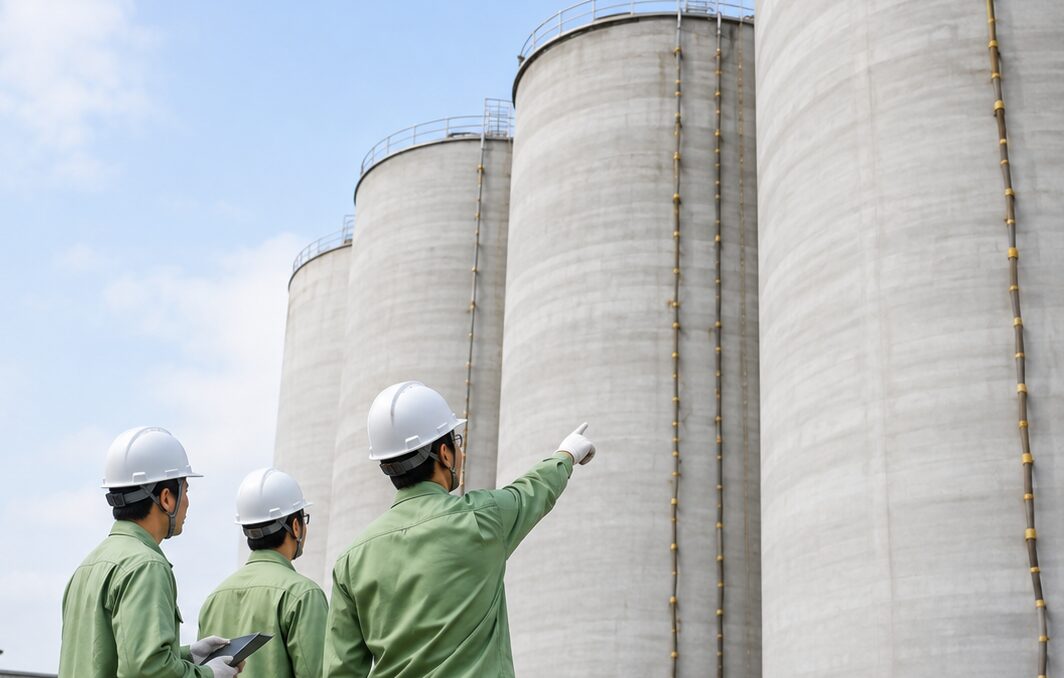
Two silos with the same 8,000-ton capacity may not necessarily require the same fumigation plan. Differences in design, commodity type, cargo condition, gas-tightness, and operating conditions can change how the fumigation process needs to be organized.
Before implementation, the VFC Fumigation technical team conducts an on-site survey to assess the silo structure, commodities to be treated, and relevant operating conditions. Based on actual field data, the technical plan covers sealing methods, fumigant placement, the gas recirculation system, concentration monitoring points, exposure time, and the aeration plan. The ability to survey and design a treatment plan according to actual site conditions is also an important criterion when businesses evaluate a fumigation provider.
See more: Criteria for selecting a fumigation provider for cargo and logistics projects.
Designing the treatment plan for each individual silo allows it to better reflect actual site conditions while helping the business plan storage and production activities after fumigation.
Gas-tightness directly affects the fumigation process
Even an effective gas recirculation system will have limited value if the fumigation area cannot maintain the required gas-tightness. In a silo, this needs careful assessment because the structure is often connected to multiple components such as access openings, material inlet and discharge systems, pipelines, and auxiliary equipment.
Before fumigant application, potential leakage points need to be identified and appropriately sealed or controlled. During the exposure period, the condition of the treatment area should also be monitored to minimize fumigant loss to the surrounding environment.
Gas-tightness control is important both for fumigation effectiveness and for safety. This is particularly critical when using Phosphine because treatment may continue for an extended period and requires close control throughout the entire exposure period.
Concentration monitoring supports control of the fumigation process
Silo fumigation should not be evaluated solely on the initial fumigant quantity. After fumigant application, its distribution and the concentrations recorded at monitoring points provide important information for the technical team to control and assess the treatment process.
VFC Fumigation uses specialized equipment to monitor fumigant concentrations at points defined in the technical plan. The collected data help the technical team track fumigant distribution during treatment and provide a basis for assessing the fumigation process. To understand how on-site data are recorded and used for post-treatment cross-checking, businesses can review transparent fumigation and the management of operational data throughout the treatment process.
For a silo containing thousands of tons of raw materials in particular, monitoring based on actual concentration data provides significantly better process control than relying solely on the initial fumigant dosage.
Safety is controlled throughout the fumigation process
Phosphine is a fumigant that requires strict implementation procedures and safety controls. When the treatment area is a large silo located within an operating factory, safety planning must also take into account personnel, equipment, and surrounding work areas.
During the exposure period, the fumigation area needs to be restricted and controlled to prevent unauthorized access. Concentration monitoring serves not only to assess the treatment process but also to support on-site safety control.
After the exposure period has ended, the silo needs to be aerated according to the approved treatment plan. Fumigant concentrations are then checked and must meet the applicable safety threshold before the area is handed back to the customer.
Fumigating an 8,000-ton silo is about protecting the entire storage system
At a scale of several thousand tons, pest-related losses are not limited to the number of insects detected inside the silo. If an infestation is not properly controlled, the quality of a large volume of stored raw materials may be affected over time.
This can also affect downstream production planning. Raw materials stored in silos are often directly connected to factory operations, so treatment time, aeration, and handover need to be coordinated with the operating schedule. If your business is currently comparing providers' implementation capabilities, you can refer to the overview of reputable warehouse fumigation companies in Vietnam to compare service scope and large-scale project capability.
High-technical fumigation is therefore not simply about “eliminating the insects that can be seen.” The objective is to control pests within a large commodity mass through a plan designed around the actual structure, while also maintaining requirements for commodity quality and operational safety.
VFC Fumigation – Technically advanced fumigation solutions for large-scale silos
For silos with capacities of several thousand tons, VFC Fumigation approaches each project as an integrated technical challenge. The process begins with an on-site survey and an assessment of the silo structure and commodity characteristics before an appropriate treatment plan is developed.
Depending on actual site conditions, the treatment plan may combine Phosphine with the J-System forced gas recirculation system, while also incorporating gas-tightness control, concentration monitoring points, and post-treatment aeration. These elements are designed as one integrated system rather than being carried out as separate, unrelated steps.
For an 8,000-ton silo, the key difference lies not only in the volume of cargo being treated but in the ability to deliver fumigant to the required areas, maintain the necessary fumigation conditions, and control safety throughout the entire process. This also provides the foundation for protecting commodity quality and reducing pest risks during storage. If the stored materials subsequently enter the export supply chain, businesses can review agricultural export fumigation: from cargo treatment to operational data and certificate management.
Contact VFC Fumigation for an on-site assessment and a fumigation plan tailored to silos, warehouses, and other large-scale commodity storage systems.





Related Blogs

29/06/2026
29/06/2026
Which criteria are export businesses using to choose a fumigation unit?
Previously, cost was often the factor prioritized by many export businesses when choosing an export cargo fumigation unit. However, along with changes in quarantine requirements and standards from importing markets, the evaluation criteria have also gradually expanded. Besides the service price, businesses are now more concerned about operational capacity, document transparency, and the ability to accompany them throughout the export process.