





Published date:
13/10/2026
Share




The EUDR (European Union Deforestation Regulation – Regulation (EU) 2023/1115) is European Union legislation prohibiting the import and commercial distribution of agricultural and forestry commodities originating from land subject to deforestation or forest degradation after December 31, 2020. To export goods into the EU market, enterprises must verify three mandatory conditions: deforestation-free production, legal compliance, and the submission of a verified Due Diligence Statement (DDS) linked to precise cultivation plot GPS coordinates.
1. What is the EUDR? Concept, Objectives, and Scope of Application
1.1 Legal Nature of Regulation (EU) 2023/1115
The EUDR is a legally binding European Union regulation adopted by the European Parliament and the Council of the European Union, officially replacing the EU Timber Regulation (EUTR No 995/2010). Unlike EU directives which require transposition into national laws the EUDR has direct, immediate legal applicability across all 27 EU Member States.
The core objective of the legislation is to curb greenhouse gas emissions, halt biodiversity loss, and prevent EU consumption from driving global deforestation and forest degradation across international supply chains.
1.2 The Seven Regulated Commodity Categories
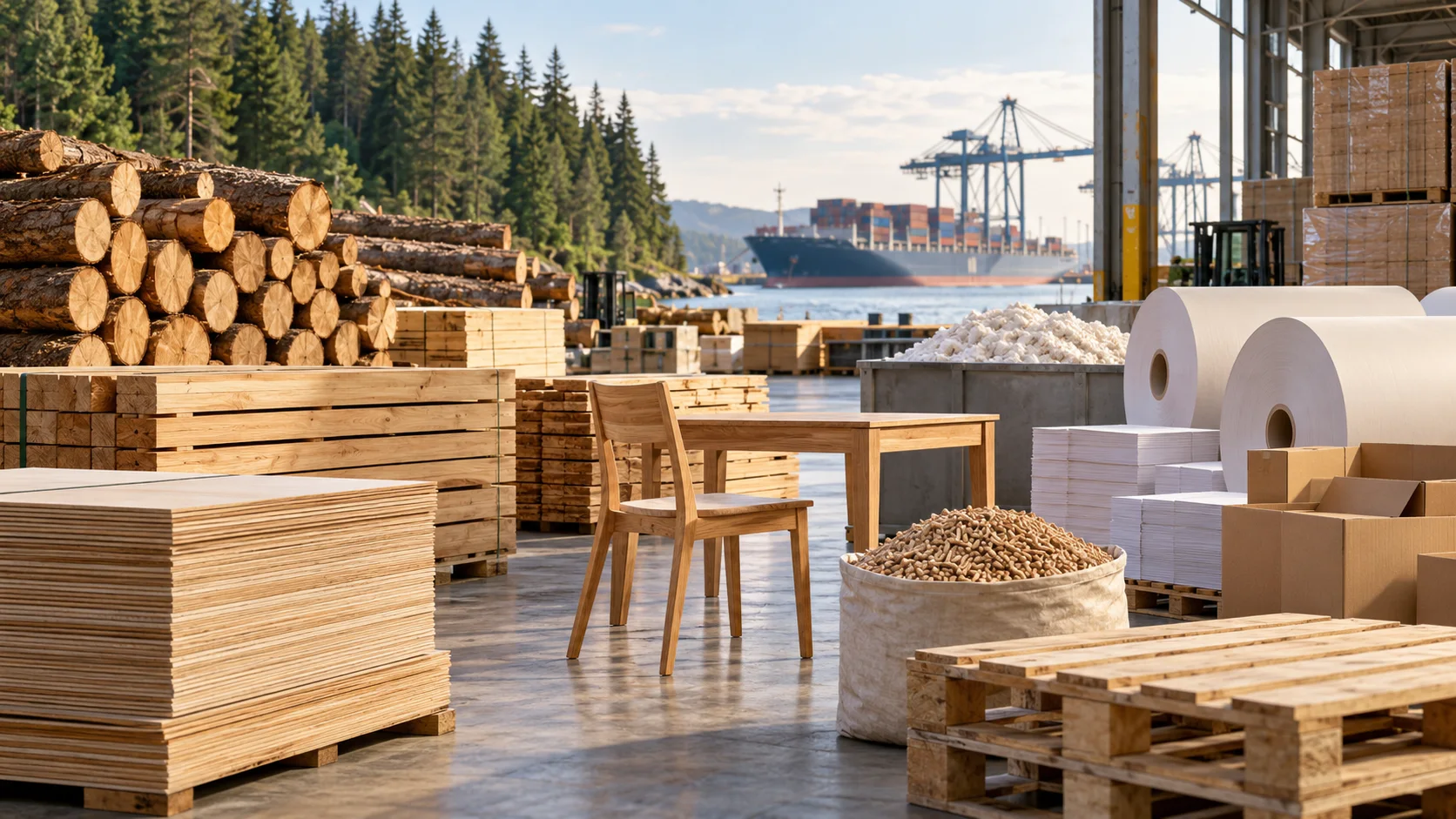
The scope of the EUDR for the timber sector encompasses raw materials and a wide array of downstream derived products
The regulation governs seven primary agricultural and forestry commodities alongside their downstream derived products: cattle, cocoa, coffee, oil palm, rubber, soya, and wood.
For the timber sector, the regulation encompasses raw materials (roundwood, rough-sawn timber) and extends to value-added downstream goods: wooden household furniture, particleboard, plywood, wood pellets, pulp, paper, and commercial wood packaging.
1.3 Deforestation Cut-off Date and Official Implementation Timelines
Fixed Deforestation Cut-off Date: December 31, 2020. Any commodity harvested or produced on land deforested or degraded after this baseline date is prohibited from entering the EU market.
Implementation Schedule:
- December 30, 2025: Mandatory enforcement for large and medium-sized enterprises.
- June 30, 2026: Mandatory enforcement for micro and small enterprises (SMEs).
2. The Three Mandatory Pillars Required for EUDR Compliance

The three mandatory EUDR pillars comprise deforestation-free production, legality, and due diligence reporting
For an export consignment to clear EU customs, operators and traders must provide verifiable documentary evidence satisfying three legal pillars:
2.1 Pillar 1: Deforestation-Free
- Commodities must not be produced on land converted from forest to agricultural use after December 31, 2020.
- For timber and wood products: Timber must be harvested without causing forest degradation, defined as the conversion of primary forests or naturally regenerating forests into plantation forests or other wooded lands.
2.2 Pillar 2: Legality of Production
Commodities must be produced in strict compliance with the relevant legislation of the country of origin, covering:
- Land tenure, land-use rights, and property ownership.
- Environmental protection and forestry management legislation.
- Labor regulations, occupational safety, and zero tolerance for child labor.
- Respect for the rights of indigenous peoples and customary land communities under the principle of Free, Prior, and Informed Consent (FPIC).
- Tax compliance, anti-corruption standards, and official customs export protocols.
2.3 Pillar 3: Due Diligence Statement (DDS)
Enterprises must operate a structured Due Diligence System to gather supply-chain data, conduct risk assessments, apply risk-mitigation measures, and submit an electronic Due Diligence Statement (DDS) to the European Commission Information System (TRACES) prior to import. Each validated DDS generates a unique reference number utilized by EU customs authorities for electronic clearance verification.
3. Impact of the EUDR on the Vietnamese Coffee Industry
Vietnam is the world's leading exporter of Robusta coffee, with the European Union absorbing approximately 38% to 40% of its total export volume. The EUDR requires structural adaptation across the domestic coffee export supply chain:

The EUDR mandates deeper traceability systems across Vietnam's export coffee supply chain
3.1 Domestic Coffee Supply Chain Structure
Vietnam's coffee supply chain is fragmented, relying on more than 1.2 million smallholder farmers across the Central Highlands (Tây Nguyên). The vast majority operate small plots (typically under 1 to 2 hectares per farming household), trading through multi-tiered networks of local collectors and district intermediaries before cherries reach centralized dry mills and export processing facilities.
3.2 Commingling and Blending Risks
In traditional trading practices, coffee beans are aggregated, bulked, and blended across local buying stations. Under the strict liability framework of the EUDR, if even a fraction of beans within an FCL container originates from farm plots deforested post-2020, the entire shipment is deemed non-compliant and rejected at EU borders.
3.3 Geolocation Standards
The EUDR mandates traceability down to the exact plot of land where the coffee cherries were cultivated:
- Plots under 4 hectares: A single geographic Point coordinate (latitude and longitude with a minimum precision of six decimal places).
- Plots of 4 hectares and above: A closed Polygon boundary mapping the full perimeter of the production plot.
Operational Strategy: Export enterprises must partner with local agricultural cooperatives and authorities to digitize farm boundaries, issue unique farmer identification numbers, and cross-reference cultivation plots against official 2020 national satellite forest cover maps.
4. Impact of the EUDR on the Timber and Wood Products Sector
The timber industry involves multi-step processing facilities using varied raw material inputs, requiring strict oversight of timber legality and deforestation-free provenance:

Timber enterprises must verify raw material sources, legal compliance, and traceability data under the EUDR
4.1 Regulated Product Scope
The regulation encompasses industrial roundwood, sawnwood, veneer sheets, plywood, particleboard, fiberboard, wood pellets, pulp, paper, and commercial wood packaging materials traded as separate commodities.
4.2 Relationship Between the EUDR and VPA/FLEGT
Vietnam and the European Union have operationalized the Voluntary Partnership Agreement on Forest Law Enforcement, Governance and Trade (VPA/FLEGT).
- Operational Note: A FLEGT license verifies the legal harvest and trade of timber under national frameworks (fulfilling Pillar 2: Legality).
- However, a FLEGT license does not automatically satisfy the deforestation-free mandate (Pillar 1) or the requirement to provide plot GPS coordinates under a DDS (Pillar 3).
4.3 Role of FSC and PEFC Forest Certification Schemes
Voluntary third-party certification schemes (FSC, PEFC) serve as evidence during the risk-assessment phase. However, the European Commission does not recognize certification as an automatic green lane or exemption from due diligence obligations. Exporters must still provide complete plot-level GPS geolocation data.
4.4 Regulatory Delineation: Pallets and Wood Packaging Material (WPM)
- Wooden Pallets as Pure Transport Packaging: If solid wood pallets, packing cases, or dunnage are utilized solely to support, cushion, or containerize another commercial cargo (e.g., pallets supporting coffee bags or securing industrial machinery), they do not require an independent EUDR Due Diligence Statement.
- Mandatory ISPM 15 Compliance: All solid wood pallets utilized for securing EU-bound export shipments must strictly comply with ISPM 15 international phytosanitary standards (subject to Heat Treatment (HT) or Methyl Bromide fumigation and bearing a legible certified IPPC mark).
5. The Three-Step Due Diligence Process
Executing due diligence is a mandatory process that enterprises must institutionalize within their operational supply chains:
Step 1: Supply Chain Data Collection
Exporters must gather, verify, and retain documentation for a minimum of five years:
- Detailed product descriptions: Commercial trade name, botanical species name, net mass, and unit volume.
- Country of harvest and geographic coordinates (GPS Point or Polygon) for all production plots.
- Timeframe or production date ranges of harvest.
- Full corporate identification of immediate suppliers and destination consignees.
- Documentation verifying legal compliance: Land-use rights certificates, harvesting licenses, tax filings, and environmental clearances.
Step 2: Risk Assessment
Enterprises evaluate non-compliance risks based on gathered documentation:
- Cross-referencing plot GPS coordinates with high-resolution satellite remote-sensing baselines dated December 31, 2020.
- Checking for overlapping boundaries with designated forest reserves, national parks, and protected wildlife zones.
- Analyzing the risk of mixing compliant commodities with unverified raw materials across transport nodes and processing facilities.
Step 3: Risk Mitigation
When non-negligible risks are detected:
- Implement corrective protocols: Request supplementary legal records, conduct independent third-party field audits, or provide capacity-building training to farming households.
- Exclude non-compliant or unverified farm plots and suppliers from the export supply chain.
- Once the risk is mitigated to a negligible level, submit the electronic DDS to the EU Information System (TRACES) to generate the customs clearance reference number.
6. Country Risk Benchmarking System and Regulatory Penalties
6.1 Country Risk Classification System
The European Commission evaluates and classifies producer countries into three risk tiers based on historical deforestation rates, forest degradation trends, and national governance transparency:
| Risk Classification | Assessment Criteria | Random Inspection Rate at EU Entry Ports | Due Diligence Procedure |
|---|---|---|---|
| Low Risk | Negligible deforestation rates; rigorous, transparent legal frameworks | 1% of consignments | Simplified Due Diligence (exempt from Steps 2 & 3 if risk remains negligible) |
| Standard Risk | Moderate deforestation rate; active regulatory remediation | 3% of consignments | Standard Three-Step Due Diligence (mandatory execution of Steps 1, 2, and 3) |
| High Risk | High deforestation rates; systemic weaknesses in land and forestry governance | 9% of consignments | Enhanced Due Diligence (rigorous documentation checks, mandatory field audits) |
6.2 Penalties for Non-Compliance
Competent authorities across EU Member States enforce deterrent penalties:
- Fines: Maximum administrative fines of at least 4% of the operator’s total annual EU turnover generated in the preceding financial year.
- Confiscation: Confiscation of the non-compliant consignment at the port of entry, alongside confiscation of commercial revenues derived from the transaction.
- Market Exclusion: Temporary bans on placing regulated commodities on the EU market, paired with exclusion from public procurement tenders.
- Public Sanctions: Publication of the infringing entity’s name on the European Commission's official registry.
7. Action Checklist for Coffee and Timber Exporters
To achieve compliance ahead of statutory enforcement deadlines, export shippers and logistics providers must execute five operational milestones:
- Digitize Sourcing Zones: Map cultivation coordinates across coffee farms and timber plantations (Point GPS for plots under 4 ha; closed Polygons for plots 4 ha and larger), overlaying all plots against December 31, 2020 satellite baselines.
- Audit Land Tenure Legality: Review Land Use Rights Certificates (LURCs), secure transparent purchase contracts, and obtain formal no-deforestation declarations from associated growers.
- Establish Chain-of-Custody Segregation: Implement physical and digital segregation from raw material harvesting through transit and mill warehousing, ensuring unverified materials are isolated.
- Train Export Documentation Teams: Train logistics and documentation personnel on the EU TRACES portal interface, account registration, and electronic DDS submission workflows.
- Standardize Biosecurity, Fumigation, and Packaging: Verify that 100% of wooden pallets comply with ISPM 15 standards, execute quarantine fumigation adhering to EU Maximum Residue Limits (MRLs), and deploy container desiccant and barrier protection to mitigate moisture damage during ocean transit.
8. Frequently Asked Questions (FAQ)
8.1 Can coffee harvested on land cultivated prior to 2020, but located within designated forestry zones, be exported to the EU?
No. While the farm plot may not breach the post-2020 deforestation cut-off, cultivating within designated state forestry land without legal authorization violates Pillar 2 (Legality under national land and forestry laws). Consequently, the consignment remains non-compliant and will be barred from EU entry.
8.2 What are the revised implementation timelines across different enterprise sizes?
Under the adopted timeline adjustments, large and medium-sized enterprises must comply starting December 30, 2025, while micro and small enterprises (SMEs) are granted an extended transition period until June 30, 2026.
8.3 What occurs if an export container of coffee contains a fraction of beans sourced from deforested land?
Under the zero-tolerance framework of the EUDR, the entire container consignment is treated as non-compliant. EU competent authorities will seize or reject the entire lot; shippers cannot segregate the compliant portion for partial clearance.
8.4 Do wooden pallets carrying export goods require an independent EUDR Due Diligence Statement?
No. Solid wood pallets and dunnage utilized purely as transport accessories to secure or cushion other primary commercial commodities are exempt from filing an independent DDS. However, they must strictly comply with ISPM 15 phytosanitary standards (heat-treated or Methyl Bromide-fumigated with an authorized IPPC stamp).
9. Partnering with VFC Fumigation to Secure EU Export Supply Chains
While exporters must navigate green EUDR traceability requirements, preserving the physical quality of agricultural commodities and maintaining the biosecurity compliance of packaging materials remain essential to seamless clearance at European seaports.

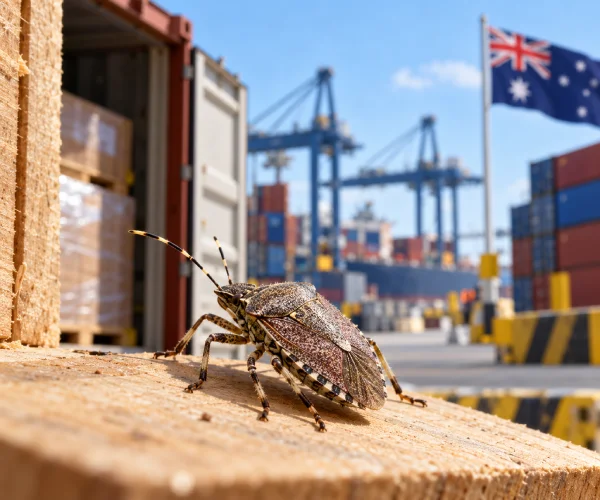
VFC Fumigation supports enterprises in safeguarding export commodities and packaging materials within EU supply chains
As the founding pioneer and industry leader in quarantine fumigation in Vietnam, VFC Fumigation delivers comprehensive cargo protection solutions for export containers bound for the EU:
- ISPM 15-Compliant Wooden Pallet Treatment: Executing treatment for pallets and dunnage via Heat Treatment (Facility Code: VN-010 HT) or Methyl Bromide fumigation (Facility Code: VN-009 MB), fully satisfying phytosanitary standards and aligning with the EU market's preference for heat-treated materials.
- Agricultural Export Fumigation Compliant with MRL Standards: Deploying treatment solutions utilizing Phosphine (PH3) fumigant for export coffee, black pepper, rice, and other commodities—ensuring the complete eradication of stored-product pests across all life stages without compromising intrinsic crop quality, while strictly adhering to EU Maximum Residue Limits (MRLs).
- Container Condensation Risk Control: Delivering specialized container ceiling paper lining and industrial desiccant installation solutions, preventing condensation drips from causing packaging mold and cargo deterioration during extended ocean voyages.
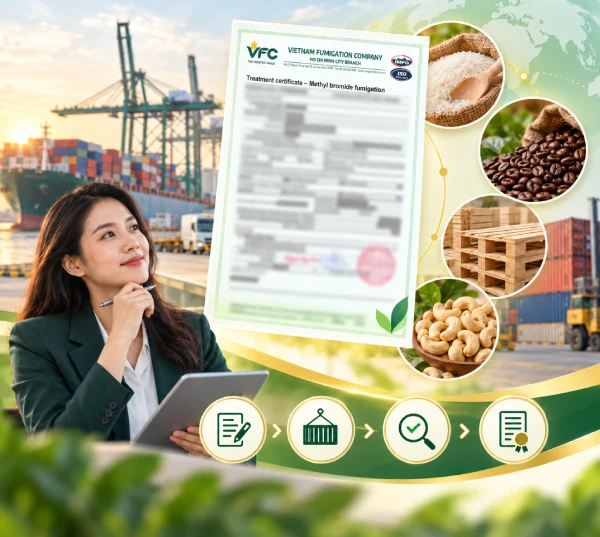
- Transparent Documentation Assurance: Every Fumigation Certificate issued by VFC Fumigation is embedded with a unique QR code, enabling clients and logistics partners to cross-check and verify certificate authenticity directly on VFC Fumigation's official database.
For technical guidance on ISPM 15 wooden pallet treatments, EU MRL-compliant commodity fumigation, or container moisture protection plans, contact VFC Fumigation:
- Hotline 24/7: 0914 773 300
- Customer Service Center: 1800 577 788
- Email: contact@fumigation.vn




Related Blogs